This site uses affiliates. Thank you for buying through our links and supporting this blog.


14 Best Things to Do in Verona, Italy (My 2026 Guide)

Verona gets reduced to Romeo and Juliet far too often. Yes, you can stand beneath the famous balcony and rub a bronze breast for luck, but that is only the beginning of the weirdness.
Beneath the modern shopping streets are Roman ruins. A whale rib has hung from an arch for centuries, supposedly waiting for an honest person to pass underneath. Gothic rulers stare down from elaborate tombs, hunchbacks carry holy-water basins on their backs and a fortified bridge still looks ready to evacuate a medieval tyrant at short notice.
I have visited Verona several times, and it is a city I enjoy more every time I return. The first visit is usually about the Arena, Juliet’s House and Piazza delle Erbe. After that, Verona becomes much more interesting: quieter churches, archaeological sites, fortified bridges, panoramic gardens, tiny artisan shops and neighbourhood streets that most day-trippers never reach.
The historic centre is compact and easy to explore on foot, but there is far more to see than most people manage to squeeze into a rushed stop between Venice and Milan. Some of the best things to do in Verona are obvious for a reason, while others are hiding beneath your feet or tucked behind buildings you would otherwise walk straight past.
This guide covers the best things to do in Verona, Italy. You will find Verona’s essential landmarks, worthwhile museums, unusual details, food experiences, tours and day trips—along with my honest take on what deserves your time.

Verona must-do’s
These are the Verona experiences I would book first for a first visit, especially during weekends, summer and the Arena opera season.
Verona Old Town walking tour
Verona Card with priority Arena entrance
Skip-the-line Verona Arena tour
Verona food and wine tour
Valpolicella and Amarone wine tour
Lake Garda and Sirmione day trip
Stay at: Hotel Milano & SPA for a central location and rooftop views directly over the Arena.
If you only book one thing, I would choose the Verona walking tour with Arena entry and Castel San Pietro. It combines the historic centre, Verona’s biggest landmark and the hilltop viewpoint. The Verona Card is also a great investment if you plan to visit several attractions or use public transport.
Where to stay in Verona
For a first visit, I would stay in Verona’s historic centre or close to Piazza Bra. This puts the Arena, Piazza delle Erbe, Juliet’s House, Castelvecchio and most of the other major Verona attractions within easy walking distance.
The area around Piazza Bra is the most practical if you are arriving by train, carrying luggage or planning to attend an evening performance at the Arena. Staying closer to Piazza delle Erbe places you deeper inside the pedestrian centre.
If you are driving, check the parking arrangements before booking. Much of central Verona is covered by a restricted traffic zone, and the most charming historic hotel is considerably less charming when you are circling the city with nowhere legal to leave the car.
ULTIMATE LUXURY
A polished five-star hotel in the heart of Verona, with an indoor pool, spa and rooftop terrace. Best for a special trip where the hotel itself is part of the experience.
BEST ARENA VIEWS
A stylish four-star hotel only steps from the Arena, with a spa, private parking and a rooftop terrace overlooking the amphitheatre. My top pick for first-time visitors.
CHARMING CENTRAL STAY
An intimate guesthouse in a historic building close to Juliet’s House and Piazza delle Erbe. Best for couples who want character and an exceptionally central location.

14 best things to do in Verona
The best things to do in Verona depend on how much time you have and how deeply you want to explore. First-time visitors should begin with the Arena, the historic centre, Juliet’s House and the two main squares, but the city becomes much more rewarding once you start connecting those famous sights with its churches, archaeological remains, Della Scala history and viewpoints.
Verona is compact enough to cover the essentials in one day, but two days gives you time to enter the museums, climb Torre dei Lamberti, explore Giardino Giusti and stay long enough to see the city after the day-trippers leave.
Use the table below to quickly decide what to prioritise, then keep reading for my complete breakdown of the best places to visit, tours to book and experiences worth making time for in Verona.
| If you want… | Do this |
|---|---|
| Classic first visit | Visit the Arena, walk through Piazza Bra and explore the historic centre on a Verona walking tour. |
| Best-value sightseeing | Buy the Verona Card if you plan to enter the Arena and several museums, towers or churches. |
| Best city view | Watch sunset from Castel San Pietro or climb Torre dei Lamberti for a higher view across the rooftops. |
| Best history experience | Follow the Della Scala trail and visit Castelvecchio Museum. |
| Best unusual experience | Look for Roman ruins beneath shops, the whale rib at Arco della Costa and Verona’s other hidden curiosities. |
| Best food experience | Try risotto all’Amarone or join a Verona food and wine tour. |
| Best wine experience | Take a Valpolicella and Amarone tour with transport from Verona. |
| Best day trip | Visit Sirmione and the southern shore of Lake Garda on a guided Lake Garda day trip. |
With two days, add Torre dei Lamberti, Castelvecchio Museum, the main churches, Giardino Giusti and the Roman Theatre. Save Lake Garda or Valpolicella for a third day.

Short on time?
With one day in Verona, prioritise the Arena, a walk through the historic centre, Juliet’s House, Piazza delle Erbe, Piazza dei Signori, Ponte Pietra and Castel San Pietro.
The easiest option is the Verona walking tour with Arena entry and Castel San Pietro, which covers the main historic sights and hilltop viewpoint in one organised experience.
With two days, add Castelvecchio Museum, the Roman Theatre, Verona’s main churches and Giardino Giusti. Save Lake Garda or Valpolicella for a third day.
1. Visit the Verona Arena
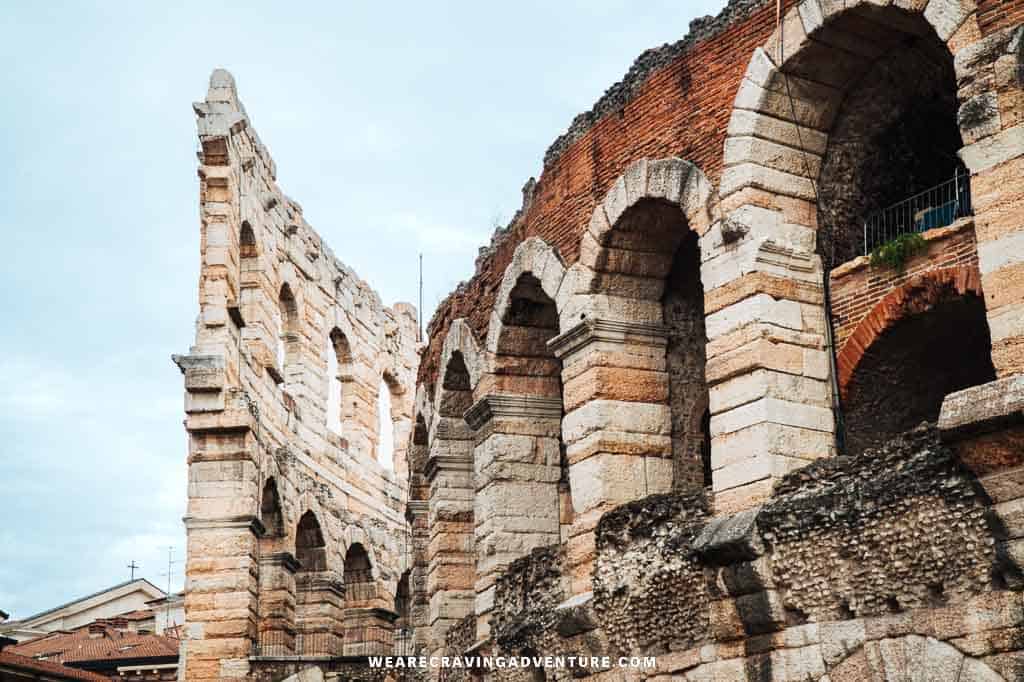
If you only visit one paid attraction in Verona, make it the Verona Arena. The enormous Roman amphitheatre dominates Piazza Bra and is easily the city’s most recognisable landmark.
The Arena was built in the first century AD, making it almost 2,000 years old. Although part of its original outer wall was destroyed by an earthquake in 1117, the interior seating and elliptical performance space remain remarkably well preserved.
Unlike many Roman ruins, the Arena is not merely an archaeological site. It still hosts concerts, cultural events and the famous Arena di Verona Opera Festival, when elaborate sets, enormous casts and thousands of spectators fill the amphitheatre on summer evenings.
I had seen plenty of photos before my first visit, but the scale still surprised me. The Arena feels substantial from Piazza Bra; once you step inside and climb through the stone passageways, it becomes much easier to understand just how large it really is.
Things to know before visiting the Verona Arena:
- Allow around 45–60 minutes: The interior is relatively straightforward to explore, but leave time to climb the seating and take in the views.
- Check the performance calendar: Visiting hours can be shortened or changed when concerts and opera performances are scheduled.
- Expect some staging: During opera season, parts of the Arena may contain scenery, equipment or temporary seating.
- Book ahead in busy periods: The entrance queue can become long, especially between late morning and mid-afternoon.
- Consider the Verona Card: It includes admission to the Arena and many of the museums, churches and monuments covered later in this guide.
A guide is useful here because there are few signs explaining how the building changed between Roman gladiatorial spectacles, medieval public events and today’s opera productions. For a first visit, I would choose the skip-the-line Verona Arena tour rather than the more gimmicky virtual-reality experiences.
Best Verona Arena tickets and tours:
Best guided visit: Skip-the-line Verona Arena tour
Best if you want a focused introduction to the amphitheatre without spending half a day on a city tour.Best value for several attractions: Verona Card with priority Arena entrance
Best if you also plan to visit Torre dei Lamberti, Castelvecchio Museum, the Roman Theatre or several churches.Best complete introduction: Verona walking tour with Arena entrance
Best if you want to understand the Arena in the context of the wider historic centre.
Insider tip: You can also get excellent views over the Arena from some of the upper floors around Piazza Bra. For the best version, head to the rooftop bar at Hotel Milano & SPA, where you can have a drink with the amphitheatre directly in front of you.

2. Discover Verona on a walking tour
Verona is compact, highly walkable and packed with details that are very easy to miss. Roman gates stand between modern shops, Renaissance palaces line busy streets, medieval courtyards hide behind unassuming arches and the Della Scala ladder emblem appears all over the city once you know to look for it.
Verona was a much bigger surprise for me than I expected. I initially thought of it as a pretty stop built around Romeo and Juliet, but the historic centre has layers of Roman, medieval, Venetian and Austrian history squeezed into a relatively small area.
You can absolutely wander around independently—I have done plenty of that myself—but this is one of those cities where a good guide adds real value. Otherwise, it is very easy to walk past a Roman gateway, an important palace or a centuries-old symbol without realising what you are seeing.
I would take the walking tour near the beginning of your stay. Verona is small enough that you can then return independently to the places that interest you rather than spending the rest of the trip wondering why a guide kept pointing at ladders carved into walls.
Best Verona walking tours:
Best classic walking tour: Verona Old Town highlights walking tour
Best for a straightforward introduction to the historic centre, major squares, Roman remains and local history.Best all-in-one option: Verona tour with Arena and Castel San Pietro
Best if you want a guided city walk, Arena entry and the hilltop viewpoint bundled into one experience.Best unusual option: Dark Historical Verona tour
Best if you are more interested in executions, intrigues, legends and strange local stories than another polished highlights tour.
If you prefer exploring alone, an efficient route is: Piazza Bra → Arena → Arco dei Gavi → Corso Cavour → Porta Borsari → Piazza delle Erbe → Piazza dei Signori → Via Sottoriva → Ponte Pietra.
That route covers most of central Verona without unnecessary backtracking, although you will still need short detours for Juliet’s House and some of the smaller curiosities covered later.
Look out for these sights while exploring Verona Old Town:
- Piazza Bra: Verona’s vast entrance square, framed by the Arena, Palazzo Barbieri, the Gran Guardia and the restaurant-lined Liston promenade.
- Portoni della Bra: The crenellated gateway beside the Gran Guardia, topped by a clock and opening onto Piazza Bra.
- Via Mazzini: Verona’s main pedestrian shopping street, running between Piazza Bra and Piazza delle Erbe.
- Porta Borsari: The monumental white-stone façade of Verona’s principal Roman gateway, dating from the first century AD.
- Porta Leoni: A less complete but fascinating Roman gate, with excavated remains visible below the modern street.
- Arco dei Gavi: A Roman triumphal arch originally built beside the Via Postumia and later reconstructed near Castelvecchio.
- Corso Cavour: One of Verona’s grandest historic streets, lined with churches, Roman remains and aristocratic palaces.
- Palazzo Canossa: A sixteenth-century palace designed by Michele Sanmicheli, best admired from the street.
- Palazzo Bevilacqua: Another elaborate Sanmicheli palace, with an unusually rich and sculptural façade.
- Via Sottoriva: One of my favourite atmospheric streets in Verona, with medieval arcades, old houses, small restaurants and a much less polished feel than Via Mazzini.
- The Adige riverfront: Walk at least part of the route between Castelvecchio and Ponte Pietra for colourful buildings, church towers and changing views across the river.

3. Visit Juliet’s House and follow the Romeo and Juliet trail
Juliet’s House is Verona’s most famous attraction after the Arena—and probably its most controversial.
Romeo and Juliet were fictional, there is no evidence that Shakespeare ever visited Verona and the famous balcony was added during a twentieth-century restoration. None of that has stopped the courtyard from becoming one of the busiest places in the city.
The medieval building belonged to the Cappello family, whose name and hat-shaped coat of arms helped connect it with Shakespeare’s Capulets. The house was extensively restored in the 1930s to create the romantic Gothic setting visitors see today.
The most famous features are the balcony and the bronze statue of Juliet in the courtyard. According to the modern superstition, rubbing Juliet’s right breast brings good luck in love, which explains why it is considerably shinier than the rest of her.
Is it historically authentic? Not really. Is it still entertaining to see how thoroughly Verona has turned a fictional tragedy into an entire tourism industry? Absolutely.
Best Romeo and Juliet options:
Best-value entry option: Verona Card
Includes Juliet’s House together with many of Verona’s other paid attractions. You must still reserve the mandatory time slot separately.Best themed walking tour: Romeo and Juliet Verona tour
Best if you want the literary story, local legends and related places around the city rather than only visiting the courtyard.Best private option: Private Verona highlights and Juliet’s House tour
Best for couples or small groups wanting a more personal tour with the main Romeo and Juliet locations.
There is another little plot twist here: Shakespeare’s original stage directions do not mention a balcony. Juliet simply appears at a window above Romeo. The balcony became standard through later theatre productions and is now so closely associated with the scene that Verona eventually supplied a physical one.
Entry is through Teatro Nuovo in Piazzetta Navona, followed by a one-way route through the theatre, courtyard and—depending on your ticket—the house.
I would not call the interior one of Verona’s absolute best museums. It contains period-style rooms, displays connected with the Romeo and Juliet legend, costumes and the chance to stand on the balcony, but the main appeal is the story and setting rather than a major historic collection.
If you are short on time, the courtyard route is cheaper and may be enough. If this is one of your main reasons for visiting Verona, book the full house visit and lean into it.
Other Romeo and Juliet sights in Verona include:
- Romeo’s House: A privately owned medieval building near the Scaliger Tombs. You can only admire the exterior, and its connection to Romeo is just as speculative as Juliet’s House.
- Juliet’s Tomb: An empty red-marble sarcophagus inside the former San Francesco al Corso convent, now part of the Fresco Museum.
- Volto Barbaro: Traditionally associated with the street fight between the Capulet and Montague families.
- The Juliet Club: Volunteers answer the thousands of letters addressed to Juliet by people seeking advice about love, heartbreak and relationships.
- Shakespearean details around town: Tours connect real Verona locations with characters, family rivalries and scenes from the play, although the line between history and tourism folklore is frequently very blurry.
Juliet’s House is extremely touristy, but I still think it’s worth seeing at least once. Just go with realistic expectations, reserve your ticket and do not mistake an entertaining literary attraction for an authentic piece of Shakespearean history.

4. Explore Piazza delle Erbe and Piazza dei Signori
Piazza delle Erbe and Piazza dei Signori sit directly beside one another and together form the historic heart of Verona. You will almost certainly pass through both while exploring the centre, but they deserve more than a quick photo on the way to Juliet’s House.
Piazza delle Erbe occupies the site of Verona’s Roman forum and has remained a centre of trade and public life for roughly two thousand years. Today it is colourful, busy and slightly chaotic, with market stalls, restaurant terraces, frescoed houses, monuments and palaces from several different periods packed around the same irregular space.
The market now sells far more souvenirs than herbs, so I would not oversell it as an authentic local food market. The square itself, however, is spectacular—especially once you stop staring at the stalls and look up at the surrounding buildings.
Things to see in Piazza delle Erbe:
- Madonna Verona: The fountain at the centre of the square incorporates a Roman statue that was reused during the medieval period and transformed into a symbol of the city.
- Palazzo Maffei: The elaborate Baroque palace at the northern end of the square, crowned by statues of classical gods.
- Torre del Gardello: The medieval clock tower beside Palazzo Maffei, also known as Torre delle Ore.
- Colonna di San Marco: The column topped by the winged lion of Saint Mark, recalling the centuries Verona spent under Venetian rule.
- Casa dei Mercanti: The former Merchants’ House, built to represent and regulate Verona’s powerful commercial community.
- Mazzanti Houses: Some of the best surviving examples of Verona’s painted façades, which once earned it the nickname urbs picta—the painted city.
- Capitello or Berlina: The small medieval canopy used for civic ceremonies, official proclamations and, less pleasantly, public punishment.


From Piazza delle Erbe, walk beneath the Arco della Costa to reach Piazza dei Signori. Suspended beneath the arch is what is traditionally described as a whale rib, although its precise origin is less certain than the legends surrounding it.
The best-known story claims the rib will fall when a completely honest person passes underneath. It has apparently been hanging there for centuries, which is either reassuring engineering or a fairly bleak assessment of humanity.
Piazza dei Signori feels calmer and more formal than Piazza delle Erbe. During the medieval period, it became Verona’s political and administrative centre under the Della Scala family and later governments.
Things to see in Piazza dei Signori:
- Dante’s statue: The monument at the centre of the square honours Dante Alighieri, who spent part of his exile in Verona under the protection of Cangrande della Scala.
- Palazzo del Podestà: A former residence of the Della Scala rulers, later altered under Venetian administration.
- Palazzo di Cansignorio: A large palace complex associated with Cansignorio della Scala and Verona’s medieval government.
- Loggia del Consiglio: An elegant Renaissance loggia with a row of statues representing notable figures traditionally linked with Verona.
- Palazzo della Ragione: The former civic and judicial centre, connected with Torre dei Lamberti, the Old Market Courtyard and Cappella dei Notai.
- Domus Nova: The pale Venetian-style building beside Arco della Costa, reconstructed several times after fires and collapses.
- The Scaliger Tombs: Visible through the nearby iron enclosure beside Santa Maria Antica and covered properly in the Della Scala section below.
Do not rush straight through these squares. Walk around the perimeter, inspect the frescoed façades, look beneath the arches and return later in the day when the market begins to quiet down.
Piazza delle Erbe is livelier and more photogenic, while Piazza dei Signori is better for understanding Verona’s political history. Together, they show exactly why Verona deserves more than being treated as a quick Romeo and Juliet stop between Venice and Milan.


5. Climb Torre dei Lamberti and explore Palazzo della Ragione
Rising above Piazza delle Erbe and Piazza dei Signori, the Torre dei Lamberti offers one of the best panoramic views in Verona. However, the tower is only one part of a much larger complex that also includes Palazzo della Ragione, Cortile del Mercato Vecchio, Scala della Ragione, Cappella dei Notai and the Achille Forti Gallery of Modern Art.
The tower was begun by the powerful Lamberti family in the twelfth century and gradually extended until it reached its current height of 84 metres. Its alternating brick and pale stone make it easy to spot from around the historic centre.
You can climb the stairs or take the lift most of the way up. I usually favour climbing historic towers, but the lift is useful if you are short on time—or if your enthusiasm for medieval architecture does not extend to several hundred steps.
From the viewing platforms, you can see the terracotta rooftops of Verona Old Town, the Adige River, Castel San Pietro and the surrounding hills. It is a broader city view than the one from Castel San Pietro, although I still prefer the latter around sunset because the city itself becomes part of the view.
Things to see around the Torre dei Lamberti complex:
- Torre dei Lamberti: Climb or take the lift to the panoramic terraces near the top of Verona’s tallest historic tower.
- Cortile del Mercato Vecchio: The enclosed Old Market Courtyard behind Piazza dei Signori, surrounded by the buildings of Palazzo della Ragione.
- Scala della Ragione: The dramatic red-marble staircase built in the fifteenth century and one of the courtyard’s most photogenic features.
- Palazzo della Ragione: Verona’s former civic and judicial centre, first built in the late twelfth century and repeatedly modified as the city’s government changed.
- Cappella dei Notai: A lavishly decorated suite of four small connecting rooms created for Verona’s influential College of Notaries.
- Achille Forti Gallery of Modern Art: A collection of nineteenth- and twentieth-century Italian art displayed inside Palazzo della Ragione.
The Cappella dei Notai is particularly easy to overlook. Its relatively plain location inside the civic complex gives little warning of the heavily decorated vaulted rooms inside, filled with paintings depicting scenes connected with Saints Zeno and Daniel.
You do not necessarily need to visit every paid part of the complex. If your priority is the view, climb the tower and spend some time in Cortile del Mercato Vecchio. Art lovers should add the Achille Forti Gallery, while the Cappella dei Notai is the most unusual interior.
Enter Cortile del Mercato Vecchio even if you do not plan to climb the tower. Many visitors pass directly between the two main squares without realising that one of Verona’s best courtyards is hiding through the archway beside them. You can see Scala della Ragione and appreciate the architecture without buying a ticket.
Best ticket option: Verona Card
The Verona Card includes Torre dei Lamberti and the Achille Forti Gallery inside Palazzo della Ragione, along with the Arena, Castelvecchio Museum, the Roman Theatre, major churches and several other attractions.

6. Follow the trail of the Della Scala family
The Della Scala—or Scaliger—family ruled Verona for much of the thirteenth and fourteenth centuries. They expanded the city’s power, welcomed Dante during his exile and left castles, fortified bridges, palaces and elaborate tombs scattered across Verona.
This is less a single attraction than a trail running across the historic centre. Once you learn to recognise the family’s ladder-shaped emblem—scala means ladder in Italian—you will start spotting it carved into walls, gateways and monuments all over the city.
The most important ruler was Cangrande I della Scala, remembered as both a military leader and patron of writers and artists. Dante stayed at his court and later praised him in the Divine Comedy.
Important Della Scala sites in Verona:
- Scaliger Tombs: A spectacular group of Gothic funerary monuments built beside the small church of Santa Maria Antica.
- Palazzo del Podestà: The family’s principal palace on Piazza dei Signori, also known as Palazzo di Cangrande.
- Palazzo di Cansignorio: Part of Verona’s medieval government complex and associated with Cansignorio della Scala.
- Castelvecchio: The fortified castle built by Cangrande II beside the Adige, now home to one of Verona’s most important museums.
- Ponte Scaligero: The fortified bridge connected to Castelvecchio, traditionally designed to provide the ruling family with a secure route across the river.
- Santa Maria Antica: The small Romanesque church that served as the family’s private chapel and burial church.
- Della Scala coats of arms: Look for carved and painted ladders incorporated into palaces, tombs, bridges and defensive structures.
The Scaliger Tombs are the highlight of the trail. They sit inside an ornate wrought-iron enclosure decorated with ladder emblems and contain the monuments of Cangrande I, Mastino II and Cansignorio.
The Verona Card includes admission to the Scaliger Tombs and Castelvecchio Museum, making it useful if you plan to follow the full trail rather than only viewing the monuments from outside.
These are not modest graves. Each ruler is shown twice: lying in repose beneath the canopy and mounted on horseback at the top, fully armoured and ready to make death look like another publicity opportunity.
Cangrande’s original equestrian statue has been moved into Castelvecchio Museum for protection, while a copy remains above his tomb. That gives you another good reason to connect the outdoor monuments with the museum later in the day.
The tombs are impressive even when viewed through the enclosure from the street, but entry lets you examine the Gothic carvings, statues and family symbols at much closer range.
Look for the ladder: The family name is written in several forms—Della Scala, Scaliger and Scaligeri—but the visual clue remains the same. Once you spot the ladder emblem at the tombs, look for a variation of it again at Castelvecchio, Ponte Scaligero and the family palaces.

7. Visit Verona’s most beautiful churches
Verona’s churches are some of the most rewarding attractions in the city, and they are far more varied than they initially appear. Within a relatively small area, you can see Romanesque bronze doors, Gothic interiors, Renaissance paintings, archaeological remains and one pair of very unlucky-looking hunchbacks.
The four main historic churches are the Verona Cathedral complex, Basilica di Santa Anastasia, Basilica di San Zeno and San Fermo Maggiore. A combined church ticket covers all four and can be used over multiple days.
With limited time, I would visit Santa Anastasia for the interior and hunchbacks, then the Cathedral complex for the cloister and archaeological layers. Add San Zeno if you have at least two days or are particularly interested in Romanesque architecture.
Best value for church-hopping: Verona Card
The Verona Card includes entry to the Cathedral complex, Santa Anastasia, San Zeno and San Fermo, as well as many of Verona’s museums and major paid attractions.

Verona Cathedral complex
Verona Cathedral—also known as the Cathedral of Santa Maria Matricolare or simply the Duomo—is not just one church. The wider complex contains the cathedral, the Baptistery of San Giovanni in Fonte, the Church of Sant’Elena, archaeological remains and the beautiful Chiostro dei Canonici.
The cathedral combines Romanesque, Gothic and later architectural elements, with a striking western portal and a soaring interior. One of its most important works is Titian’s Assumption of the Virgin in the Cartolari-Nichesola Chapel.
My favourite part is the Chiostro dei Canonici. The peaceful Romanesque cloister feels almost hidden beside the much grander cathedral, with slender paired columns surrounding a small garden.
Do not leave without entering Sant’Elena, where glass panels and openings reveal archaeological remains beneath the floor. The layers include structures connected with earlier Christian buildings that occupied the site before the present cathedral complex.
Basilica di Santa Anastasia
Santa Anastasia is Verona’s largest church and one of its most impressive Gothic interiors. The unfinished brick façade is relatively restrained, which makes the scale, striped columns, decorated chapels and painted vaults inside even more surprising.
The church’s most famous artwork is Pisanello’s Saint George and the Princess, but the first things most visitors notice are the two marble hunchbacks supporting holy-water basins near the entrance.
According to local superstition, touching the hunch of the figure on the left brings good luck. I rubbed both because I could not remember which one was supposed to work. No idea whether this doubles the luck or cancels it out, but covering both options seemed sensible.
Basilica di San Zeno
Located slightly west of the historic centre, San Zeno requires more effort to reach but is arguably Verona’s most important church.
The Romanesque façade is dominated by a large rose window known as the Wheel of Fortune. Inside, the highlights include medieval frescoes, the crypt associated with Verona’s patron saint and Andrea Mantegna’s celebrated San Zeno Altarpiece.
Pay particular attention to the extraordinary bronze doors, which are covered with relief panels illustrating biblical scenes. They are among the most distinctive medieval artworks in Verona and are easy to rush past when entering.
San Zeno also gets pulled into Verona’s Romeo and Juliet mythology. Shakespeare’s play places the couple’s secret marriage in Friar Laurence’s cell, and local tradition later associated the wedding with this basilica—although, as usual, the literary connection is rather more enthusiastic than the historical evidence.
San Fermo Maggiore
San Fermo is often the least familiar of Verona’s four main churches, but it has one of the most unusual layouts. It consists of two churches built one above the other: a lower Romanesque church and a larger Gothic upper church.
The wooden ceiling in the upper church resembles the upturned hull of a ship, while the lower church feels much older and quieter. San Fermo is particularly easy to add while walking between Piazza delle Erbe, Porta Leoni and Juliet’s Tomb.

8. Cross Verona’s historic bridges
The Adige curls around Verona’s historic centre, and walking across the river is one of the best ways to appreciate the city’s setting. The two bridges you should not miss are Ponte Pietra and Ponte Scaligero.
They look completely different and represent two major periods of Verona’s history: Ponte Pietra developed from a Roman crossing, while Ponte Scaligero was built as part of the Della Scala family’s fortified medieval castle.
Ponte Pietra
Ponte Pietra is Verona’s oldest and most photogenic bridge. It crosses the Adige below the Roman Theatre and Castel San Pietro, connecting the historic centre with the hillside on the opposite bank.
The bridge contains a visible patchwork of pale stone and red brick because it was altered, damaged and rebuilt repeatedly over almost two thousand years. Its history stretches back to the Roman period, although not every surviving section is ancient.
Retreating German troops blew up Ponte Pietra in 1945. Stones and bricks recovered from the river were carefully catalogued and reused during its post-war reconstruction, completed in the 1950s.
This is the bridge I would choose for classic Verona views. From the centre, you can see the coloured riverfront buildings, church towers and Castel San Pietro rising above the opposite bank.
Cross it on the way to the Roman Theatre and return after visiting Castel San Pietro. The view changes significantly as the light softens toward sunset.
Ponte Scaligero
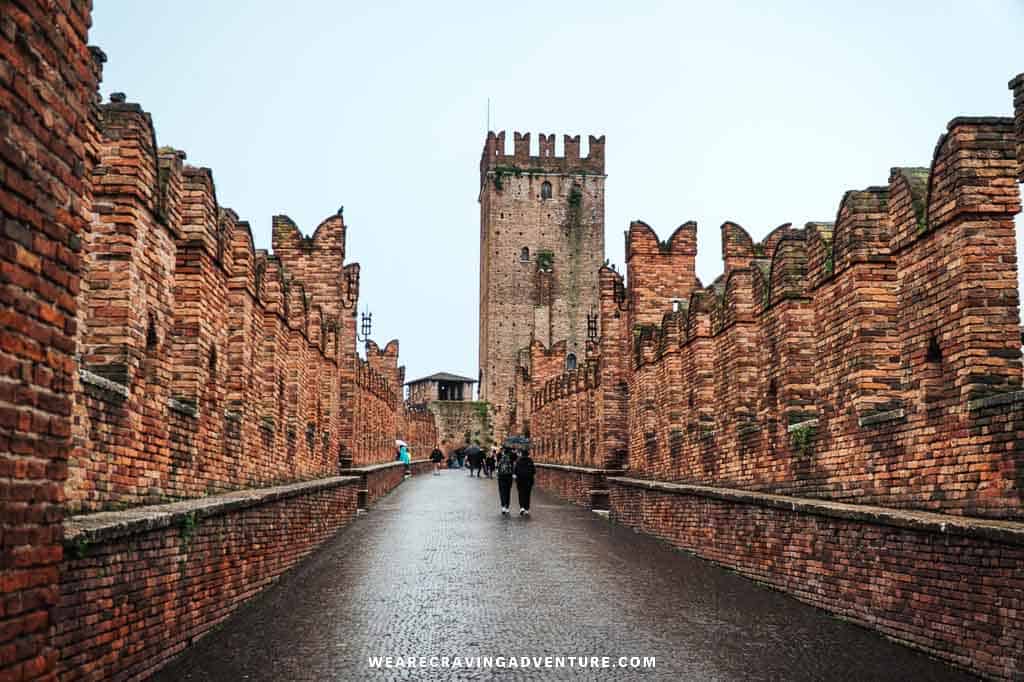
Ponte Scaligero, also known as the Castelvecchio Bridge, is a fortified brick bridge attached directly to Castelvecchio.
Built during the second half of the fourteenth century, the bridge has three unequal arches, high defensive walls and distinctive swallowtail battlements. It is often described as an escape route for the Della Scala rulers, allowing them to cross the river directly from the castle if Verona became unsafe.
Like Ponte Pietra, it was destroyed by retreating German forces in 1945 and reconstructed using original material recovered from the Adige.
Walking across the bridge is free and completely separate from visiting Castelvecchio Museum. Even if you skip the museum, step onto the bridge for framed views through the battlements, changing river perspectives and one of Verona’s best examples of medieval defensive architecture.

9. Watch sunset from Castel San Pietro
For the best panoramic view over Verona, head to the terrace in front of Castel San Pietro.
The viewpoint sits above Ponte Pietra and the Roman Theatre, with the Adige curving around the historic centre below. From here, you can pick out church towers, terracotta rooftops, Torre dei Lamberti and the tightly packed streets inside the river bend.
This is one of my favourite places in Verona, especially around sunset. The view is broad enough to appreciate the entire shape of the city, but close enough that individual towers, bridges and façades remain recognisable.
The building at the top is not a medieval castle open for sightseeing. The present structure is a nineteenth-century Austrian barracks built on a hill that had already been fortified and occupied for centuries.
The attraction is the terrace and view rather than touring the building itself.
There are two ways to reach Castel San Pietro:
- Walk up: The staircase begins near Ponte Pietra and the Roman Theatre. It is short but fairly steep.
- Take the funicular: The inclined lift runs from close to the Roman Theatre and reaches the top in around 90 seconds.
I prefer walking up because the views gradually open behind you, but the funicular is cheap, convenient and particularly useful in summer heat or for visitors who struggle with steep steps.
There is also a pleasant aperitivo spot near the viewpoint where you can have a relatively inexpensive drink overlooking Verona. Prices and management can change, but it is worth checking what is open rather than automatically returning to the much more touristy terraces in the central squares.
Want to visit with a guide?
The Verona walking tour with Arena entrance and Castel San Pietro combines the historic centre, the Roman Arena and the hilltop viewpoint in one guided experience.
My tip: Do not schedule your evening so tightly that you have to leave before the sun actually drops. Verona looks best in the period just after sunset, when the sky still has colour but the lights across the city begin to appear.

10. Explore Verona’s archaeological sites and museums
The Arena is only the most obvious surviving piece of Roman Verona. Archaeological remains appear beneath modern streets and shops, while the city’s museums cover Roman life, medieval art, Della Scala history and some seriously clever twentieth-century architecture.
- Castelvecchio Museum: Housed inside the fourteenth-century Della Scala castle, this is my top museum pick in Verona. The collection includes medieval and Renaissance art, sculpture and the original equestrian statue of Cangrande, but Carlo Scarpa’s restoration and display design are just as interesting as the artworks. Allow around 1.5–2 hours.
- Roman Theatre and Archaeological Museum: Cross Ponte Pietra to explore the remains of Verona’s first-century BC theatre, then continue through the former convent above it to see mosaics, sculptures, inscriptions and Roman objects. The hillside setting also delivers some excellent city views.
- Maffeiano Lapidary Museum: A smaller and more specialised collection of Roman, Greek and Etruscan inscriptions and carved stone beside Piazza Bra. Easy to add if you enjoy ancient history but do not want another large museum.
- National Archaeological Museum: Best for understanding the Verona area before and beyond the Roman period, with finds covering prehistoric settlements, the Bronze Age, Celtic communities and Romanisation.
- Porta Leoni: Excavated remains of the Roman gate and road survive below the modern pavement, showing just how directly today’s Verona was built over the ancient city.
Best-value museum ticket: Verona Card
It includes Castelvecchio Museum, the Roman Theatre and Archaeological Museum, the Maffeiano Lapidary Museum, Torre dei Lamberti, the Arena and several other paid attractions.

11. Find Verona’s hidden curiosities
Some of my favourite things in Verona are not major attractions at all. They are the strange details hiding beneath shops, hanging from arches or squeezed into spaces most people walk straight past.
- Roman ruins beneath the Benetton shop: Glass flooring and a lower-level display inside the Via Mazzini store reveal part of Roman Verona beneath the modern shopping street. You can walk in expecting knitwear and accidentally find an archaeological site.
- Gioielleria Porta Borsari: Tucked into the wall of the thirteenth-century Church of San Giovanni in Foro, this tiny jewellery shop measures only 3.78 square metres and claims to be the smallest jewellery shop in the world. Look for it at Vicolo San Giovanni in Foro 1/A, just off Corso Porta Borsari.
- Scaravelli near Juliet’s House: This sweets, gelato and chocolate shop on Via Cappello sells pralines, chocolate bars, hot chocolate, tiramisu and a suitably touristy gelato flavour called Juliet’s Kiss. It is a convenient sweet stop after dealing with the crowds around the balcony.
- The whale rib beneath Arco della Costa: A large bone has hung between Piazza delle Erbe and Piazza dei Signori for centuries. According to the local legend, it will fall when a completely honest person passes underneath. Humanity remains undefeated.
- Bocca di Leone: Look for the carved Lion’s Mouth in the Palazzo di Cansignorio complex. Under Venetian rule, written accusations and reports could be submitted through these stone slots.
- The hunchbacks of Santa Anastasia: Two crouching marble figures support holy-water basins near the entrance. Touching the left hunch is supposed to bring good luck; I rubbed both because I could not remember which one worked.
- Fossils in the paving stones: Verona’s pale limestone contains visible marine fossils. Look down for shell shapes and spirals embedded in streets and buildings around the historic centre.
- Della Scala ladder symbols: Once you recognise the ruling family’s ladder emblem, you will start seeing it carved into tombs, palaces, Castelvecchio and Ponte Scaligero all over town.
For executions, political intrigue and more of Verona’s stranger stories, join the Dark Historical Verona walking tour.

12. Walk through Giardino Giusti
Giardino Giusti is best known as a Renaissance garden, but the real reward is the view from the belvedere above it.
The route begins among formal hedges, fountains, statues and the long cypress avenue before climbing through a quieter, less manicured upper section. As you gain height, the rooftops and towers of Verona gradually appear behind the garden rather than being revealed all at once.
At the top, the belvedere looks across the historic centre toward Torre dei Lamberti, the cathedral and the hills beyond Verona. I particularly like that the city view feels earned: you reach it through terraces, woodland paths and the garden’s slightly theatrical grotto rather than stepping straight off a funicular.
What to look for on the way up:
- The cypress avenue: The garden’s most recognisable feature and the main visual axis leading uphill.
- The grotto and stone mask: The large mask was designed so flames could emerge from its mouth during elaborate garden entertainments.
- The upper paths: Less formal and more atmospheric than the symmetrical lower garden.
- The belvedere: The main reason I would visit, with one of the best elevated views over Verona.
Allow around 1–1.5 hours and expect steps and uphill paths. The Verona Card generally provides reduced admission rather than including the garden completely free.
Free alternative: For a similar elevated view without paying garden admission, walk up to Punto Panoramico San Zeno in Monte. The viewpoint sits above Veronetta and looks across the rooftops toward the historic centre, with far fewer visitors than Castel San Pietro.

13. Eat and drink your way through Verona
Verona sits between the fertile plains of the Veneto, Lake Garda and the Valpolicella wine hills, so eating and drinking here should be treated as an attraction rather than an inconvenient break between monuments.
The city’s food is generally richer and more northern Italian than the pizza-and-pasta stereotype many visitors arrive expecting. Risotto, polenta, braised meats, local cheeses and powerful red wines appear frequently on traditional menus.
Local Verona food and drinks to try:
- Risotto all’Amarone: Creamy risotto prepared with Amarone wine, which gives it a deep red-purple colour and rich flavour.
- Bigoli: Thick strands of pasta traditionally served with rich sauces such as duck ragù or salted fish.
- Pastissada de caval: A long-cooked horse-meat stew, usually served with polenta. It is one of Verona’s most traditional dishes, although obviously not everyone will want to try it.
- Polenta: Served soft or grilled alongside meat, cheese and stews.
- Monte Veronese: A local cow’s-milk cheese available in younger, milder and more mature versions.
- Pandoro: The tall, star-shaped Christmas cake that originated in Verona.
- Amarone della Valpolicella: A powerful red wine made using partially dried grapes.
- Valpolicella Ripasso: Usually lighter and less expensive than Amarone, but still rich enough to pair well with local food.
- Recioto: A sweet red wine made using dried grapes and traditionally served with desserts or cheese.
- Soave and Lugana: Two useful local white-wine alternatives if an entire evening of heavy reds sounds exhausting.
Risotto all’Amarone is the dish I would prioritise. The wine gives it a distinctive colour and depth without making it taste like someone accidentally poured a glass of red wine into ordinary rice.
A good food tour is useful in Verona because several regional dishes are difficult to identify from tourist menus, and the guide can also explain how Amarone, Ripasso and Recioto are produced differently.
Best Verona food experiences:
Best overall food tour: Verona food and wine walking tour with lunch
This highly rated small-group tour combines historic food shops, local dishes, wine and a funicular ride to the Castel San Pietro viewpoint.Best for Amarone and local specialities: Guided Verona food tour with Amarone tasting
A strong choice if you specifically want to try risotto all’Amarone and understand the region’s wines.Best hands-on experience: Pasta and tiramisu cooking class with wine
Best if you would rather cook than spend another afternoon following someone through a church.

14. Take a day trip from Verona
Verona is surrounded by some of northern Italy’s best wine country, lake scenery, historic towns and family attractions. If you have more than two days, it makes an excellent base for exploring the wider Veneto and Lake Garda area.
The best day trip depends on whether you want scenery, wine, history or rollercoasters. Lake Garda is the easiest all-round recommendation, while Valpolicella makes the most sense for wine lovers.
Lake Garda and Sirmione
Lake Garda is the most obvious day trip from Verona. The southern shore is relatively close, and towns such as Sirmione, Lazise, Bardolino and Peschiera del Garda can be reached without spending the entire day travelling.
Sirmione is the headline destination, with a medieval castle, narrow streets, lakefront views and the extensive Roman ruins of the Grotte di Catullo at the tip of the peninsula.
The drawback is that Sirmione becomes extremely crowded. A guided excursion removes the transport problem and usually combines the town with a boat ride and another Lake Garda stop.
The Lake Garda and Sirmione day tour from Verona is the strongest general option. It includes transport, Sirmione, a boat ride around the peninsula and time in another lakeside town.
For a smaller and less established alternative, the Lake Garda, Sirmione and Borghetto tour adds the tiny riverside village of Borghetto sul Mincio.
Valpolicella wine country
The Valpolicella hills begin just north of Verona and are home to Amarone, Ripasso, Recioto and Valpolicella Classico wines.
A proper wine tour makes more sense than trying to improvise with public transport. The wineries are spread across the countryside, and somebody still has to remain sober enough to drive back.
The small-group Amarone wine tour from Verona is the strongest half-day choice. It includes round-trip transport, two family-run wineries and tastings of Valpolicella wines, including Amarone.
For a longer and more substantial experience, the full Valpolicella tour with two wineries and lunch includes transport, multiple tastings and a meal in the wine region.
Be careful with listings described as being “from Verona”. Some winery experiences require visitors to arrange their own taxi or transport despite the wording in the title. Check the meeting point and inclusions before booking.

Madonna della Corona
The Sanctuary of Madonna della Corona clings dramatically to a cliff face on Monte Baldo, north of Verona.
It is one of the most visually unusual religious sites in the region, but reaching it without a car is less convenient than travelling to Lake Garda or Mantua.
This is a strong choice if you enjoy mountain scenery, pilgrimage sites and short hikes. It is not the best option for travellers looking for an effortless half-day excursion.
Gardaland
Gardaland is Italy’s best-known theme park and an easy option for families, groups of friends or anyone who has reached their lifetime limit for medieval churches.
The park sits near the southeastern shore of Lake Garda, close to Peschiera del Garda. It has large rollercoasters, family rides, children’s areas, shows and themed attractions.
I genuinely enjoy Gardaland, but I would not sacrifice a first day in Verona for it. It makes sense when you have at least three days in the region, are travelling with children or actively want a theme-park day.
Check whether your chosen ticket includes only park admission or any transport from Verona. The train to Peschiera del Garda is straightforward, but you still need to connect from the station to the park.
Mantua
Mantua is one of the best cultural day trips from Verona and is far less overwhelmed by tourism than Venice or Lake Garda.
The historic centre is associated with the powerful Gonzaga family and contains Palazzo Ducale, Palazzo Te, Renaissance squares, frescoed rooms and a lakeside setting created by the Mincio River.
This is the day trip I would choose if you want another art-and-history city without recreating Verona’s crowds in a different postcode.
Best day trips from Verona:
Best for first-time visitors: Lake Garda and Sirmione day tour
Best combination of lake scenery, historic streets, a boat trip and straightforward transport.Best for wine lovers: Small-group Valpolicella and Amarone tour
Includes round-trip transport and two winery visits, so nobody has to negotiate Italian country roads after eight wine tastings.Best full wine day: Valpolicella wineries and lunch tour
A longer option with two wineries, lunch and transport from central Verona.
How many days do you need in Verona?
One full day is enough to see Verona’s most famous attractions, but two days is the ideal amount of time for most first-time visitors.
With one day, you can visit the Arena, walk through the historic centre, see Juliet’s House, explore Piazza delle Erbe and Piazza dei Signori, cross Ponte Pietra and finish at Castel San Pietro. It is a full day, but the route is realistic because central Verona is compact and walkable.
Two days gives you time to enter Castelvecchio Museum, visit the Roman Theatre, climb Torre dei Lamberti, explore Verona’s churches and walk through Giardino Giusti without treating the city like a medieval obstacle course.
| Time in Verona | What to prioritise | Best booking option |
|---|---|---|
| Half a day | Arena exterior, Piazza Bra, Juliet’s House area, Piazza delle Erbe, Piazza dei Signori and Ponte Pietra | Verona Old Town walking tour |
| One day | Add the Arena interior, Torre dei Lamberti or one museum, then Castel San Pietro at sunset | Arena, Old Town and Castel San Pietro tour |
| Two days | Add Castelvecchio, the Roman Theatre, churches, Giardino Giusti and quieter streets | 48-hour Verona Card |
| Three days | Spend two days in Verona and use the third for Lake Garda, Valpolicella or Mantua | Lake Garda and Sirmione day trip |
Best time to visit Verona
The best time to visit Verona is generally April to June or September to October, when the weather is comfortable for walking and the city is lively without the worst of the summer heat.
- Spring: Best for gardens, comfortable sightseeing weather, longer days and day trips to Lake Garda.
- Summer: Best for the Arena opera season, festivals and evenings outdoors, but expect heat, higher prices and larger crowds.
- Autumn: Best for wine tours, harvest season, comfortable temperatures and softer light around the Adige.
- Winter: Best for lower prices, fewer visitors, Christmas markets and a more atmospheric city break.
Summer is worth considering if attending an Arena performance is a priority. Book accommodation and performance tickets well ahead, as popular dates can affect hotel prices across central Verona.
For a colder trip, see my guide to Verona in winter.


How to get to Verona
Verona is one of the easiest cities to include in a northern Italy itinerary. It sits on major train routes between Milan, Venice, Bologna and the Lake Garda area.
- By train: Verona Porta Nuova has fast and regional connections with Milan, Venice, Bologna, Padua, Florence, Rome and several Lake Garda towns.
- By plane: Verona Villafranca Airport is the closest airport. Airport buses and taxis connect it with Verona Porta Nuova and the city centre.
- By car: A car is useful for Valpolicella, Madonna della Corona and smaller Lake Garda towns, but unnecessary for sightseeing in central Verona.
Verona Porta Nuova is around a 20–25-minute walk from Piazza Bra. Local buses and taxis are useful when arriving with luggage, especially if your hotel is deeper inside the historic centre.
Arriving by car? Do not casually drive towards your hotel and hope for the best. Much of central Verona is covered by a restricted traffic zone. Confirm parking and ZTL instructions directly with your accommodation before arrival.
Hotel Milano & SPA is particularly useful for drivers because it offers private parking while remaining steps from the Arena.
Getting around Verona
The best way to get around Verona is on foot. Most of the principal attractions sit inside the historic centre, and walking allows you to notice the Roman remains, frescoed façades, courtyards and Della Scala symbols between them.
Local buses are useful for Verona Porta Nuova, San Zeno and accommodation outside the centre. Urban transport is included with the Verona Card.
The funicular to Castel San Pietro saves a steep uphill walk, while central attractions such as the Arena, Juliet’s House, Piazza delle Erbe, Piazza dei Signori, Torre dei Lamberti and Ponte Pietra are all relatively close together.

Things to do in Verona FAQ
What are the best things to do in Verona, Italy?
The best things to do in Verona are visiting the Roman Arena, exploring the historic centre, seeing Juliet’s House, walking through Piazza delle Erbe and Piazza dei Signori, climbing Torre dei Lamberti, crossing Ponte Pietra and watching sunset from Castel San Pietro.
With more time, add Castelvecchio Museum, the Roman Theatre, Verona’s churches, Giardino Giusti and a Valpolicella wine tour.
What are the must-see attractions in Verona?
The principal must-see Verona attractions are:
- Verona Arena
- Piazza Bra
- Juliet’s House
- Piazza delle Erbe
- Piazza dei Signori
- Torre dei Lamberti
- Ponte Pietra
- Castel San Pietro
The Verona tour with Arena entry and Castel San Pietro covers many of these highlights in one organised experience.
Is the Verona Card worth it?
The Verona Card is usually worth buying if you plan to enter the Arena plus at least two or three museums, churches or monuments.
It is particularly useful because many of Verona’s main paid attractions are included:
- Verona Arena
- Juliet’s House
- Torre dei Lamberti
- Castelvecchio Museum
- Roman Theatre and Archaeological Museum
- Scaliger Tombs
- Verona Cathedral complex
- Santa Anastasia
- San Zeno
- San Fermo
- Urban bus transport
It is less useful when you only have a few hours and mostly plan to explore the free squares, bridges and viewpoints. Juliet’s House also requires a separate timed reservation even when admission is covered by the card.
Is Verona worth visiting?
Yes, Verona is absolutely worth visiting. It combines Roman monuments, medieval architecture, attractive squares, river views, excellent food and easy day trips in a compact, walkable city.
It is particularly good for travellers who want a historic Italian city that is easier to navigate than Venice, Rome or Florence. Just do not come expecting the Romeo and Juliet attractions to be historically authentic. Verona’s real history is far more interesting.
Is one day enough for Verona?
One day in Verona is enough to see the major sights, provided you begin early and follow an efficient route. You can visit the Arena, walk through the historic centre, see Juliet’s House, explore the main squares, cross Ponte Pietra and finish at Castel San Pietro.
You will need to choose between Torre dei Lamberti, Castelvecchio Museum and the Roman Theatre rather than entering all three. See my one-day Verona itinerary for a realistic route.
Are two days enough for Verona?
Two days is ideal for most first-time visitors to Verona. You can cover the main attractions on the first day, then use the second for museums, churches, Giardino Giusti, quieter streets and a slower meal.
A 48-hour Verona Card usually offers the best value for this type of trip.
Can you walk everywhere in Verona?
Most central Verona attractions are easily walkable. Piazza Bra, the Arena, Juliet’s House, Piazza delle Erbe, Piazza dei Signori, Torre dei Lamberti, Santa Anastasia and Ponte Pietra all sit within the compact historic centre.
San Zeno, Giardino Giusti and some accommodation areas require longer walks. The climb to Castel San Pietro is steep, but a funicular is available.
Is the Verona Card worth buying?
The Verona Card is worth buying if you plan to enter the Arena and at least two or three additional attractions. It includes many of Verona’s main museums, churches and monuments, along with urban public transport.
It is less useful if you are only spending a few hours in Verona and mainly visiting free squares, bridges and viewpoints.
Check current Verona Card prices and availability.
Do you need to book Verona attractions in advance?
You should book Juliet’s House, Arena tours, opera tickets, food tours and transported day trips in advance, especially during summer and weekends.
- Juliet’s House: Timed reservations are required, including for Verona Card holders.
- Verona Arena: Advance tickets or a skip-the-line Arena tour reduce queueing.
- Food tours: Small-group departures have limited capacity.
- Lake Garda and Valpolicella tours: Transported excursions can sell out during peak periods.
What can you do in Verona for free?
Some of the best free things to do in Verona include exploring Piazza Bra, Piazza delle Erbe and Piazza dei Signori, crossing Ponte Pietra and Ponte Scaligero, seeing Porta Borsari and Arco dei Gavi, walking along the Adige and visiting the Castel San Pietro viewpoint.
Punto Panoramico San Zeno in Monte is another excellent free viewpoint, while several Roman ruins can be seen beneath streets and inside modern shops without purchasing a museum ticket.
What are the best unusual things to do in Verona?
Unusual things to see in Verona include Roman remains beneath the Benetton shop, the tiny Gioielleria Porta Borsari, the whale rib hanging beneath Arco della Costa, the Bocca di Leone denunciation slot, fossils in the paving stones and the marble hunchbacks inside Santa Anastasia.
The Dark Historical Verona walking tour is a good option if you want more local legends, executions and political intrigue.
What is the best viewpoint in Verona?
Castel San Pietro has the best classic panorama over Verona and is particularly beautiful around sunset. Torre dei Lamberti offers the highest central view, while Giardino Giusti combines a panoramic view with a historic Renaissance garden.
For a quieter free alternative, walk to Punto Panoramico San Zeno in Monte.
What is the best day trip from Verona?
Lake Garda is the best all-round day trip from Verona. Sirmione combines a medieval castle, old streets, lake views and Roman ruins, while other southern Lake Garda towns add boat trips and a more relaxed waterfront atmosphere.
Book the Lake Garda and Sirmione day tour from Verona if you do not want to coordinate trains, buses and boats yourself.
Wine lovers should choose a Valpolicella and Amarone wine tour with round-trip transport.
Where should you stay in Verona for the first time?
First-time visitors should stay in Città Antica or close to Piazza Bra. These areas keep the Arena, historic centre, restaurants, main squares and riverfront within walking distance.
Hotel Milano & SPA is my best all-round recommendation for its Arena location, rooftop view, spa and private parking.
See my complete guide to where to stay in Verona for neighbourhood comparisons and more hotel options.
Planning a trip to Italy?
Italy is dangerously easy to over-plan. Everything looks close enough, beautiful enough and pasta-adjacent enough to justify adding one more city. Then your relaxing holiday quietly turns into a train timetable with luggage.
I have been visiting Italy since childhood and have returned repeatedly for longer trips around Verona, Venice, Milan, Bologna and northern Italy. These guides are based on the places I have explored, the routes I have actually taken and the logistical mistakes I would rather you did not repeat.
Use the guides below to build the rest of your trip, compare bases, choose realistic day trips and book the attractions that genuinely need advance planning.
Read next:
Verona:
Verona itinerary for 1, 2 or 3 days
Where to stay in Verona
Verona in winter
Venice:
Venice itinerary for 1, 2, 3 or 5 days
Best things to do in Venice
Best day trips from Venice
Where to stay in Venice
Best Venice hotels with canal views
St Mark’s Basilica guide
Doge’s Palace guide
Venice Carnival guide
Venice in winter
Bologna:
Bologna itinerary for 1, 2 or 3 days
Best things to do in Bologna
Best day trips from Bologna
Where to stay in Bologna
Bologna in winter
Milan:
One day in Milan
Milan itinerary for 2, 3, 4 or 5 days
Best things to do in Milan
Best day trips from Milan
Where to stay in Milan
Milan in winter
More Italy:
Unique things to do in Italy in winter
Reliable travel insurance
Good travel insurance is an absolute must when travelling abroad, and I learned that the hard way.
Now I always get insured before I leave, and Travel Insurance Masters is my go-to platform for comparing insurance options for a specific trip.
The platform works as a search engine and recommends available insurance companies and plans based on your trip details. It takes into account factors such as your age, nationality, destination, travel dates and prepaid costs, which can all affect eligibility and price.
When comparing policies, check the actual wording for:
- Emergency medical treatment and evacuation
- Trip cancellation and interruption
- Flight delays and missed connections
- Lost, stolen or delayed baggage
- Pre-existing medical-condition exclusions
- Rental-car coverage, if relevant
- Activities and sports you plan to do
Get your travel insurance quote and compare provider recommendations here.
