This site uses affiliates. Thank you for buying through our links and supporting this blog.


Verona Itinerary: How to Spend 1, 2 or 3 Days in Verona

Verona gets reduced to Romeo and Juliet far too often. Yes, the balcony is here. So are the love notes, the statue, the crowds and the people queuing to pose beneath a fictional teenager’s window. But the most interesting parts of Verona have very little to do with Shakespeare.
Verona is a city built in layers. Roman gates still frame the streets. The Arena remains in use almost two thousand years after it was built. Medieval rulers constructed fortified bridges in case they needed to escape their own subjects. Gothic tombs rise above the pavement like miniature cathedrals, while the Adige curls around the historic centre beneath some of the best viewpoints in northern Italy.
I first visited Verona in my teens, when it felt like a fairly easy addition to a northern Italy trip. I returned a few times since then and the difference in visitor numbers is impossible to miss. But I also realised how much more depth this city has than I initially realised.
Verona has become busier over the years, especially around the Arena, Piazza delle Erbe and Juliet’s House. Visit the wrong places at the wrong time and you can spend much of the day standing in queues or fighting through groups. That’s why it is important to follow a sensible route and book the key tickets ahead.
This Verona itinerary begins with a detailed one-day walking route through the essential sights, then expands into two and three days with museums, churches, gardens, food experiences and day trips to Lake Garda or Valpolicella.
Along the way, I have included the places I genuinely think are worth entering, the ones you can admire quickly from outside, the viewpoints worth climbing for and the attractions I would skip when time is tight.

In a hurry?
Book these Verona experiences first
These are the Verona experiences I would book first for a first visit, especially during weekends, summer and the Arena opera season.
Best all-in-one option:
Verona walking tour with pre-reserved Arena tickets
Best for independent sightseeing:
Verona Card with priority Arena entrance
Best for Juliet’s House:
Juliet’s House fast-track ticket and audio guide
Best food experience:
Verona food and Amarone wine tour
Best day trip:
Sirmione and Lake Garda day tour with boat cruise
Stay at:
Hotel Milano & SPA for a central base beside the Arena and a rooftop terrace overlooking it.
How Many Days in Verona?
You need one full day to see Verona’s main attractions, but two days is the best choice for most first-time visitors. Three days makes sense if you want to add a day trip to Lake Garda or the Valpolicella wine region.
Verona’s historic centre is compact, and the majority of the famous sights sit within easy walking distance of each other. That makes it much easier to cover than Venice, Rome or Milan. The real question is not whether you can see Verona in one day, but how many interiors, museums and meals you want to squeeze into it.
- With one day, I would prioritise a guided Verona walking tour with Arena tickets or use the Verona Card and choose only the paid attractions that genuinely interest you.
- Two days also leaves space for one bookable experience, such as a Verona food and Amarone wine tour or a fresh pasta and tiramisu cooking class.
- With three days spend two days in Verona, then use your third for a Sirmione and Lake Garda day tour or a small-group Amarone wine tour through Valpolicella.
| Time in Verona | Best for | What you can realistically see |
|---|---|---|
| Half a day | Stopovers and very short visits | Piazza Bra, Arena exterior, Via Mazzini, Piazza delle Erbe, Piazza dei Signori and Juliet’s courtyard |
| 1 day | Day trips and short city breaks | Arena, Castelvecchio Bridge, historic squares, Juliet’s House, Santa Anastasia, Ponte Pietra and Castel San Pietro |
| 2 days | Best first-time visit | Complete one-day route plus Castelvecchio Museum, San Zeno, Giardino Giusti, Veronetta and the Roman Theatre |
| 3 days | Verona plus the surrounding region | Two full city days plus a Lake Garda tour or Valpolicella wine tour |
| 4+ days | Slow travel and multiple day trips | A slower Verona visit plus Lake Garda, Valpolicella, Mantua, Borghetto, Venice or the Dolomites |

Verona Itinerary Overview: 1, 2 and 3 Days in Verona
The one-day route begins at Piazza Bra and moves west to Castelvecchio before cutting through the Roman and medieval centre towards Ponte Pietra and Castel San Pietro. It avoids unnecessary backtracking and ends at the city’s best free viewpoint.
With two days, the historic-centre highlights remain on Day 1 while Day 2 adds the museums, churches, gardens and neighbourhoods that deserve more than a hurried stop.
The three-day route focuses the first day on the medieval centre and eastern riverfront, while the second covers the Arena, Castelvecchio, San Zeno and the wider city. Day 3 is reserved for a trip beyond Verona.
| Itinerary | Main route | Focus |
|---|---|---|
| One day in Verona | Piazza Bra → Arena → Castelvecchio → historic centre → Juliet’s House → Ponte Pietra → Castel San Pietro | Verona’s essential landmarks and best first-time route. Start with a guided Verona walking tour with Arena tickets or explore independently with the Verona Card. |
| Two days in Verona | Day 1 historic-centre highlights; Day 2 Castelvecchio Museum → San Zeno → Giardino Giusti → Veronetta | Major sights plus museums, gardens, churches and local food. Add a Verona food and Amarone wine tour or a fresh pasta and tiramisu cooking class. |
| Three days in Verona | Two detailed city days followed by Lake Garda, Valpolicella or another day trip | A complete Verona visit plus the surrounding Veneto region. Choose a Sirmione and Lake Garda day tour with a boat cruise or a small-group Amarone wine tour through Valpolicella. |
Expect Plenty of Walking
Verona is compact, but most itinerary days still involve around 5–7 kilometres of walking. That does not include the distance covered inside the Arena, Castelvecchio Museum, Juliet’s House, churches or the Roman Theatre.
The historic centre is largely pedestrian only and flat, although the paving is not always kind to flimsy shoes. Castel San Pietro, the Roman Theatre and the upper parts of Giardino Giusti involve steps or uphill walking. The Castel San Pietro funicular removes the steepest climb.
Plan Around Opening Days and Performances
Verona’s museums and churches do not all follow the same opening schedule. Some operate reduced hours, close on Mondays or change access during religious services and events.
The Arena may also have altered access when performances, concerts or stage preparations are taking place. During opera season, the interior can look very different from the empty Roman amphitheatre visitors may expect.
Check official opening information shortly before visiting and arrange your fixed bookings first. Build the rest of the itinerary around your Arena, Juliet’s House, tour or performance time.
The paid attractions most likely to affect your itinerary are:
- Verona Arena: Book the priority-access Arena tour for historical context, or enter using the Verona Card.
- Juliet’s House: The courtyard and museum are different experiences. Reserve a fast-track Juliet’s House ticket if you want to enter and stand on the balcony.
- Castelvecchio Museum: Worth allowing 90 minutes or more if you care about medieval art, Renaissance painting or Carlo Scarpa’s architecture.
- Torre dei Lamberti: Choose it for a high view directly over the medieval centre. Castel San Pietro gives you a wider city panorama for free.
- Roman Theatre and Archaeological Museum: Best for visitors particularly interested in Roman Verona.
- Verona’s churches: Santa Anastasia, San Zeno and the cathedral complex each deserve time, but you do not need to visit every church in one day.
Book the Main Verona Attractions in Advance
You do not need to book every hour of your Verona itinerary, but a few reservations make the route considerably easier.
- Guided introduction: The small-group Verona walking tour with Arena tickets is my first choice for a one- or two-day visit because it coordinates the main historical introduction with Arena access.
- Verona Arena: Book the priority-access guided Arena tour if you only want guidance inside the amphitheatre.
- Independent sightseeing: The Verona Card is best when you plan to visit the Arena and several participating museums, towers or churches. Compare the 24-hour and 48-hour versions against your itinerary.
- Juliet’s House: Reserve the fast-track Juliet’s House ticket and audio guide if entering the house and balcony matters to you.
- Food and wine: Book the Verona food and Amarone wine tour for a guided tasting experience in town, or the pasta and tiramisu cooking class for a hands-on alternative.
- Lake Garda: The Sirmione and Lake Garda tour with a boat cruise is the easiest Day 3 choice.
- Valpolicella: Book the small-group Amarone wine tour if you want two wineries and tastings without driving.
Prefer One Booking Instead of Several?
The easiest option is the Verona walking tour with pre-reserved Arena tickets. It gives you a guided introduction to the city, covers the historic centre and removes the most important ticket decision from your first morning.
Where to Stay for This Verona Itinerary
Stay inside Verona’s historic centre or close to Piazza Bra for the easiest itinerary.
The centre is compact enough that location matters more than transport access once you have arrived. A hotel near Piazza Bra, Piazza delle Erbe or the Arena allows you to start early, return for a break and stay out for dinner without organising buses or taxis.
OPULENT CHARM
A luxurious boutique hotel offering an exquisite blend of timeless elegance and modern comfort in the heart of Verona’s historic center.
PANORAMIC VIEWS
Only steps away from the Arena it offers excellent service, beautiful design, and a rooftop bar & jacuzzi with unparalleled views.
ADULTS ONLY
Located in a historic building it combines historic architecture with modern furnishing and amenities for a sophisticated retreat.


One Day in Verona Itinerary
Route: Piazza Bra → Verona Arena → Castelvecchio Bridge → Porta Borsari → Piazza delle Erbe → Piazza dei Signori → Torre dei Lamberti → lunch → Juliet’s House → Basilica di Santa Anastasia → Verona Cathedral → Ponte Pietra → Castel San Pietro
Book ahead: Verona walking tour with Arena tickets, Verona Card or separate Juliet’s House tickets
Walking: Approximately 5–6 km, plus walking inside the Arena and other attractions. The final section to Castel San Pietro is uphill, but you can take the funicular instead.
One day in Verona is enough to see the city’s biggest landmarks, walk through the historic centre, visit the Arena, stop at Juliet’s House and finish with the panoramic view from Castel San Pietro.
This is a full day, but Verona is compact and the route is genuinely manageable. Most of the main attractions sit within a relatively small historic centre, and the itinerary moves in one logical direction without sending you backwards and forwards across the city.
I would still start early. Verona has become noticeably busier between my visits, and places such as the Arena, Piazza delle Erbe and Juliet’s courtyard can feel very different once the tour groups arrive. An early start gives you a quieter look at Piazza Bra and leaves enough time for a proper lunch rather than eating something sad while speed-walking towards the next monument.
If this is your first visit, the easiest option is to begin with this guided walking tour. Verona is pretty enough to wander around without knowing anything, but its Roman streets, Scaliger history, medieval palaces and Shakespeare connections become considerably more interesting once somebody explains what you are actually looking at.
| Time | Plan |
|---|---|
| Morning | Piazza Bra, Verona Arena, Castelvecchio Bridge, Porta Borsari and the historic centre. Book this small-group Verona walking tour with Arena tickets for the easiest introduction. |
| Late morning | Piazza delle Erbe, Arco della Costa, Piazza dei Signori, Scaliger Tombs and optional Torre dei Lamberti. The Verona Card includes many of the main paid attractions. |
| Lunch | Stop around Piazza delle Erbe or Piazza dei Signori and try risotto all’Amarone or another Veronese speciality. |
| Afternoon | Juliet’s House, Basilica di Santa Anastasia, Verona Cathedral and Ponte Pietra. Reserve fast-track Juliet’s House entry if you want to visit the museum and stand on the balcony. |
| Evening | Take the funicular or walk up to Castel San Pietro for city views, then return to the centre for aperitivo and dinner. During the opera season, finish with a performance inside the Arena. |
Book for your one day in Verona
Small-group Verona walking tour with Arena tickets
My top choice for a first visit. This highly rated tour covers Verona’s historic centre with a guide, includes pre-reserved Arena access and offers options involving the Castel San Pietro funicular and Juliet’s House.
Verona Card with priority Arena entrance
Best if you prefer exploring independently and plan to enter several attractions. Depending on current inclusions, it covers major sights such as the Arena, Juliet’s House, Torre dei Lamberti, Castelvecchio Museum and several churches and museums.
Verona tour with Arena, cable car and optional Juliet tickets
Another strong all-in-one option if you want the main historic sights, Arena entry and the Castel San Pietro viewpoint coordinated in a single booking.
Priority-access Verona Arena guided tour
Best if you want to explore the rest of Verona independently but would like a short guided visit inside the Arena. The tour takes around 45 minutes, so it fits easily into a one-day itinerary.
Juliet’s House fast-track ticket and audio guide
Best if you want to enter the house, see the rooms and step onto the famous balcony rather than only visiting the public courtyard.
Start in Piazza Bra
Start your one day in Verona at Piazza Bra, the broad square outside the Arena. This is the most practical starting point if you are arriving from Verona Porta Nuova station and also gives you the city’s biggest landmark before the centre becomes properly busy.
Piazza Bra is lined with cafés, colourful palazzi and the long row of restaurants along the Liston. The Arena dominates the square, but take a moment to look around before rushing inside. You will also see Palazzo Barbieri, Verona’s neoclassical town hall, and the city walls and monumental gates at the southern end of the square.
On my later visits, this part of Verona felt noticeably busier than I remembered from the first time. Arriving early makes a real difference. Later in the morning, Piazza Bra fills with tour groups, restaurant terraces and people trying to photograph the Arena without fifty strangers wandering through the background. An optimistic project at the best of times.
Visit the Verona Arena
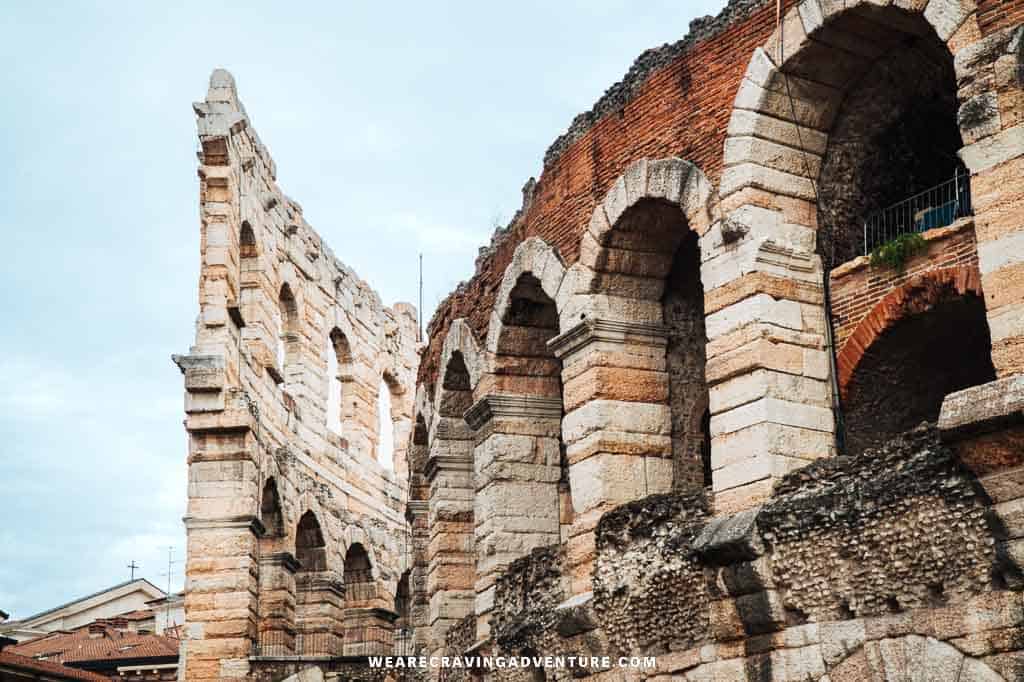
The Arena di Verona is a Roman amphitheatre dating from the first century AD and one of the city’s most recognisable monuments. It was built for large public spectacles and could originally hold tens of thousands of spectators.
Part of the original outer ring was destroyed following a major earthquake in the 12th century, but the central amphitheatre survived and remains in use. Today, the Arena is particularly famous for its open-air opera season, when the ancient seating and vast stage are transformed for elaborate productions.
The interior is relatively straightforward compared with a palace or art museum, but the history makes far more sense with a guide. Without one, you are essentially looking at a very impressive collection of stone steps and trying to imagine two thousand years of gladiators, crowds, medieval reuse and opera productions by yourself.
Book your Verona Arena visit:
Verona walking tour with pre-reserved Arena tickets
Best overall choice for one day because it combines the Arena with an introduction to the wider historic centre.
Priority-access Arena guided tour
Best if you only want a short guided Arena visit before continuing independently.
Verona Card
Best if you plan to visit several included monuments and museums during your stay.
Walk to Castelvecchio Bridge
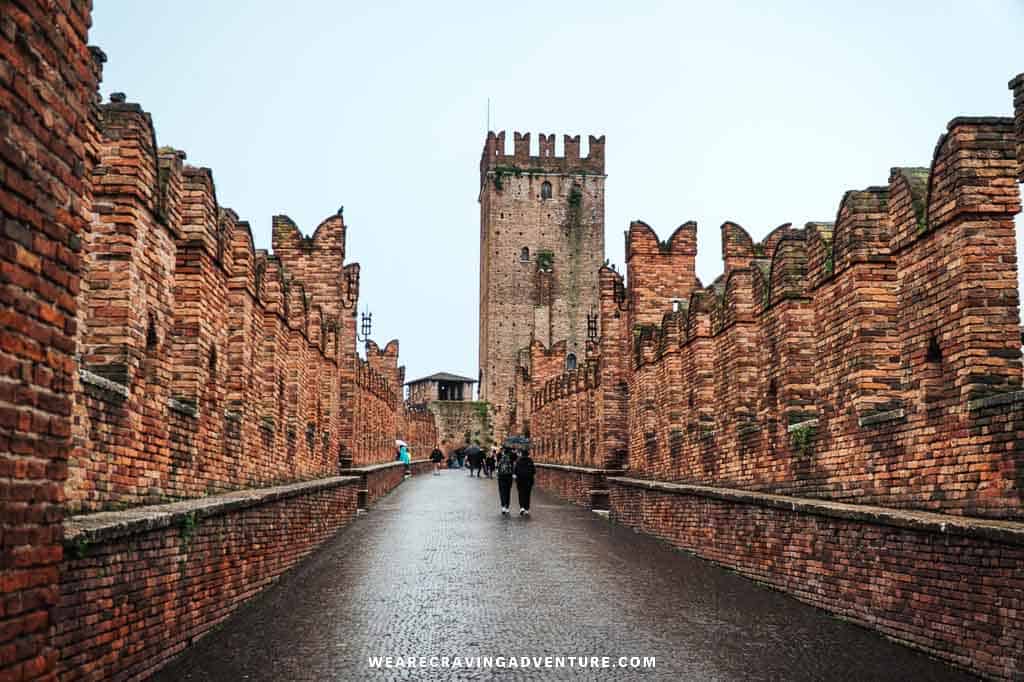
From Piazza Bra, walk west towards Castelvecchio and the fortified Scaliger Bridge. This adds a small detour to the otherwise direct route into the historic centre, but it is worth it for the river views and one of Verona’s most distinctive medieval structures.
Castelvecchio was built in the 14th century by the powerful della Scala family as both a fortress and a residence. The adjoining bridge provided a protected route across the Adige and, rather conveniently, an escape from the city should the family’s rule become unpopular.
The bridge was destroyed during World War II and later reconstructed using recovered material and traditional techniques. Its red-brick walls, towers and crenellations make it feel far more dramatic than an ordinary river crossing, while the openings along the bridge frame views over the Adige.
Walk at least partway across, look back towards the castle and then return towards Corso Cavour.
The castle now houses the Castelvecchio Museum, with medieval and Renaissance paintings, sculpture, historic weapons and important architecture by Carlo Scarpa. It is a worthwhile museum, but I would treat it as optional with only one day in Verona. A proper visit can easily take 90 minutes or more, and the historic centre still contains a lot.
The museum is better suited to the second day of a longer Verona itinerary unless art and architecture are among your main reasons for visiting.
Entry is generally included with the Verona Card.
Porta Borsari and Historic Verona
Continue along Corso Cavour towards Porta Borsari, one of the surviving Roman gateways into Verona.
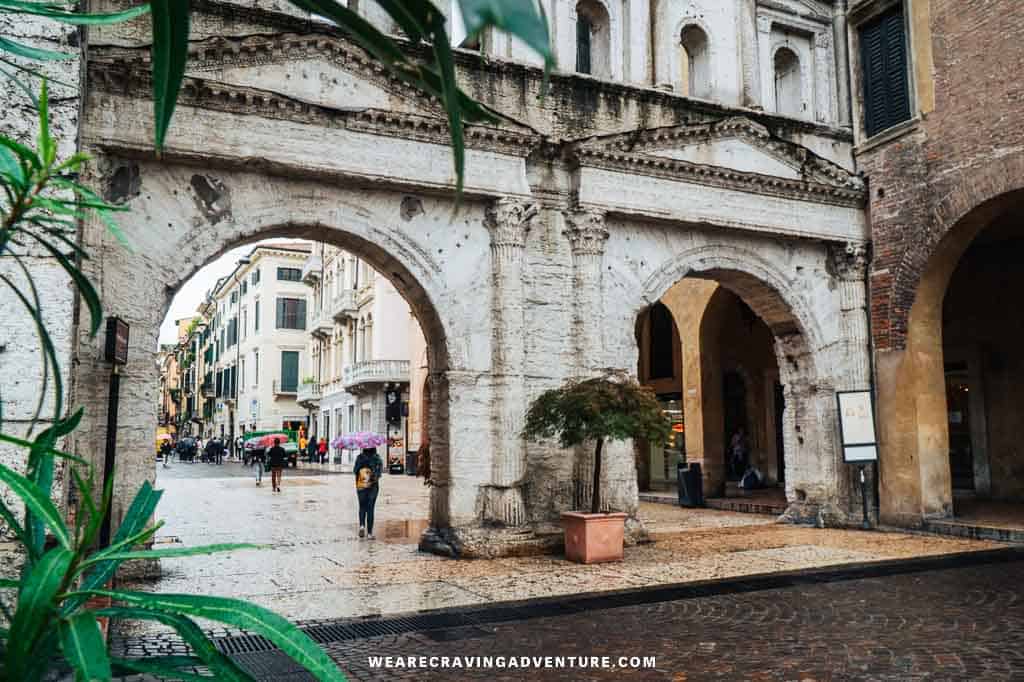
The gate dates mainly from the first century AD and once marked the entrance to the Roman city along the Via Postumia. Only its decorative white-stone façade remains, but the two levels of arched windows make it one of the most elegant Roman monuments in Verona.
Walk through the gate and continue along Corso Porta Borsari. This street follows part of Verona’s original Roman layout and leads directly towards Piazza delle Erbe, which occupied the site of the Roman forum.
This is one of the reasons I recommend taking a guided walking tour in Verona. You can cross Porta Borsari in thirty seconds and think, “Nice old gate.” A good guide connects it to the Roman roads, city walls, forum and layers of later medieval Verona, which makes the entire centre feel less like a random collection of attractive buildings.

Piazza delle Erbe
Piazza delle Erbe is Verona’s oldest square and one of the liveliest places in the historic centre. It developed over the Roman forum and is surrounded by buildings from several different periods, including frescoed houses, medieval towers and the baroque Palazzo Maffei.
The square is busy, colourful and a little chaotic. Market stalls fill much of the centre, café tables spread around the edges and people generally seem to be moving in every possible direction at once.
Look for:
- The fountain topped by the ancient Madonna Verona statue
- Palazzo Maffei and the winged Lion of Saint Mark
- The frescoed façades of the surrounding merchant houses
- The Gardello Tower and Torre dei Lamberti rising above the square
- The old market column and Capitello, once used for public proclamations and ceremonies
Piazza delle Erbe lies within Verona’s UNESCO-listed historic centre and brings together the Roman, medieval and Venetian layers that explain why the wider city received the designation.
Arco della Costa
Before entering Piazza dei Signori, look beneath Arco della Costa for the large rib suspended from the arch.
It is traditionally described as a whale rib and has hung here for centuries, although its precise origin and the reason it was placed above the street remain uncertain.
The best-known local legend claims that the bone will fall on the first completely innocent person who walks underneath it. It has stayed firmly attached despite generations of judges, clergy, residents and tourists passing below, which is either reassuring or a fairly damning assessment of humanity.
Piazza dei Signori and the Scaliger Tombs
Pass beneath Arco della Costa into Piazza dei Signori, also known as Piazza Dante after the statue standing in its centre.
The square feels calmer and more formal than Piazza delle Erbe. It was Verona’s political centre during the rule of the della Scala family and is surrounded by former government buildings, palaces and covered passageways.
Important buildings around the square include:
- Palazzo della Ragione, once used for civic administration and justice
- Loggia del Consiglio, an elegant Renaissance building
- Palazzo del Podestà, associated with the Scaliger rulers
- Palazzo di Cansignorio, another centre of political power
- The Domus Nova, historically linked with judges and civic offices
Continue behind the square to the Scaliger Tombs, or Arche Scaligere. These elaborate Gothic monuments commemorate members of the della Scala dynasty, which ruled Verona during the 13th and 14th centuries.
The pointed canopies, equestrian statues and dense stone decoration make the tombs look almost impossibly theatrical. You can see much of the complex from the street, so this remains a worthwhile stop even when the enclosed section is closed.


Torre dei Lamberti
Torre dei Lamberti rises above Piazza delle Erbe and offers one of the best elevated views over Verona’s tiled rooftops, church towers and surrounding hills.
The tower was begun by the Lamberti family in the 12th century and later extended to its current height of approximately 84 metres. You can climb the stairs or pay to use the lift for most of the ascent.
The view is excellent, but Torre dei Lamberti is optional in a one-day Verona itinerary because you will finish the day at Castel San Pietro, which offers another panoramic view for free.
Choose Torre dei Lamberti if you want a higher viewpoint directly over the medieval centre. Choose Castel San Pietro if you would rather see the entire old town, river and bridges together. Doing both is possible, but not essential unless you have a serious commitment to looking down on cities.
Admission is included with the Verona Card.
Lunch in the Historic Centre
Stop for lunch before continuing to Juliet’s House. Piazza delle Erbe and Piazza dei Signori are convenient, although the restaurants directly on the main squares tend to trade heavily on location.
Walk one or two streets away if you want something quieter, or accept the central-square premium and enjoy the view. You only have one day in Verona; this is not the moment to launch a forensic investigation into every menu within a two-kilometre radius.
Veronese dishes to look for include:
- Risotto all’Amarone: creamy risotto made with the powerful red wine produced in nearby Valpolicella
- Bigoli: thick pasta traditionally served with rich sauces
- Pastissada de caval: a slow-cooked local meat stew for more adventurous carnivores
- Polenta: commonly served with meat, mushrooms or cheese
- Local wine: Valpolicella, Ripasso, Amarone or a lighter Bardolino
Risotto all’Amarone is one of Verona’s best-known dishes and the one I would prioritise if you want something distinctly connected to the city and its surrounding wine region.
Prefer to combine lunch with sightseeing?
This Verona food, wine and lunch walking tour combines local food, Veronese wine and city history. It takes around three hours, so choose it instead of some of the detailed afternoon sightseeing rather than trying to cram it on top of everything else.

Juliet’s House and Balcony
After lunch, walk to Via Cappello and Juliet’s House, or Casa di Giulietta.
Let us clear up the obvious problem first: Juliet was not a real historical resident of this house. She is a fictional character, and Shakespeare probably never visited Verona.
The building itself is genuinely medieval and was once associated with the Cappello family, whose name helped connect it with the Capulets. Verona purchased and heavily restored the property during the 20th century, creating the romantic house visitors see today. The famous balcony was also added during this later transformation.
The public courtyard is free to enter when capacity allows. Inside, you will find the balcony, walls covered with notes and messages, and the bronze statue of Juliet.
The courtyard is one of the busiest and most chaotic places in Verona. It can be romantic in theory and rather less so when several hundred people are trying to take the exact same photograph. Still, it is such a famous part of the city’s identity that I would not tell a first-time visitor to skip it entirely.
You have two sensible options:
- Visit the courtyard only: Best if you are mildly curious, short on time or not particularly invested in Romeo and Juliet.
- Enter the museum: Best if you want to explore the reconstructed rooms, see exhibits connected with the story and step onto the balcony.
Reserve a timed ticket if you want to go inside. Entry procedures and crowd controls have changed over time, and this is not an attraction where I would rely on casually wandering up during a busy afternoon.
Book your Juliet’s House visit:
Juliet’s House fast-track ticket with audio guide
Includes fast-track entry, the house, courtyard and balcony, with an audio guide you can follow on your phone.
Verona walking tour with optional Juliet’s House tickets
Best if you want to combine Verona’s wider history, the Arena and the Romeo and Juliet sights in one guided experience.
Verona Card
Best if Juliet’s House is one of several paid attractions you plan to visit.
Santa Anastasia and Verona Cathedral
Continue north through the historic centre towards the Basilica di Santa Anastasia.
Santa Anastasia is Verona’s largest church and, despite its unfinished brick façade, has one of the most impressive interiors in the city. The Gothic nave is lined with red-and-white marble columns, decorated chapels and frescoes.
Look for the unusual holy-water basins supported by carved hunchbacks near the entrance and Pisanello’s celebrated fresco of Saint George and the Princess inside the Pellegrini Chapel.
From Santa Anastasia, continue to Verona Cathedral. The cathedral complex includes the main Duomo, the baptistery of San Giovanni in Fonte, the Church of Sant’Elena and the Canon’s Cloister.
The buildings combine Romanesque and Gothic elements and stand over the remains of earlier Christian structures. Inside the cathedral, one of the main works is Titian’s Assumption of the Virgin.
With only one day, you do not need to study every church from foundation stone to ceiling fresco. Choose based on your pace:
- Visit Santa Anastasia if you want the more visually dramatic Gothic interior.
- Visit the cathedral complex if you are particularly interested in layers of religious architecture and archaeology.
- Visit both if you are moving comfortably and enjoy churches, art and historic interiors.
- See them from outside if your energy is fading and you would rather save time for Ponte Pietra and Castel San Pietro.
Both are generally included with the Verona Card.

Cross Ponte Pietra
Continue to Ponte Pietra, the most picturesque bridge across the Adige and the final major stop before climbing to Castel San Pietro.
A bridge has crossed the river here since Roman times, although Ponte Pietra has been damaged and reconstructed repeatedly. Retreating German forces destroyed much of it during World War II, and the bridge was later rebuilt using stones recovered from the river wherever possible.
From the bridge, you can see the colourful buildings lining the Adige, the remains of the Roman Theatre and the steep hillside rising towards Castel San Pietro.
This is one of my favourite parts of Verona. The centre is beautiful, but the view from Ponte Pietra finally allows the city to open up. You get the river, hills, towers, bridges and warm-coloured buildings together instead of seeing Verona one narrow street at a time.
Optional: Roman Theatre and Archaeological Museum
Immediately across Ponte Pietra is Verona’s Roman Theatre and Archaeological Museum.
The theatre predates the Arena and was constructed against the hillside during the first century BC. The archaeological museum occupies parts of the former convent above it and contains Roman mosaics, sculpture, inscriptions and other finds from Verona.
This is a worthwhile attraction, but it does not fit comfortably into every one-day itinerary. Add it if Roman archaeology is a priority and you skipped Castelvecchio Museum or one of the church interiors.
Entry is generally included with the Verona Card.

Castel San Pietro Viewpoint
Finish your Verona one-day itinerary at Castel San Pietro, the hilltop viewpoint above the Roman Theatre.
You can walk up the stairs or take the short funicular. The climb is not enormous, but it feels considerably more enthusiastic after a full day of walking around Verona. There is no moral superiority in arriving at the viewpoint under your own power, so take the funicular if your legs have started negotiating industrial action.
The castle itself is not normally the main attraction. Come for the terrace in front, which gives you a broad view over:
- Ponte Pietra and the bends of the Adige River
- The red rooftops of Verona’s historic centre
- Torre dei Lamberti and the city’s church towers
- The Arena area and modern city beyond
- The surrounding hills and countryside
There was also a small bar near the top on my visit, and the prices were surprisingly reasonable considering the location. Grab a drink when it is open, find a place overlooking the city and allow yourself to stop moving for a while.
Late afternoon and early evening are particularly beautiful, when the light becomes softer and the terracotta roofs start looking exactly as dramatic as Italian rooftops believe they deserve to look.
Aperitivo, Dinner or Opera
Walk or take the funicular back down and return across Ponte Pietra for aperitivo and dinner in the historic centre.
Piazza delle Erbe is the obvious choice if you want a lively evening surrounded by historic buildings. For something less hectic, explore the streets around the cathedral, Ponte Pietra or the quieter edges of the old town.
During the summer opera season, you can also end your day with a performance inside the Arena. This requires more advance planning, but it is one of the most distinctive experiences in Verona. The same amphitheatre you explored as a Roman monument in the morning becomes an enormous open-air performance venue at night.
Make your evening in Verona more memorable:
Compare Verona Arena opera tickets and evening experiences
Best during the annual opera season or when concerts are scheduled inside the Arena.
Verona sunset food and wine tour
Best if you would rather finish with local wine, food and city views than organise your own aperitivo stops.
Tips for Seeing Verona in One Day
- Book your guided walking tour or Arena visit first. Any timed entry will determine the order of the morning.
- Start early. Verona is compact, but the Arena, main squares and Juliet’s House become substantially busier later in the day.
- Do not visit every museum. Castelvecchio Museum and the Archaeological Museum are worthwhile, but choose one at most during a one-day visit.
- Decide whether you want to enter Juliet’s House. The courtyard is enough for many visitors, while the museum requires more time and a reserved ticket.
- Consider the Verona Card carefully. The Verona Card makes the most sense if you plan to enter the Arena and several additional churches, towers or museums.
- Wear comfortable shoes. The route is walkable, but it includes stone paving and an optional uphill finish.
- Do not skip lunch. The route remains manageable when you stop for an hour. It becomes considerably less charming when everybody is hungry and annoyed.
- Leave Castel San Pietro until late afternoon. The view is better in softer light and makes a natural ending to the sightseeing day.

Two Days in Verona Itinerary
Two days in Verona is ideal for most first-time visitors. You can follow the classic historic-centre route on your first day, then use your second day for Castelvecchio Museum, San Zeno, Giardino Giusti, Veronetta and a proper food or wine experience.
This is the Verona itinerary I would choose if you want to see the major landmarks without trying to force every museum, church and viewpoint into one increasingly frantic day. Verona is compact, but that does not mean you need to treat it like a sightseeing obstacle course.
With two days, you can spend longer inside the Arena, visit Juliet’s House without constantly checking the time, explore Castelvecchio Museum properly and still stop for lunch, aperitivo and the occasional unplanned detour. Those detours are often where Verona is at its best.
| Day | Plan |
|---|---|
| Day 1 | Piazza Bra, Verona Arena, Castelvecchio Bridge, Porta Borsari, Piazza delle Erbe, Piazza dei Signori, Juliet’s House, Santa Anastasia, Ponte Pietra and Castel San Pietro. Start with this Verona walking tour with Arena tickets or explore independently with the Verona Card. |
| Day 2 | Castelvecchio Museum, Arco dei Gavi, Basilica di San Zeno, lunch, Giardino Giusti, Veronetta and the Roman Theatre. Finish with a Verona food and Amarone wine tour, pasta and tiramisu cooking class or dinner in the historic centre. |
Book for your two days in Verona
Small-group Verona walking tour with Arena tickets
Best for your first morning in Verona. It introduces the historic centre and includes pre-arranged Arena access, so you do not waste your first few hours figuring out tickets and opening procedures.
Verona Card with priority Arena entrance
Usually the most useful ticket for a two-day itinerary because it covers or discounts many of the attractions spread across both days, including the Arena, Castelvecchio Museum, Torre dei Lamberti and several churches and museums. Check the current inclusions before booking.
Juliet’s House fast-track ticket and audio guide
Best if you want to enter the museum and step onto the balcony instead of only squeezing into the free courtyard with everybody else.
Verona food and Amarone wine tour
My preferred addition for the second day if you want local food, regional wine and neighbourhood context rather than another conventional museum.
Fresh pasta and tiramisu cooking class with wine
Best hands-on alternative for your second afternoon or evening. You make fresh pasta and tiramisu, then eat everything with local wine. Consider this dinner with considerably more effort and a much better story attached.
Traditional pasta class in a local Verona home
Best if you prefer a more personal cooking experience based on family recipes, followed by a full meal with your host.


Day 1: Verona’s Historic Centre and Famous Landmarks
Route: Piazza Bra → Verona Arena → Castelvecchio Bridge → Porta Borsari → Piazza delle Erbe → Piazza dei Signori → Torre dei Lamberti → lunch → Juliet’s House → Basilica di Santa Anastasia → Ponte Pietra → Castel San Pietro
Book ahead: Verona walking tour with Arena tickets, Verona Card or separate Juliet’s House tickets
Walking: Approximately 5–6 km, plus walking inside the Arena and other attractions. The final section to Castel San Pietro is uphill, but you can take the funicular instead.
Your first day follows the essential Verona route through the Roman and medieval historic centre. It covers the landmarks most first-time visitors come to see, but the distances are short enough that you can still stop for lunch and enjoy the city instead of speed-walking past it.
I would begin with the small-group Verona walking tour with Arena tickets. Verona is easy to walk independently, but a good guide helps connect the Roman gateway, former forum, Scaliger palaces, Arena and medieval streets before they start blending into one long stream of attractive Italian stonework.
| Time | Plan |
|---|---|
| Morning | Start at Piazza Bra and enter Verona Arena. Continue to Castelvecchio Bridge, then walk through Porta Borsari towards the historic centre. Book the guided Verona walking tour with Arena access or enter independently using the Verona Card. |
| Late morning | Explore Piazza delle Erbe, Piazza dei Signori, the Scaliger Tombs and optional Torre dei Lamberti access with the Verona Card. |
| Lunch | Stop around Piazza delle Erbe or Piazza dei Signori for risotto all’Amarone, bigoli or another Veronese speciality. |
| Afternoon | Visit Juliet’s courtyard or use a fast-track Juliet’s House ticket to enter the museum. Continue to Santa Anastasia and Ponte Pietra. |
| Evening | Walk or take the funicular to Castel San Pietro for panoramic views, then return to the historic centre for aperitivo, dinner or an Arena performance. |
This is essentially the detailed one-day Verona itinerary above, but you have one important advantage: you do not need to force Castelvecchio Museum, the Roman Theatre or every major church into the same day. Those fit far more naturally into Day 2.
Use the extra breathing room to spend longer inside the Arena, sit down for lunch and decide whether Juliet’s House genuinely interests you. The courtyard is enough if you mainly want to see the balcony, while the fast-track Juliet’s House ticket and audio guide makes sense if you want to explore the reconstructed interiors and step onto the balcony.
Book for Day 1 in Verona
Verona walking tour with Arena tickets
Best introduction to the Roman Arena, main squares, historic streets and central Verona landmarks.
Verona Card
Best for independent visitors entering several paid attractions across both days.
Juliet’s House fast-track entry and audio guide
Best if entering the house and standing on the balcony are important to you.


Day 2: Castelvecchio, San Zeno and Veronetta
Route: Castelvecchio Museum → Arco dei Gavi → Basilica di San Zeno → lunch → Giardino Giusti → Veronetta → Roman Theatre and Archaeological Museum → food tour, cooking class or dinner
Book ahead: Verona Card for Castelvecchio, San Zeno and the Roman Theatre, plus your choice of food and Amarone wine tour, pasta and tiramisu class or traditional pasta class in a local home
Walking: Approximately 6–7 km. The route includes a longer walk between San Zeno and Giardino Giusti, so use a local bus or taxi if you want to save your legs for Veronetta and the Roman Theatre.
Your second day moves beyond Verona’s headline attractions and into places that deserve more than a rushed glance. Start west of the centre at Castelvecchio, continue to the Basilica di San Zeno, then cross Verona for the Renaissance gardens and quieter streets of Veronetta.
This day feels different from the first. There are fewer compulsory photographs and more time for art, architecture, gardens, neighbourhood streets and food. It is also where Verona starts feeling like a real city rather than a collection of locations associated with Romans, opera and a teenager who never actually existed.
| Time | Plan |
|---|---|
| Morning | Visit Castelvecchio Museum and walk beneath the reconstructed Arco dei Gavi. Use the Verona Card for included or discounted museum access, subject to current terms. |
| Late morning | Continue to the Basilica di San Zeno and explore the church, cloister and Mantegna altarpiece. Entry is generally covered by the Verona Card. |
| Lunch | Eat around San Zeno or return towards the historic centre before crossing the river. |
| Afternoon | Visit Giardino Giusti, explore Veronetta and add the Roman Theatre and Archaeological Museum using the Verona Card if you still have time and energy. |
| Evening | Finish with a Verona food and Amarone wine tour, fresh pasta and tiramisu class or relaxed dinner and wine in the centre. |
Castelvecchio Museum
Begin Day 2 at Castelvecchio Museum, which you passed briefly during the one-day route.
The 14th-century castle was built by Cangrande II della Scala as a fortified residence beside the Adige. Its walls, towers and protected bridge were not merely decorative medieval flourishes. The complex gave the ruling family control over the river and a convenient escape route if Verona’s political mood turned against them.
Today, the castle houses one of Verona’s most important art collections. The route through the museum combines medieval and Renaissance paintings, sculpture, historic weapons and frescoes with the much-admired 20th-century restoration by architect Carlo Scarpa.
Even if you are not the sort of person who reads every museum label, the building itself makes the visit worthwhile. Scarpa’s staircases, platforms, windows and carefully framed views turn the castle into part of the exhibition rather than a neutral box containing old art.
Highlights include:
- Medieval sculpture from churches and monuments around Verona
- Paintings by artists including Pisanello, Bellini and Veronese masters
- The dramatic equestrian statue of Cangrande I della Scala
- Original frescoes and decorative fragments from historic Veronese buildings
- Carlo Scarpa’s architectural interventions and framed views across the castle
Allow around 90 minutes, or closer to two hours if you are particularly interested in art and architecture.
Admission is generally included with the Verona Card.
Arco dei Gavi
After the museum, walk around the castle to Arco dei Gavi, the Roman arch standing beside Corso Cavour.
The arch was constructed during the first century AD for the prominent Gavia family and originally stood across the Via Postumia, the Roman road running through Verona.
French troops dismantled it during the Napoleonic period, and it was reconstructed beside Castelvecchio in the 20th century using surviving stones. Its current position is not original, but it remains an important reminder that Roman Verona extended far beyond the Arena.
This is a quick stop rather than a destination in itself. Walk beneath the arch, look for the grooves worn into the Roman road stones nearby and then continue west towards San Zeno.
Basilica di San Zeno
The Basilica di San Zeno sits outside the busiest part of central Verona and is one of the city’s most important Romanesque churches.
The current basilica developed mainly between the 10th and 12th centuries over earlier religious buildings associated with Saint Zeno, Verona’s patron saint. Its warm stone façade, rose window and bronze doors make it impressive before you even step inside.
The interior feels calmer and more austere than Santa Anastasia. Alternating brick-and-stone columns divide the long nave, while stairs lead down towards the crypt traditionally associated with Saint Zeno.
Do not miss:
- The carved Romanesque doorway and sculptural decoration
- The bronze door panels depicting biblical scenes
- The large rose window known as the Wheel of Fortune
- The peaceful Romanesque cloister beside the church
- Mantegna’s San Zeno Altarpiece in the raised presbytery
- The crypt containing the shrine of Saint Zeno
According to Shakespeare’s story, Romeo and Juliet were married in the church associated with San Zeno, although this is literary tourism rather than documented history. The basilica does not need the fictional connection to justify the walk. It is one of Verona’s best religious buildings in its own right.
Entry is generally included with the Verona Card. Allow around 45 minutes for the church, crypt and cloister.
Lunch Around San Zeno
The San Zeno neighbourhood is a good place to stop for lunch because it feels more residential and less relentlessly visitor-focused than the streets around Piazza delle Erbe and Juliet’s House.
Look for a traditional osteria or trattoria and try something you missed on Day 1. Bigoli, polenta, gnocchi, local cheeses and slow-cooked meat dishes are all common in Veronese cooking.
You can then walk, take a bus or use a taxi towards Giardino Giusti. The full walk is manageable, but this is the least elegant transfer of the itinerary. Saving your legs here is entirely reasonable, particularly if you still plan to explore the gardens, Veronetta and Roman Theatre on foot.

Giardino Giusti
Giardino Giusti is a formal Renaissance garden on the eastern side of the Adige, behind the Giusti family palace.
The garden was developed during the 16th century and arranged along terraces rising towards the hillside. Clipped hedges, fountains, statues, cypress trees and gravel paths create a very different atmosphere from Verona’s busy central squares.
Parts of the garden are highly controlled and symmetrical, while the upper areas become greener and more irregular. Climb towards the higher terraces for views over the garden and Verona beyond.
There is also a hedge maze, although “maze” may oversell the threat level slightly. It is charming rather than a serious risk to your onward travel plans.
Allow around one hour. The gardens are particularly pleasant in spring and early summer, but the shaded paths can also provide a welcome break during hotter weather.
Explore Veronetta
Giardino Giusti lies in Veronetta, the neighbourhood stretching east of the Adige beneath Castel San Pietro.
Veronetta feels less polished than the main historic centre. It has university buildings, small bars, residential streets, churches, independent businesses and a more mixed, lived-in atmosphere.
I would not turn this section into another rigid list of monuments. Walk through the neighbourhood, stop for coffee or a drink and enjoy seeing a part of Verona that is not organised entirely around Piazza delle Erbe and Shakespeare souvenirs.
Depending on your interests and energy, you can also look for:
- Santa Maria in Organo and its detailed wooden choir
- San Giovanni in Valle, one of Verona’s older churches
- University streets and local bars around Via XX Settembre
- Views towards Castel San Pietro and the eastern city walls
- Smaller lanes leading back towards the Roman Theatre and Ponte Pietra
Roman Theatre and Archaeological Museum
Finish the main sightseeing route at Verona’s Roman Theatre and Archaeological Museum, built into the hillside beside Ponte Pietra.
The theatre dates from the first century BC, making it older than the Arena. Its hillside position created a natural setting for the seating, with the stage area facing the river and Roman city.
The archaeological museum occupies parts of the former convent above the theatre. Its collections include Roman mosaics, inscriptions, sculpture, glass, ceramics and other objects discovered in and around Verona.
The museum route also provides elevated views over the theatre, river and historic centre. It is an excellent final museum for visitors genuinely interested in Roman Verona, but do not force it if Castelvecchio and San Zeno have already used most of your cultural attention span.
Allow around 60–90 minutes. Entry is generally included with the Verona Card.
Finish with Food, Wine or a Cooking Class
Your second evening is the right time to add a proper food or wine experience. You have already seen the main landmarks, so you can give three or four hours to eating and drinking without worrying that you are sacrificing half of your Verona itinerary.
The guided Verona food and Amarone wine tour is the best fit if you want somebody to lead you between local venues while explaining Veronese dishes and regional wines. It combines several tastings with local context and removes the need to guess which “traditional” restaurant is traditional and which one merely purchased a convincing wooden sign.
For something hands-on, book the fresh pasta and tiramisu cooking class with wine. It takes place near the Arena and includes making, eating and drinking, so it replaces dinner rather than becoming another appointment you somehow need to fit around dinner.
The traditional pasta class in a local Verona home is a more personal alternative based on family recipes and a shared meal with your host.
Book for Day 2 in Verona
Verona Card
Best for combining Castelvecchio Museum, San Zeno, the Roman Theatre and other covered attractions across your two-day stay.
Guided Verona food tour with Amarone wine tasting
Best for local food, several regional wines and insider restaurant recommendations without committing to a full day outside the city.
Fresh pasta and tiramisu cooking class with wine
Best hands-on evening experience in central Verona and an easy replacement for a conventional restaurant dinner.
Traditional pasta class in a local home
Best for a more intimate meal, family recipes and a personal introduction to Italian home cooking.
Traditional Veronese cooking class with wine
Best if you want to prepare a broader seasonal meal that may include pasta, risotto and dessert rather than focusing only on pasta and tiramisu.
Three Days in Verona Itinerary
Three days in Verona gives you enough time to explore the historic centre properly, visit the museums and churches that usually get cut from a shorter itinerary, enjoy at least one food or wine experience and use your final day for a trip into the surrounding region.
The first two days keep the original route of this itinerary. Day 1 focuses on the medieval centre, Juliet’s House, the churches around the Adige and the views from Castel San Pietro. Day 2 covers the Arena, Castelvecchio, San Zeno and the western side of Verona before returning through the Roman city centre.
On Day 3, choose between Lake Garda, the Valpolicella wine region, Gardaland, Venice or the Dolomites. Lake Garda and Valpolicella are the most logical options because they are close enough to Verona to feel like a proper day out rather than an endurance test involving several transport connections and a questionable station sandwich.
| Day | Plan |
|---|---|
| Day 1 | Juliet’s House, Piazza delle Erbe, Piazza dei Signori, Torre dei Lamberti, Scaliger Tombs, Santa Anastasia, Ponte Pietra, Roman Theatre and Castel San Pietro. Join a guided Verona walking tour and reserve Juliet’s House tickets if you want to enter the museum. |
| Day 2 | Verona Arena, Castelvecchio Bridge and Museum, Basilica di San Zeno, Porta Borsari, Via Mazzini, Verona Cathedral and Giardino Giusti. Use the Verona Card for many of the paid attractions. |
| Day 3 | Choose a Lake Garda and Sirmione day tour, Valpolicella Amarone wine tour, Gardaland, Venice or the Dolomites. |
Book for your three days in Verona
Small-group Verona walking tour with Arena tickets
Best introduction to Verona’s Roman streets, medieval squares and main historic landmarks.
Verona Card with priority Arena entrance
Best for entering several museums, churches and monuments over the first two days. Check current inclusions and whether the 24-hour or 48-hour version works better for your schedule.
Juliet’s House fast-track ticket and audio guide
Best if you want to enter the reconstructed house and stand on the balcony rather than only visiting the free courtyard.
Sirmione and Lake Garda day tour with cruise
Best all-round Day 3 option. It combines guided sightseeing in Sirmione, free time, a boat trip and a second Lake Garda town without requiring you to coordinate trains, buses and boats yourself.
Small-group Amarone wine tour through Valpolicella
Best for wine lovers. The tour includes transport from Verona, two family-run wineries, cellar visits, local products and tastings of Valpolicella, Ripasso and Amarone.
Valpolicella grand tour with two wineries and lunch
Best if you want a longer wine experience with a proper meal rather than a compact tasting trip.


Day 1: Verona’s Medieval Centre and Riverside
Route: Juliet’s House → Piazza delle Erbe → Arco della Costa → Piazza dei Signori → Torre dei Lamberti → Scaliger Tombs → lunch → Basilica di Santa Anastasia → Ponte Pietra → Roman Theatre and Archaeological Museum → Castel San Pietro → risotto all’Amarone
Book ahead: Guided Verona walking tour, Juliet’s House tickets and the Verona Card
Walking: Approximately 4–5 km. Most of the route is flat, but the Roman Theatre contains steps and the final ascent to Castel San Pietro is uphill. Take the funicular if you do not fancy finishing the day with an impromptu leg workout.
Day 1 follows the original route through Verona’s medieval centre and finishes on the eastern bank of the Adige. This is the best day for a guided walking tour of Verona because the main stops are close together but contain several overlapping layers of Roman, Scaliger, Venetian and literary history.
Without that context, it is easy to move from one beautiful square to another while absorbing little beyond the fact that Verona’s architects were very committed to arches, towers and dramatic family politics.
| Time | Plan |
|---|---|
| Morning | Begin at Juliet’s House before the courtyard reaches peak chaos. Continue to Piazza delle Erbe, Arco della Costa, Piazza dei Signori, Torre dei Lamberti and the Scaliger Tombs. Reserve fast-track Juliet’s House access if you want to enter. |
| Lunch | Eat around Piazza delle Erbe, Piazza dei Signori or one of the quieter streets leading towards Santa Anastasia. |
| Afternoon | Visit Santa Anastasia, cross Ponte Pietra and explore the Roman Theatre and Archaeological Museum using the Verona Card. |
| Evening | Take the stairs or funicular to Castel San Pietro for panoramic views, then return to the centre for aperitivo and risotto all’Amarone. |
Juliet’s House and Balcony
Begin at Juliet’s House before the tour groups and day-trippers fully descend on Via Cappello.
The building is genuinely medieval and was historically associated with the Cappello family, whose name helped link it with Shakespeare’s fictional Capulets. However, Juliet was not a real resident, and the famous balcony was added during the building’s 20th-century transformation into a literary attraction.
The courtyard is free to enter when capacity allows. It contains the balcony, the bronze statue of Juliet and an impressive quantity of romantic graffiti produced by people apparently convinced that permanent marker is the natural language of love.
Book the fast-track Juliet’s House ticket and audio guide if you want to enter the reconstructed rooms and step onto the balcony. Otherwise, ten or fifteen minutes in the courtyard is enough.
Piazza delle Erbe
Continue to Piazza delle Erbe, Verona’s oldest square and the former site of the Roman forum.
The square is surrounded by frescoed merchant houses, medieval towers, the baroque Palazzo Maffei and several reminders of Verona’s later period under Venetian rule. At its centre stands the Madonna Verona fountain, created using an ancient Roman statue.
Piazza delle Erbe is beautiful but rarely calm. Market stalls, restaurant terraces and guided groups compete for the same limited space. Walk around the edges and look up at the buildings rather than focusing only on the stalls in the middle.
Arco della Costa
Pass beneath Arco della Costa, the covered passage linking Piazza delle Erbe with Piazza dei Signori.
A large rib has hung beneath the arch for centuries and is traditionally described as a whale rib, although its precise origin is uncertain. According to local legend, it will fall on the first completely innocent person to walk underneath it.
It remains firmly attached. Verona has clearly met a lot of people.

Piazza dei Signori
Piazza dei Signori served as the political centre of medieval Verona during the rule of the della Scala family.
The square is more formal and much calmer than Piazza delle Erbe. Around it stand the Palazzo della Ragione, Loggia del Consiglio, Palazzo del Podestà and other buildings once connected with Verona’s government and courts.
The statue in the centre represents Dante Alighieri, who spent time in Verona after being exiled from Florence.
Torre dei Lamberti
Enter the courtyard of Palazzo della Ragione to climb Torre dei Lamberti, Verona’s tallest historic tower.
The tower rises approximately 84 metres above the centre and offers a close view over Piazza delle Erbe, the tiled rooftops, church towers and the Adige.
You can climb the stairs or use the lift for most of the ascent. Access is generally included or discounted through the Verona Card.
With three days, you have time for both this viewpoint and Castel San Pietro. Torre dei Lamberti gives you a bird’s-eye view directly over the medieval centre, while Castel San Pietro shows the city, river and bridges together.
Scaliger Tombs
Continue to the Scaliger Tombs beside the small Church of Santa Maria Antica.
These elaborate Gothic monuments commemorate members of the della Scala dynasty, which ruled Verona during the 13th and 14th centuries. Their pointed canopies, equestrian statues and dense stone decoration make the tombs look less like graves and more like an architectural competition between men determined to remain important indefinitely.
Much of the complex is visible from the street, so stop even when the enclosed area is closed.

Basilica di Santa Anastasia
After lunch, continue towards the Basilica di Santa Anastasia, Verona’s largest church.
The unfinished brick façade gives little indication of the highly decorated Gothic interior. Inside, look for the marble holy-water basins supported by carved hunchbacks and Pisanello’s fresco of Saint George and the Princess in the Pellegrini Chapel.
Entry is generally covered by the Verona Card. Allow approximately 30–45 minutes.
Ponte Pietra
Walk to Ponte Pietra, Verona’s most scenic bridge and one of my favourite places in the city.
A bridge has crossed the Adige here since Roman times, although it has been damaged and rebuilt repeatedly. Much of the structure was destroyed during World War II and later reconstructed using recovered stone wherever possible.
The views from the bridge take in the colourful riverfront buildings, Roman Theatre, Castel San Pietro hillside and the curve of the Adige. It is the point where Verona finally opens up after several hours spent inside narrow streets and enclosed squares.
Roman Theatre and Archaeological Museum
Cross Ponte Pietra to the Roman Theatre, built into the hillside during the first century BC and therefore older than the Arena.
The Archaeological Museum occupies parts of the former convent above the theatre and contains Roman mosaics, sculpture, glass, inscriptions and other finds from Verona.
The site is more fragmented than the Arena, but it gives a much broader picture of everyday Roman Verona. The terraces also provide excellent views over the theatre, river and city.
Entry is generally included with the Verona Card. Allow around 60–90 minutes.
Castel San Pietro Viewpoint
Finish Day 1 at Castel San Pietro above the Roman Theatre.
Take the stairs or use the funicular. The viewpoint in front of the castle overlooks Ponte Pietra, the Adige, Verona’s red rooftops and the towers of the historic centre.
There was a small bar near the top during my visit, with prices that were surprisingly reasonable considering it occupied the sort of viewpoint where businesses usually add a scenery tax to every drink.
Return to the centre for aperitivo and dinner. Risotto all’Amarone is the obvious dish to try: creamy rice cooked with the powerful red wine produced in nearby Valpolicella.
Book for Day 1 in Verona
Guided Verona walking tour with Arena tickets
Best introduction to the historic centre and the city’s Roman and Scaliger history.
Juliet’s House fast-track ticket and audio guide
Best for entering the museum, visiting the rooms and stepping onto the balcony.
Verona Card
Best for Torre dei Lamberti, Santa Anastasia, the Roman Theatre and several Day 2 attractions.
Day 2: The Arena, Castelvecchio and Wider Verona
Route: Verona Arena → Piazza Bra → Castelvecchio Bridge → Castelvecchio Museum → Basilica di San Zeno → lunch → Porta Borsari → Via Mazzini → Verona Cathedral and Canon’s Cloister → Giardino Giusti or San Zeno in Monte
Book ahead: Priority-access Arena tour, Verona Card and your evening pasta and tiramisu cooking class or food and wine tour
Walking: Approximately 7–8 km. This is the longest city day because San Zeno and Giardino Giusti sit on opposite sides of Verona. Use a local bus or taxi for one of the longer transfers if you want to preserve some energy for the gardens and evening.
Day 2 preserves the original western Verona route before returning through the Roman centre towards the cathedral and eastern gardens.
This is the heavier museum and architecture day. Start early at the Arena, give Castelvecchio Museum the time it deserves and then walk to San Zeno before the longer afternoon route back through the centre.
| Time | Plan |
|---|---|
| Morning | Start inside Verona Arena using a priority-access guided Arena tour. Continue to Castelvecchio Bridge and Castelvecchio Museum. |
| Late morning | Walk to the Basilica di San Zeno and visit the church, crypt and cloister using the Verona Card. |
| Lunch | Stop in the San Zeno neighbourhood or return towards Corso Cavour and Porta Borsari. |
| Afternoon | Walk through Porta Borsari and Via Mazzini, visit Verona Cathedral and the Canon’s Cloister, then finish at Giardino Giusti or the San Zeno in Monte viewpoint. |
| Evening | Join a Verona food and wine tour, take a pasta and tiramisu cooking class or attend an Arena performance. |
Verona Arena
Start at Verona Arena before Piazza Bra becomes crowded.
The amphitheatre was built during the first century AD for public spectacles and remains one of the best-preserved Roman arenas still in regular use. Today, it hosts concerts and the famous summer opera festival.
A priority-access guided tour of Verona Arena makes the visit much more meaningful. The structure is impressive independently, but a guide explains how it functioned, how it survived earthquakes and reuse, and how it was adapted into a modern performance venue.
Independent entrance is generally included with the Verona Card.
Castelvecchio Bridge
Walk west from Piazza Bra to Castelvecchio and the fortified Scaliger Bridge.
The red-brick bridge was built during the 14th century as part of the castle complex and provided the ruling della Scala family with a protected escape route across the Adige.
It was destroyed during World War II and later reconstructed. Walk across at least part of it for the river views and the best perspective back towards the castle.
Castelvecchio Museum
The castle now houses an important collection of medieval and Renaissance art, sculpture, frescoes and historic weapons.
What makes the museum especially interesting is the restoration by Carlo Scarpa. His staircases, platforms, windows and carefully framed sightlines make the building itself part of the experience.
Allow 90 minutes to two hours. Access is generally included with the Verona Card.
Basilica di San Zeno
Continue to the Basilica di San Zeno, one of northern Italy’s finest Romanesque churches.
The warm stone façade, large rose window and bronze doors lead into a calm interior divided by alternating brick-and-stone columns.
Do not miss Mantegna’s San Zeno Altarpiece, the Romanesque cloister and the crypt associated with Verona’s patron saint.
Entry is generally included with the Verona Card. Allow approximately 45 minutes.
Porta Borsari
After lunch, return towards the centre and walk through Porta Borsari.
This elegant first-century Roman gateway once marked the main entrance into the city along the Via Postumia. Only the decorative white-stone façade survives, but its two levels of arches remain one of the clearest signs of Roman Verona outside the Arena.
The later name is associated with officials who collected customs duties on goods entering the city.
Via Mazzini
Continue through Via Mazzini, Verona’s main pedestrian shopping street connecting Piazza Bra with Piazza delle Erbe.
The street is lined with international shops, but its polished shopfronts sit over layers of Roman Verona. Keep an eye out for visible archaeological remains incorporated into commercial buildings, although individual stores and access arrangements can change.
Via Mazzini is usually crowded and not remotely hidden, but it forms part of the historic route through the former Roman city.

Verona Cathedral and the Canon’s Cloister
Continue north to Verona Cathedral, officially the Cathedral of Santa Maria Matricolare.
The cathedral complex includes the main Duomo, the baptistery of San Giovanni in Fonte, Sant’Elena and the Canon’s Cloister. The current buildings stand over earlier Christian structures and combine Romanesque and Gothic elements.
Inside the cathedral, look for Titian’s Assumption of the Virgin. Behind the church, the cloister offers a quieter space with Romanesque columns and visible traces of previous religious buildings.
Access is generally included with the Verona Card.
Giardino Giusti or San Zeno in Monte
Finish at Giardino Giusti, a formal Renaissance garden rising behind the Giusti family palace.
The garden contains terraces, cypress trees, fountains, statues, clipped hedges and a small maze. The upper sections provide views over Verona and feel surprisingly removed from the noise of the centre.
Allow approximately one hour. The gardens are particularly attractive in spring and early summer, although the shaded paths are also welcome during hot weather.
If formal gardens do not appeal to you, head instead to the viewpoint near San Zeno in Monte. It offers another broad view over Verona without repeating the exact perspective from Castel San Pietro.
Add a Food Tour or Cooking Class
With three days in Verona, you have enough time to book a proper food experience without sacrificing half your sightseeing.
The guided Verona food and wine tour is the easiest choice if you want local dishes, regional wine and recommendations for places you might return to independently.
For something hands-on, book the fresh pasta and tiramisu cooking class with wine. It replaces dinner and gives you something more useful to take home than another photograph of yourself standing near a statue.
Book for Day 2 in Verona
Priority-access guided Arena tour
Best for understanding the amphitheatre without committing to another full city tour.
Verona Card
Best for the Arena, Castelvecchio Museum, San Zeno, the cathedral complex and other covered attractions.
Verona food and wine tour
Best for an easy evening of guided tastings, local dishes and Veronese wine.
Fresh pasta and tiramisu cooking class with wine
Best hands-on evening experience and a complete replacement for dinner.

Day 3: Take a Day Trip from Verona
Route: Choose Lake Garda and Sirmione, Valpolicella, Gardaland, Venice or the Dolomites
Book ahead: Sirmione and Lake Garda tour with cruise, Amarone wine tour, Valpolicella wine tour with lunch or other day trips from Verona
Walking: Depends on the excursion. Lake Garda tours normally include moderate walking and a boat trip. Winery tours involve little walking but may include steps and uneven cellar floors. Venice and the Dolomites are substantially longer travel days.
Verona is exceptionally well placed for exploring Lake Garda and the Valpolicella wine region. Both are close enough that you can enjoy a full experience and still return to Verona for dinner.
You can also visit Gardaland, Venice or the Dolomites, but those options suit more specific travellers. Gardaland is for theme-park fans and families, Venice works when Verona is your only practical base, and the Dolomites are best for anyone willing to accept a long day for mountain scenery.
| Day trip | Best for | Recommended booking |
|---|---|---|
| Lake Garda and Sirmione | First-time visitors, scenery, historic towns and boat trips | Sirmione and Lake Garda tour with cruise |
| Valpolicella | Wine lovers, couples and food-focused travellers | Small-group Amarone wine trail tour |
| Valpolicella with lunch | A slower full-day wine experience | Two wineries and lunch tour |
| Gardaland | Families, teenagers and theme-park fans | Gardaland tickets and experiences |
| Venice | Travellers unable to give Venice a separate stay | Travel independently by train and use my Venice itinerary |
| Dolomites | Mountain scenery and travellers comfortable with a long day | Compare guided day trips from Verona |
Option 1: Sirmione and Lake Garda
Lake Garda is the best all-round day trip from Verona and my first recommendation for most visitors.
Sirmione sits on a narrow peninsula extending into the southern lake. Its compact historic centre contains the waterside Scaliger Castle, narrow lanes, small beaches and the Roman ruins known as the Grotte di Catullo.
The easiest option is the guided Sirmione and Lake Garda day tour with a boat cruise. It includes transport from Verona, a guided introduction to Sirmione, free time, a boat trip and time in Lazise.
This is much easier than trying to combine several Lake Garda towns independently. Public transport can get you to the southern lake, but moving between towns by bus and seasonal boats requires more attention to timetables than most people want during a one-day excursion.
Lake Garda is the best choice if you want:
- A mix of scenery and historic sightseeing
- A boat trip rather than another full day of city walking
- One of northern Italy’s most recognisable lake towns
- A straightforward organised excursion from Verona

Option 2: Valpolicella and Amarone Wine
Valpolicella begins just outside Verona and is the natural choice if Amarone, Ripasso and winery visits sound more appealing than another town.
The hills are covered with vineyards, stone villages and family-run wineries. Amarone is produced using partially dried grapes, creating a powerful, concentrated wine quite different from lighter everyday Valpolicella.
I would book a guided tour rather than drive. Apart from the obvious issue of tasting several wines, the wineries are scattered through the countryside and are not always practical to reach by public transport.
The small-group Amarone wine trail tour lasts around four hours and visits two family-run wineries. It includes transport, cellar tours, tastings of several wines and local cheese, salami and olive oil.
For a longer experience, the Valpolicella grand tour with two wineries and lunch includes a meal and makes the wine region the focus of the entire day.
Valpolicella is the best choice if you want:
- Guided tastings rather than independent sightseeing
- Amarone, Ripasso and traditional Valpolicella wines
- A small-group experience outside the city
- A relaxed third day with very little logistical work
Option 3: Combine Sirmione and Amarone
Travellers unable to choose between the lake and wine region can combine both on a Sirmione, Lake Garda and Amarone day tour.
The itinerary includes Sirmione, a boat ride on Lake Garda and an Amarone tasting with a light winery lunch.
This is the most efficient choice if you want variety, although it offers less time in each destination than the dedicated Lake Garda or Valpolicella tours. It is a sampler platter rather than the full meal.
Option 4: Gardaland
Gardaland is one of Italy’s largest theme parks and sits close to the southeastern shore of Lake Garda.
This is the obvious option for families, teenagers and anyone who has reached their personal limit of medieval churches.
Book Gardaland entry tickets and related experiences ahead during weekends, school holidays and summer.
Option 5: Venice
Venice can be reached from Verona by direct train and is possible as a day trip.
However, I would only recommend this if you genuinely cannot give Venice a separate stay. Venice deserves more than a rushed loop from the station to Rialto and San Marco before sprinting back for an evening train.
When a day trip is your only option, travel early and follow my one-day Venice itinerary. Reserve major attractions before arriving, particularly St Mark’s Basilica and Doge’s Palace.

Option 6: The Dolomites
The Dolomites offer the most dramatic scenery but also require the longest day.
A guided excursion is substantially easier than trying to reach mountain viewpoints by public transport from Verona. Routes, stops and operating dates vary, so compare the current guided day trips from Verona before committing.
I would still prefer spending at least two or three nights in the Dolomites. Use this option only when the choice is one long day or not seeing them at all.
Book your Day 3 trip from Verona
Sirmione and Lake Garda day tour with boat cruise
Best overall choice for first-time visitors. Includes transport, guided sightseeing, free time and a scenic lake cruise.
Small-group Amarone wine trail tour
Best compact Valpolicella option, with two wineries, transport, guided tastings and local products.
Valpolicella grand tour with two wineries and lunch
Best full wine-country day with tastings, vineyard scenery and a proper meal.
Sirmione, Lake Garda and Amarone combined tour
Best if you want to sample both the lake and wine region in one day.
Gardaland tickets and experiences
Best for families and anyone prioritising rides over another day of historical sightseeing.

Getting to Verona
Verona is well-connected by various transportation options, making it easily accessible from different parts of Italy and neighboring countries.
By Air: Verona is serviced by Verona’s Valerio Catullo Airport (VRN) operated by several major airlines and offers both domestic and international flights. From the airport, you can take a shuttle, taxi, or public bus to reach the city center.
By Train: Verona is well-connected to Italy’s extensive rail network. It’s easily accessible by high-speed trains (Frecciarossa) from major cities like Rome, Milan, Venice, Florence, and others. The Verona Porta Nuova railway station is the city’s main station and only a short bus or taxi ride from the old city center.
By Car: If you prefer a more flexible and scenic journey, driving to Verona is an option. The city is well-connected to the Italian highway system, and you can reach it via the A4 motorway from cities like Milan or Venice. However, keep in mind that driving in the city center might be challenging due to traffic restrictions in some areas.
By Bus: Several long-distance bus companies operate routes to Verona from various cities in Italy and Europe. While this option may take longer than a train or flight, it can be more economical and suitable for budget travelers.
Getting around Verona
The best way to get around in Verona, especially in the old city center, is on foot. Verona’s historic center is relatively compact and pedestrian-friendly, making it ideal for exploring by walking. Many of the city’s main attractions, such as Piazza Bra, Juliet’s House, the Arena di Verona, and Piazza delle Erbe, are within a short walking distance from each other.
If you need to cover longer distances within the city or want to visit sights located outside the historic center check out this Hop-on, Hop-off Bus.
Verona also has a reliable public bus system. Make sure to convalidate your ticket as you board the bus, download the ATV bus ap or purchase the Verona Card which includes public transport as well as entrance tickets to most attractions.

Is Verona worth visiting?
Verona is absolutely worth visiting and you should visit it sooner rather than later before it becomes overly touristic as we’ve seen happen with some other Italian destinations.
Verona offers the perfect blend of beautiful architecture, rich history, romance and legend, while also offering incredible events, a lively bar scene, great food, fabulous shopping opportunities and so much more!
Best time to visit Verona
Verona is beautiful any time of the year and can be visited year-round, even in winter. In fact, Verona is the perfect destination for a Valentine’s Day getaway.
Spring and autumn are especially beautiful when the surrounding hills and Verona’s parks take on a new layer of color. In summer you can enjoy many events in Verona but it can get quite hot.
Verona Itinerary FAQ
Can You See Verona in One Day?
Yes. You can see Verona’s main landmarks in one full day if you begin early and follow an efficient walking route.
A realistic one-day itinerary includes Piazza Bra, Verona Arena, Castelvecchio Bridge, Porta Borsari, Piazza delle Erbe, Piazza dei Signori, Juliet’s House, Ponte Pietra and Castel San Pietro.
You will need to be selective about museum and church interiors. For the easiest day, book the small-group Verona walking tour with pre-reserved Arena access, then continue independently through the historic centre.
Is Verona Walkable?
Yes. Verona is very walkable, and most major attractions are concentrated within or immediately around the historic centre.
A typical sightseeing day involves around 5–7 kilometres of walking, plus time spent inside museums and monuments. The main centre is mostly flat, although Castel San Pietro, the Roman Theatre and Giardino Giusti involve steps or uphill sections.
You can take the funicular to Castel San Pietro instead of walking up. Local buses are also useful when travelling between San Zeno and the eastern side of Verona.
Is the Verona Card Worth It?
The Verona Card is usually worth considering if you plan to enter the Arena and at least two or three additional participating attractions.
Depending on the current version and inclusions, it may cover or discount attractions such as:
- Verona Arena
- Juliet’s House
- Castelvecchio Museum
- Torre dei Lamberti
- Roman Theatre and Archaeological Museum
- Basilica di San Zeno
- Santa Anastasia
- Verona Cathedral complex
The Verona Card with priority Arena entrance makes the most sense for a two-day stay, when you have enough time to use several included attractions.
Check the current list of attractions, reservation rules and validity period before buying. A city card is only a bargain when you actually use it rather than carrying it around with great financial optimism.
Do You Need to Book Verona Arena in Advance?
Advance booking is recommended during weekends, holidays, summer and the Arena opera season.
Access can also change when concerts, performances or stage preparations are taking place, so check the schedule before visiting.
For historical context and easier access, book a priority-access guided Verona Arena tour. For a broader introduction, choose the Verona walking tour with Arena tickets.
Is Juliet’s House Worth Visiting?
Juliet’s House is worth a quick visit because it is one of Verona’s most famous attractions, but not everybody needs to pay to enter the museum.
The courtyard gives you a view of the balcony and Juliet statue. It is usually enough if you are only mildly interested in the Romeo and Juliet connection.
The museum is worth booking if you want to explore the reconstructed rooms, learn how the building became associated with Shakespeare’s story and step onto the balcony. Reserve a Juliet’s House fast-track ticket with audio guide because the attraction can become extremely busy.
Was Juliet a Real Person?
No. Shakespeare’s Juliet was a fictional character.
The building known as Juliet’s House is a genuine medieval property historically associated with the Cappello family. The similarity between Cappello and Capulet helped connect the building with Shakespeare’s story.
The house was heavily restored and adapted as a literary attraction during the 20th century, and the famous balcony was added during that process.
What Is the Best Viewpoint in Verona?
Castel San Pietro offers the best overall view of Verona.
From the terrace, you can see Ponte Pietra, the Adige River, the historic rooftops and Verona’s towers together. The viewpoint is free, and you can walk up or take the funicular.
Torre dei Lamberti offers a different perspective directly over the medieval centre. Access is generally included or discounted with the Verona Card.
Choose Castel San Pietro for the most attractive city panorama and Torre dei Lamberti for a higher view straight down over Piazza delle Erbe and Verona’s rooftops.
What Is the Best Time to Visit Verona?
Spring and early autumn are generally the best times to visit Verona for comfortable walking weather and fewer extremes of heat.
Summer brings the famous Arena opera season and a lively evening atmosphere, but it is also hotter, busier and usually more expensive.
Winter is quieter and can be excellent for museums, churches and food-focused visits, although shorter daylight hours make the longer itineraries less flexible.
Whenever you visit, book your Verona walking tour and Arena access early if your dates fall during weekends, festivals or the opera season.
What Is the Best Area to Stay in Verona?
Piazza Bra and the Arena area are best for most first-time visitors.
This location places you at the beginning of the one-day route, close to restaurants and within reasonable walking distance of Verona Porta Nuova station.
The Piazza delle Erbe area is better for historic atmosphere, while Ponte Pietra is quieter and convenient for Castel San Pietro and Veronetta.
My preferred short-stay option is Hotel Milano & SPA because it sits immediately beside the Arena and has a rooftop terrace overlooking it.
Can You Visit Verona on a Day Trip from Venice?
Yes. Verona is one of the easiest major day trips from Venice because the cities are connected by direct trains.
Leave Venice early, begin at Piazza Bra and follow the one-day Verona route through the historic centre. Book the guided Verona walking tour with Arena tickets if you want to cover the key history efficiently.
Staying overnight is still better because Verona is particularly pleasant after the day-trippers leave and the central squares settle into aperitivo and dinner mode.
Can You Visit Verona on a Day Trip from Milan?
Yes. Direct high-speed and intercity trains make Verona possible as a day trip from Milan.
The journey is longer than travelling from Venice, so an early departure matters. Stay close to the core one-day route and avoid attempting several full museum visits.
Reserve the Verona Card for independent sightseeing or join the walking tour with Arena access to make the most of the limited time.
What Are the Best Day Trips from Verona?
Lake Garda and Valpolicella are the best day trips from Verona because both are nearby and offer a clear contrast to the city.
The best choices are:
- Lake Garda and Sirmione: Best for scenery, historic towns and a boat trip. Book the Sirmione and Lake Garda tour with a cruise.
- Valpolicella: Best for wine lovers. Choose the small-group Amarone wine trail tour.
- Valpolicella with lunch: Best for a slower full-day wine experience. Book the two-winery Valpolicella tour with lunch.
- Gardaland: Best for families and theme-park fans. Compare Gardaland tickets and experiences.
- Venice: Possible by direct train, although Venice is better with at least one overnight stay.
Should You Choose Lake Garda or Valpolicella?
Choose Lake Garda if you want scenery, a historic town and a boat trip. Choose Valpolicella if food, wine and a relaxed small-group experience are more important.
The Sirmione and Lake Garda day tour is the safest all-round choice for first-time visitors.
The small-group Amarone wine tour is more distinctly connected to Verona and requires much less walking.
To experience both, book the combined Sirmione, Lake Garda and Amarone tour.
What Food Is Verona Known For?
Verona is known for risotto all’Amarone, bigoli pasta, polenta, gnocchi, rich meat dishes and wines from the surrounding Valpolicella region.
Amarone is the most famous local wine, while Valpolicella and Ripasso are usually lighter and easier to pair with a normal dinner.
For a guided introduction, book the Verona food and Amarone wine tour. For something more hands-on, join the fresh pasta and tiramisu cooking class with wine.

Planning a trip to Italy?
Italy is such a stunning country that packs beautiful nature, astonishing architecture, rich history, interesting culture, loads of hand gestures, and delicious food. Oh, don’t even get me started on Italian food!
I’ve prepared a whole plethora of articles to help you plan your Italian adventure and if you’re planning a trip to Venice make sure to check out the relevant resources below:
Read next:
Verona:
Verona itinerary for 1, 2 or 3 days
Where to stay in Verona
Verona in winter
Venice:
Venice itinerary for 1, 2, 3 or 5 days
Best things to do in Venice
Best day trips from Venice
Where to stay in Venice
Best Venice hotels with canal views
St Mark’s Basilica guide
Doge’s Palace guide
Venice Carnival guide
Venice in winter
Bologna:
Bologna itinerary for 1, 2 or 3 days
Best things to do in Bologna
Best day trips from Bologna
Where to stay in Bologna
Bologna in winter
Milan:
One day in Milan
Milan itinerary for 2, 3, 4 or 5 days
Best things to do in Milan
Best day trips from Milan
Where to stay in Milan
Milan in winter
More Italy:
Unique things to do in Italy in winter
Travel Insurance
Good travel insurance is an absolute must when traveling abroad, and I’ve learned that the hard way!
Now I always get insured before we leave and Travel Insurance Masters is my go-to platform to find the best insurance options for the specific trip.
The TIM platform works as a search engine and suggests the best insurance company and insurance plan for your criteria so you don’t end up paying more for things you don’t need! It also takes into account your age, nationality, destination etc. which can greatly impact the final price.
You can get your quote & provider recommendations here.
