This site uses affiliates. Thank you for buying through our links and supporting this blog.


Visiting St Mark’s Basilica in Venice: Tickets, Tours and What to Expect

St Mark’s Basilica is the most extraordinary church in Venice, covered in golden mosaics, coloured marble, ancient sculptures, Byzantine treasures and centuries of political and religious symbolism.
It is also Venice’s cathedral today, which is why you may see it described as Venice Cathedral, Venice Duomo or San Marco Cathedral. However, that was not its original role. For most of the Venetian Republic, the entire basilica functioned as the ceremonial chapel of the Doge and remained closely connected to Doge’s Palace next door.
I do not usually prioritise churches when I travel, but St Mark’s Basilica is different. Its dark interior, uneven marble floor, enormous domes and gold-covered mosaics feel unlike the lighter Gothic and Renaissance churches found elsewhere in Venice.
It was built to house the relics traditionally identified as those of St Mark the Evangelist, Venice’s patron saint, and gradually became an architectural treasure chest filled with objects, columns, marble and artworks collected, commissioned or taken from across Venice’s trading world.
The interior can be difficult to understand without context. The mosaics span centuries, different sections require different access options, and many of the basilica’s most important objects are tied to the politics of the Venetian Republic, the Fourth Crusade and Venice’s relationship with Constantinople.
For that reason, I highly recommend visiting with a guide rather than simply walking through the main church. This guided St Mark’s Basilica and Doge’s Palace tour is my top choice for first-time visitors because it explains the religious and political centres of historic Venice together.
In this complete guide to visiting St Mark’s Basilica in Venice, I’ll explain which ticket or tour to book, what each access option includes, when to visit and what you should not miss inside.
You’ll also find detailed information about the Pala d’Oro, golden mosaics, marble floor, treasury, museum, original Horses of St Mark, terrace, Campanile and the basilica’s close connection with the Doge and Venetian Republic.

In a hurry? Book your St Mark’s Basilica essentials:
Best overall experience:
St Mark’s Basilica and Doge’s Palace guided tour
Best crowd-free experience:
St Mark’s Basilica after-hours tour
Best basilica-focused tour:
Guided tour of St Mark’s Basilica
Best all-in-one Venice package:
Venice in a day with basilica, palace and gondola ride
Prefer to explore independently?
Reserve your St Mark’s Basilica ticket
Best panoramic view:
Book a ticket for St Mark’s Campanile
St Mark’s Basilica at a Glance
St Mark’s Basilica stands at the eastern end of St Mark’s Square beside Doge’s Palace. It is dedicated to St Mark the Evangelist and contains relics traditionally identified as his remains beneath the high altar.
| Italian name | Basilica di San Marco |
| Also called | St Mark’s Cathedral, Venice Cathedral, Venice Duomo and San Marco Cathedral |
| Location | St Mark’s Square, beside Doge’s Palace |
| Current role | Cathedral church of the Patriarch of Venice |
| Historic role | Ducal chapel of the Doge and ceremonial church of the Venetian Republic |
| Known for | Golden mosaics, Pala d’Oro, marble floor, Byzantine treasures, original bronze horses and terrace views |
| Time needed | Approximately 45–60 minutes for the main church or 1.5–2 hours with the museum, Pala d’Oro and terrace |
| Best way to visit | With a guided basilica and Doge’s Palace tour |
| Best quieter option | St Mark’s Basilica after-hours tour |
| Separate attraction | St Mark’s Campanile requires its own entrance and ticket |
The present basilica is the third church built on or near this site. Construction began during the 11th century, and the building was consecrated in 1094. Its marble cladding, mosaics, sculptures, Gothic additions and treasures accumulated over many later centuries.
St Mark’s Basilica is Venice’s cathedral today, but it was not the city’s cathedral during the Republic. It functioned as the chapel of the Doge and remained under ducal control. Venice’s cathedral was formerly San Pietro di Castello until the patriarchal seat moved to St Mark’s in 1807.
The distinction matters because it explains why the basilica is so tightly connected to Doge’s Palace and why its decoration celebrates not only Christianity but also the authority, wealth and claimed divine protection of the Venetian state.
Important: St Mark’s Basilica is divided into several visitor areas. A basic entry option may not include the Pala d’Oro, museum, original horses or terrace. Choose a full-access ticket option or book a tour that clearly lists the areas you want to see.
Is St Mark’s Basilica Worth Visiting?
Yes, St Mark’s Basilica is absolutely worth visiting. It is one of the defining buildings of Venice and one of the most unusual major churches in Europe.
The exterior is spectacular, but it does not prepare you for the interior. Inside, the light is low, the walls and domes shimmer with gold-ground mosaics and the floor seems to move beneath you because centuries of settlement have left its coloured marble surface visibly uneven.
The basilica contains approximately 8,000 square metres of mosaics, created, repaired and replaced over hundreds of years. Their subjects include biblical scenes, saints, prophets, the life of Christ and the story of St Mark’s relics.
Other highlights include the Pala d’Oro, one of the most elaborate surviving works of Byzantine enamel and medieval goldsmithing, the original ancient Horses of St Mark, the treasury and the terrace overlooking St Mark’s Square.
I would not settle for the quickest possible walk through the main nave. The basilica makes far more sense when you understand why objects from Constantinople are embedded in its facade, why the Doge controlled the church and how Venice used St Mark’s relics to support its political identity.
This is especially important because the building can feel chaotic. The mosaics cover huge surfaces, visitors move quickly and access to the Pala d’Oro, museum and terrace is not always included automatically.
My recommendation: book this guided St Mark’s Basilica and Doge’s Palace tour. Seeing both buildings with one guide gives you the clearest picture of how religion, ceremony, justice and government worked together in Venice.

Best St Mark’s Basilica Tours and Tickets
I highly recommend visiting St Mark’s Basilica with a guide. The church is visually overwhelming, and many of its most important details are easy to miss without an explanation.
A good guide connects the mosaics, St Mark’s relics, Doge’s Palace, Fourth Crusade, Pala d’Oro and imported Byzantine objects into one coherent story.
The best choice depends on whether you want a quick basilica visit, full historical context, fewer crowds, terrace access or a package combining Venice’s principal attractions.
| Best for | Tour or ticket |
|---|---|
| Best overall | St Mark’s Basilica and Doge’s Palace guided tour |
| Fewer crowds and atmosphere | St Mark’s Basilica after-hours tour |
| Basilica only | Guided tour of St Mark’s Basilica |
| One-day Venice package | Basilica, Doge’s Palace, city walk and gondola ride |
| Secret rooms and Casanova | Secret Itineraries and St Mark’s Basilica tour |
| Independent visit | St Mark’s Basilica reserved-entry ticket |
| Highest viewpoint | St Mark’s Campanile ticket |
Best Overall: St Mark’s Basilica and Doge’s Palace Tour
For most first-time visitors, I recommend this St Mark’s Basilica and Doge’s Palace guided tour.
The two buildings stand beside one another and formed the ceremonial, religious, political and judicial centre of the Venetian Republic. Visiting them together gives you a much more complete understanding of Venice than treating them as two unrelated attractions.
Inside the basilica, the guide explains the mosaics, relics and connection with the Doge. The palace portion continues through the government chambers, Bridge of Sighs and New Prisons.
Some departure options may include the basilica terrace or earlier access. Check the precise option and inclusions when booking, because access can vary between departures.
Check availability for the St Mark’s Basilica and Doge’s Palace guided tour
St Mark’s Basilica After-Hours Tour
For the most atmospheric experience, book this St Mark’s Basilica after-hours tour.
The visit takes place after the normal public opening, when the basilica is quieter and the illuminated mosaics can be appreciated without the same daytime crowd pressure.
Depending on the current tour itinerary, special access may include areas such as the crypt that are not normally part of a standard daytime visit. Check the live inclusions before booking.
An optional Doge’s Palace upgrade may be available. The exclusive after-hours component applies to St Mark’s Basilica, so do not assume the palace is also entered privately after closing.
Book the St Mark’s Basilica after-hours tour
St Mark’s Basilica Guided Tour
Choose this guided tour of St Mark’s Basilica if you want an introduction focused on the church without also touring Doge’s Palace.
The guide explains the basilica’s Byzantine-influenced architecture, golden mosaics, relic traditions and role in Venetian history.
Check the selected option carefully. Basilica-only tours do not always include the Pala d’Oro, museum or terrace. Choose an upgrade or separate full-access ticket if those areas matter to you.
I would choose this option if you have already visited Doge’s Palace, have limited time or want an expert introduction before continuing through additional sections independently.
Check availability for the guided St Mark’s Basilica tour

Venice in a Day with Basilica, Palace and Gondola
If you have only one full sightseeing day, book this Venice in a day tour with St Mark’s Basilica, Doge’s Palace and a gondola ride.
The package combines the basilica, palace government chambers, Bridge of Sighs, prisons, guided city walk and gondola ride into one coordinated itinerary.
This is my recommendation for cruise visitors, short stays and first-time visitors who want the headline experiences without juggling several separate bookings.
It is a packed day and not ideal if you want to examine every mosaic slowly. For efficiency and convenience, however, it is one of the strongest combinations available.
Check availability for the Venice basilica, palace and gondola package
Secret Itineraries and St Mark’s Basilica Tour
This Secret Itineraries and St Mark’s Basilica tour is the best specialised option if the hidden rooms and prison history of Doge’s Palace interest you as much as the basilica.
It combines St Mark’s Basilica with restricted palace areas potentially including secret government offices, archives, the torture chamber, Piombi prisons and reconstructed cells associated with Casanova.
The special palace route uses steep stairs and confined passages and is not suitable for visitors with restricted mobility, claustrophobia, vertigo or certain health conditions.
I would not choose it purely for the basilica. Book it when the hidden political machinery of Doge’s Palace is a major part of the appeal.
Book the Secret Itineraries and St Mark’s Basilica tour
St Mark’s Basilica Reserved-Entry Ticket
If you prefer to visit independently, reserve your St Mark’s Basilica ticket before arriving.
Ticket pages may offer several selectable access levels. A basic option may cover only the main basilica, while fuller options can add the Pala d’Oro, museum, original horses and terrace.
Choose the full-access option if available and if you want the complete experience. The museum and terrace are particularly worthwhile because they provide close views of the mosaics, access to the original horses and panoramic views over St Mark’s Square.
Reserved admission reduces time spent in the general ticket queue, but all visitors remain subject to security, dress-code checks and operational restrictions.
Check St Mark’s Basilica ticket options and availability
St Mark’s Campanile Ticket
St Mark’s Campanile is a separate building and is not included in a normal basilica ticket. The freestanding bell tower stands in St Mark’s Square opposite the basilica and requires its own entrance reservation.
At almost 100 metres tall, it is the highest structure in Venice and provides panoramic views across the city, lagoon, domes and surrounding islands.
The current tower is a reconstruction of the historic Campanile, which collapsed in 1902 and was rebuilt in the same location. A lift carries visitors to the viewing level, making it substantially easier than Venice’s many stair-only towers.
I recommend adding the Campanile before or after the basilica if visibility is good. On hazy or rainy days, the terrace of St Mark’s Basilica may provide a more rewarding close-range view of the square and facade.
Check St Mark’s Campanile ticket availability

Visiting St Mark’s Basilica
Visiting St Mark’s Basilica requires slightly more planning than walking into an ordinary church. It is an active cathedral, one of Venice’s busiest attractions and a complex divided into several separately controlled visitor areas.
Decide before booking whether you only want the main church or also want the Pala d’Oro, museum, original horses and terrace. Do not assume every ticket or tour includes everything.
For the best first visit, I recommend booking a guided basilica and Doge’s Palace tour. For a quieter and more atmospheric experience, choose the after-hours tour.
Which St Mark’s Basilica Ticket or Tour Should You Book?
- First visit to Venice: Book the St Mark’s Basilica and Doge’s Palace guided tour.
- Want fewer crowds: Choose the St Mark’s Basilica after-hours tour.
- Only interested in the basilica: Book this guided St Mark’s Basilica tour.
- Only one day in Venice: Choose the full-day basilica, palace and gondola package.
- Prefer independent sightseeing: Reserve a St Mark’s Basilica ticket and choose the full-access option.
- Want panoramic views: Add a separate St Mark’s Campanile ticket.
St Mark’s Basilica Ticket Options
St Mark’s Basilica does not operate like one simple museum with one universal ticket. The main church, Pala d’Oro, museum and terrace may be sold through different combinations.
| Access option | Best for | What to know |
|---|---|---|
| Main basilica | Quick visit | Covers the church interior and mosaics but may exclude the Pala d’Oro, museum and terrace. |
| Basilica + Pala d’Oro | Interior art and high altar | Includes access to the monumental enamelled altarpiece behind the high altar. |
| Basilica + Museum and Loggia | Original horses and terrace views | Includes the museum, upper interior viewpoint and exterior terrace. |
| Full-access combination | Complete independent visit | Choose an option clearly listing the basilica, Pala d’Oro, museum and terrace. |
| Guided tour | History and interpretation | Check whether the tour includes only the main church or also the museum, terrace and Pala d’Oro. |
| Campanile | Highest panoramic view | Separate building, entrance and ticket. |
Ticket products can change their selectable options, so always read the current inclusion list before paying. The safest choice for an independent visit is the most comprehensive full-access ticket option.
What Is Included in a St Mark’s Basilica Ticket?
What is included depends on the exact ticket you select. A complete visitor experience can include:
- Main basilica interior and golden mosaics
- Marble mosaic floor
- High altar and view toward St Mark’s relics
- Pala d’Oro
- St Mark’s Museum
- Original Horses of St Mark
- Upper loggia and interior viewpoint
- Exterior terrace overlooking St Mark’s Square
The treasury may have separate or changing access arrangements, and the Campanile is always a separate attraction.
A basic ticket should never be assumed to include every section. Check for explicit mention of the Pala d’Oro, Museum or Loggia dei Cavalli and terrace when selecting your ticket option.
St Mark’s Basilica Location and Entrance
St Mark’s Basilica occupies the eastern end of St Mark’s Square, directly beside Doge’s Palace.
Follow signs for San Marco when walking through Venice. The closest commonly used vaporetto stops include San Marco–Vallaresso, San Marco–Giardinetti and San Zaccaria, depending on your route.
The tourist entrance and meeting point for guided groups may differ. Always follow the exact instructions on your tour confirmation or ticket rather than joining the first impressive-looking queue.
St Mark’s Campanile is a standalone building in the middle of the square and has its own entrance queue.
St Mark’s Basilica Opening Hours and Religious Services
St Mark’s Basilica is an active cathedral, so tourist access operates around Masses, feast days and religious ceremonies.
Public visitor hours are generally longer from Monday to Saturday, while Sunday and holiday sightseeing often begins later because of morning services.
Hours and access can change without much warning for major liturgies, religious events, restoration work, security requirements or high water.
Use the entry time shown on your ticket or tour booking as your primary reference.
You can attend Mass without treating it as a sightseeing visit. Remain respectful, do not wander around taking photographs and do not use a religious service merely as a free shortcut into the attraction.
How Long Do You Need at St Mark’s Basilica?
Allow approximately 45–60 minutes for the main basilica and 1.5–2 hours if you add the Pala d’Oro, museum and terrace.
- 30–45 minutes: Quick visit to the main church
- 45–60 minutes: Main basilica with time to study the mosaics and floor
- 1–1.5 hours: Basilica plus Pala d’Oro or museum
- 1.5–2 hours: Full-access visit with Pala d’Oro, museum, original horses and terrace
- Half day: Combine the basilica with Doge’s Palace on this guided tour
- Full day: Book the basilica, palace, city walk and gondola package
Add extra time for security, checking bags, finding the correct entrance and waiting for a guided group to assemble.
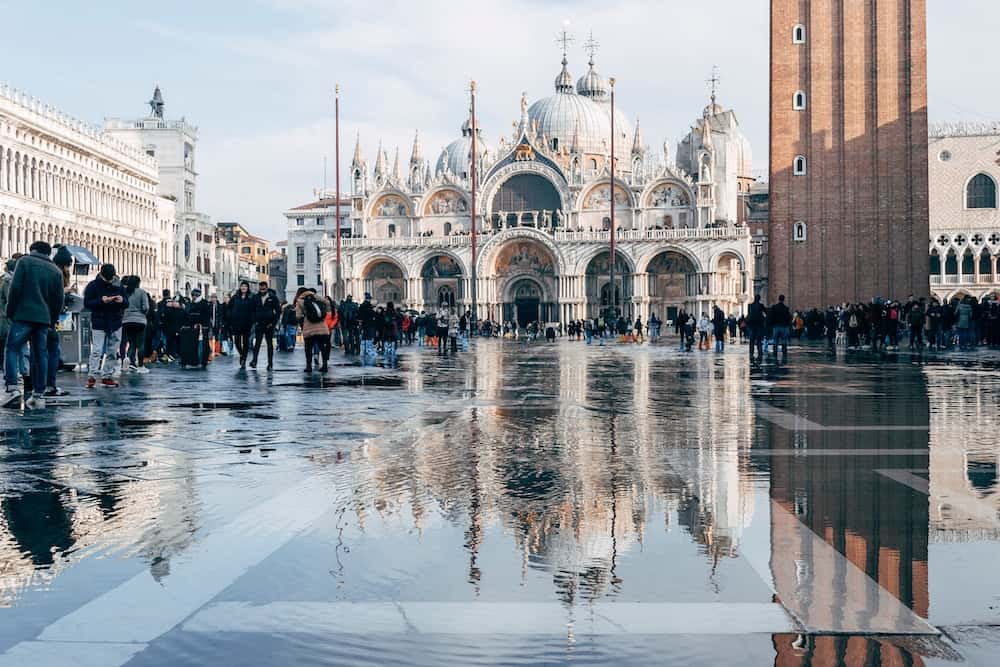
Best Time to Visit St Mark’s Basilica
Early public entry and later afternoon are usually calmer than the busiest middle part of the day.
However, the strongest crowd-avoidance strategy is booking a timed tour rather than arriving at St Mark’s Square and hoping the queue develops compassion.
For the quietest and most atmospheric experience, I recommend the St Mark’s Basilica after-hours tour.
Peak summer, weekends, Carnival, Easter and major religious feasts can be extremely busy. Winter and quieter weekdays usually offer a more manageable experience, although opening schedules may be shorter.
St Mark’s Basilica Dress Code
St Mark’s Basilica requires respectful clothing because it is an active Catholic cathedral.
- Cover shoulders
- Cover knees
- Remove hats inside
- Avoid clothing with offensive slogans or imagery
Bring a lightweight scarf or cover-up in summer. Do not assume staff will ignore the rules because you have already paid for a ticket or tour.
Bags and Luggage at St Mark’s Basilica
Large bags, luggage and bulky backpacks are not permitted inside St Mark’s Basilica.
Carry only a small personal bag if possible. Storage arrangements and permitted bag dimensions can change, and arriving with luggage may cause you to miss your timed entry.
Leave suitcases at your hotel or a luggage-storage facility before visiting. St Mark’s Square is not the place to discover that your wheelie suitcase has become a theological problem.
Can You Take Photos Inside St Mark’s Basilica?
Photography rules inside St Mark’s Basilica are stricter than at many museums and can change depending on the area, service and current policy.
Follow the signs and staff instructions rather than assuming non-flash photography is automatically permitted everywhere. Flash, tripods, filming equipment and disruptive photography are not acceptable.
The terrace provides one of the best legitimate photography opportunities, with clear views over St Mark’s Square, the facade and surrounding buildings. Choose a ticket option including the museum and terrace.
Accessibility at St Mark’s Basilica
The main basilica can accommodate visitors with reduced mobility through designated access arrangements, but the historic building has uneven flooring and some restricted sections.
The museum and terrace require upper-level access and may be considerably less straightforward for wheelchair users or visitors who cannot manage stairs.
The marble floor is visibly uneven in places, so visitors with balance difficulties should move carefully even on the main level.
St Mark’s Campanile has lift access to the viewing level, making it one of Venice’s more accessible elevated viewpoints, although queues and platform conditions should still be considered.
Contact the tour provider before booking when step-free access or specific assistance is essential. A tour may use a standard group entrance that is not the same as the accessible visitor route.
Ready to visit? Book this St Mark’s Basilica and Doge’s Palace tour for the strongest first-time experience, this after-hours tour for atmosphere and fewer crowds, or this reserved-entry ticket if you prefer to explore independently.
Things to See at St Mark’s Basilica
There is far more to see at St Mark’s Basilica than the golden interior visible from the main visitor route. The complex includes the richly decorated facade, atrium, main church, Pala d’Oro, high altar, treasury, museum, original Horses of St Mark, upper loggia and exterior terrace.
The freestanding St Mark’s Campanile is also included in this guide because it forms such an important part of the San Marco complex, but it is a separate building with its own entrance and ticket.
Not every ticket includes every section. Basic basilica admission may exclude the Pala d’Oro, museum and terrace, while the Campanile always requires a separate booking. Check the exact access listed on your St Mark’s Basilica ticket before confirming.
The basilica is also much easier to understand with a guide. Imported marble, ancient sculpture, biblical mosaics, Venetian state symbolism and objects taken from Constantinople all sit beside one another without much obvious explanation.
For a first visit, I highly recommend this guided St Mark’s Basilica and Doge’s Palace tour. It connects the church with the political institutions next door and explains why San Marco became such a powerful symbol of Venice.
My top five: the golden mosaics, Pala d’Oro, original Horses of St Mark, marble floor and terrace. The after-hours experience is also exceptional if you want to see the mosaics illuminated without the usual daytime crowds.
1. St Mark’s Basilica Facade
Look for: five entrance portals, mosaic lunettes, imported columns, Gothic pinnacles and replica horses
Best viewpoint: from the centre and western side of St Mark’s Square
Best for: architecture, sculpture and understanding Venice’s connections with Constantinople
The facade of St Mark’s Basilica is not one uniform medieval design. It developed over centuries as Venice added mosaics, sculptures, coloured marble, columns, Gothic decoration and objects brought from across the eastern Mediterranean.
The lower level contains five deep entrance portals framed by arches and dense sculptural decoration. Above them, mosaic lunettes illustrate scenes connected with Christ and the arrival of St Mark’s relics in Venice.
Many of the marble columns and stone panels were imported or reused from earlier buildings. The variety of colours, sizes and materials is part of the point: the facade displayed Venice’s wealth, reach and ability to absorb prestigious objects from other cultures into its own visual identity.
The upper level was transformed further during the Gothic period with pinnacles, statues and elaborate architectural additions. Four gilded horses stand above the central entrance, but the animals visible outside today are replicas. The ancient originals are protected inside St Mark’s Museum.
Take time to examine the facade from different distances. From the square, the whole building reads as one extravagant composition. From closer up, it becomes a chaotic collection of mismatched columns, carvings, mosaics and trophies that somehow still works.
See the facade from above: choose a ticket option including St Mark’s Museum and terrace for close views of the mosaics, sculptures and replica horses.
2. The Portrait of the Four Tetrarchs
Location: exterior corner beside the Porta della Carta and Doge’s Palace
Material: purple porphyry
Look for: four nearly identical rulers embracing in pairs and the missing foot section
The Portrait of the Four Tetrarchs is embedded into the basilica’s exterior near the corner shared with Doge’s Palace.
Unlike the four horses above the main facade, the Tetrarchs displayed outside are the ancient sculpture itself, not a modern replica.
The group was carved from imperial purple porphyry and depicts four Roman rulers embracing in pairs. It is generally associated with the Tetrarchy introduced under Emperor Diocletian, when authority over the Roman Empire was divided among two senior and two junior emperors.
The figures appear deliberately similar rather than individually recognisable. Their rigid poses, matching armour and embrace communicate unity, loyalty and shared imperial power.
The sculpture originally stood in Constantinople and was brought to Venice following the Fourth Crusade and sack of the city in 1204.
One figure is missing part of a foot and base. A matching fragment discovered in Istanbul near the former Byzantine imperial centre strongly supports the sculpture’s Constantinopolitan origin.
It is surprisingly easy to miss because it stands at waist height and is usually surrounded by visitors moving between the basilica and Doge’s Palace.
3. The Atrium and Old Testament Mosaics
Location: vestibule before the main church
Look for: Creation dome, stories of Noah, Abraham, Joseph and Moses
Best for: seeing some of the basilica’s clearest narrative mosaics
The atrium wraps around the western end of the basilica and prepares visitors for the main interior with a sequence of mosaics illustrating stories from the Old Testament.
Among the most important is the Creation dome, where concentric scenes represent the creation of the world, Adam and Eve, the Fall and expulsion from Eden.
Other sections follow the stories of Cain and Abel, Noah, Abraham, Joseph and Moses. The visual sequence leads symbolically from the Old Testament toward the life of Christ represented more extensively inside the church.
The mosaics were influenced by Byzantine models and illuminated manuscripts, but they were created over time by artists working within the Venetian environment.
Do not rush through the atrium simply because the main church lies ahead. Some of its mosaics are easier to study than those inside because the narrative scenes are organised into clearer sequences.

4. Golden Mosaics and Domes
Approximate area: around 8,000 square metres
Main subjects: Christ, the Virgin, apostles, prophets, biblical narratives and St Mark
Best experience: after-hours when the mosaics are illuminated
The golden mosaics are the defining feature of St Mark’s Basilica. They cover approximately 8,000 square metres across the domes, vaults and upper walls, earning San Marco its nickname, the Church of Gold.
The gold-ground tesserae are not solid chunks of gold. A very thin layer of gold leaf is enclosed between layers of glass, allowing the surfaces to catch and reflect light.
The earliest surviving mosaics date from the medieval period, but decoration continued, deteriorated and was replaced across centuries. Some later mosaics were based on designs by major Venetian artists, including Titian, Tintoretto, Veronese and others.
The mosaics depict scenes from the Old and New Testaments, Christ, the Virgin, apostles, prophets, saints and episodes connected with St Mark.
The main domes follow a broad theological sequence. The Ascension dome, Pentecost dome and other major compositions guide the visitor through Christ’s life, the mission of the apostles and the foundation of the Church.
The dim daytime interior can make the mosaics difficult to appreciate properly. They change dramatically when illuminated, which is one reason the St Mark’s Basilica after-hours tour is such a strong option.
My top choice for the mosaics: book this after-hours tour of St Mark’s Basilica. The quieter setting and artificial illumination make the gold surfaces much easier to appreciate.

5. Marble Mosaic Floor
Approximate area: more than 2,000 square metres
Techniques: opus sectile and opus tessellatum
Look for: geometric patterns, birds, animals and visibly uneven sections
It is easy to spend the entire visit looking upward, but the marble floor is one of the basilica’s masterpieces.
The pavement covers more than 2,000 square metres with geometric patterns, circles, interlocking shapes, animals and symbolic motifs formed from coloured marble and stone.
Two principal techniques appear throughout:
- Opus sectile: larger pieces of coloured stone cut into precise geometric shapes and fitted together
- Opus tessellatum: smaller tesserae arranged into patterns and figurative designs
Some parts of the floor rise and fall visibly because the basilica has settled unevenly on the soft lagoon foundations over centuries.
The undulation is part of the experience, although it is also a conservation problem and can make walking difficult for visitors with balance or mobility concerns.
Look for peacocks, lions, griffins and other animals woven into the geometric decoration. Many carried religious, political or moral meaning rather than being included as simple ornament.
6. High Altar and Relics of St Mark
Location: beneath the ciborium in the sanctuary
Contains: relics traditionally identified as those of St Mark
Important: the saint’s present shrine is beneath the high altar, not in the crypt
The high altar stands beneath an elaborate ciborium supported by carved columns. Beneath it are the relics traditionally identified as those of St Mark the Evangelist, Venice’s patron saint.
According to Venetian tradition, two merchants removed the relics from Alexandria in 828 and concealed them beneath pork to prevent Muslim officials from inspecting the cargo.
The story became central to Venetian identity and appears in mosaics on and inside the basilica. It should be understood as a mixture of historical tradition, religious narrative and civic legend rather than a completely documented modern event.
The first church dedicated to St Mark was built to house the relics. After later rebuilding and uncertainty about their location, the remains were ceremonially rediscovered according to medieval tradition.
The relics were transferred to their present position beneath the high altar in the 19th century. The crypt lies below the church and remains historically important, but it should not be described as St Mark’s current tomb.
Special visits, including some versions of the after-hours tour, may include access to the crypt. Check the current itinerary when booking.

7. Pala d’Oro
Location: behind the high altar
Materials: gold, gilded silver, Byzantine enamels, pearls and gemstones
Access: requires an option that explicitly includes the Pala d’Oro
The Pala d’Oro is one of the most spectacular medieval altarpieces in Europe. It stands behind the high altar and combines Byzantine enamel panels with goldwork, pearls, gemstones and an elaborate Gothic frame.
The object developed in several stages rather than being created at one moment. Earlier enamel panels were commissioned or acquired during different periods, and the altarpiece was enlarged, rearranged and reframed under later Doges.
The current composition includes images of Christ, archangels, apostles, prophets, saints and scenes connected with St Mark.
Published counts vary, but the Pala d’Oro is generally described as containing more than 2,000 pearls and precious stones, including a mixture of pearls, emeralds, sapphires, garnets, amethysts, rubies and other gems.
The exact breakdown differs between sources and should be treated as approximate. What matters is the scale: the surface is packed with stones and enamels rather than decorated with a few isolated jewels.
The translucent Byzantine enamels are as important as the gemstones. Their extraordinarily fine figures and intense colours are among the strongest reasons to pay for access beyond the main basilica.
The Pala d’Oro is not automatically included with every basilica ticket or tour. Select an option that explicitly lists it when booking your St Mark’s Basilica ticket.
Do not accidentally skip it: choose a full-access ticket that lists the Pala d’Oro, or confirm its inclusion before booking a guided tour.
8. Icon of the Nicopeia
Subject: the Virgin Mary holding the Christ Child
Origin: Byzantine world, brought from Constantinople
Best for: understanding the basilica’s religious and imperial connections
The Icon of the Nicopeia is one of the basilica’s most important devotional images, although it receives far less attention than the mosaics or horses.
The icon depicts the Virgin Mary holding the Christ Child and was associated with military protection and victory in the Byzantine world.
It was brought to Venice from Constantinople after the Fourth Crusade and became an object of major devotion within the basilica.
Its presence demonstrates how Venice did not merely display Byzantine art as foreign treasure. The Republic absorbed these objects into its own religious ceremonies, legends and political identity.
9. Treasury of St Mark’s
Collection: reliquaries, chalices, vessels, enamels and carved stone objects
Origins: Byzantine, Islamic and Western workshops
Access: may require separate or changing admission arrangements
The Treasury of St Mark’s preserves liturgical vessels, reliquaries, chalices, carved stone objects, enamels and other precious works accumulated over centuries.
Much of the collection has Byzantine origins, and several of its most important objects reached Venice from Constantinople following the Fourth Crusade in 1204.
The treasury also includes objects connected with Islamic and Western workshops, reflecting Venice’s position between different trading, political and artistic worlds.
Notable types of objects include rock-crystal vessels, Byzantine enamelled reliquaries, chalices, liturgical containers and an unusual vessel shaped like a miniature building.
The collection has varied origins. Some objects arrived through trade, commissions and gifts, while many of its most famous Byzantine pieces were brought from Christian Constantinople after the Fourth Crusade.
Treasury access can vary and may not be bundled with every visitor ticket. Check the current inclusions when booking rather than assuming it is part of the standard route.
10. St Mark’s Museum and Loggia dei Cavalli
Location: upper level of the basilica
Highlights: original horses, historic mosaics, textiles and close views into the church
Access: ticket must include the museum and loggia
St Mark’s Museum is worth the additional access. It occupies the upper level of the basilica and contains objects connected with the building’s history, decoration and restoration.
The collection includes original mosaic fragments, illuminated manuscripts, liturgical textiles, Persian carpets and other works that were removed from or associated with the basilica.
The museum also gives you an elevated view into the main church, allowing you to appreciate the domes and mosaics from much closer than the ground-level route.
Most importantly, it contains the original Horses of St Mark. The museum route then leads onto the Loggia dei Cavalli and exterior terrace.
Choose a ticket option including the Museum and Loggia dei Cavalli if the horses and terrace are priorities.

11. Original Horses of St Mark
Originals: inside St Mark’s Museum
Replicas: on the exterior facade above the main entrance
Origin: ancient quadriga, exact date and original location disputed
The four gilded copper-alloy Horses of St Mark are the star attraction of the museum.
The ancient originals once stood on the exterior loggia but were moved indoors to protect them from weathering and pollution. The horses visible outside today are replicas.
Their exact age, maker and original location remain disputed. They probably formed part of a monumental quadriga created during classical antiquity, but confident attributions to a specific sculptor or century should be treated cautiously.
Their later history is better documented. The horses stood in Constantinople before being taken to Venice following the Fourth Crusade in 1204.
Napoleon later removed them to Paris after the fall of the Venetian Republic. They were returned to Venice after his defeat and placed back on the basilica before eventually being moved inside for conservation.
Seen from close up, they are much more imposing than the exterior replicas suggest. Their surfaces still show traces of gilding as well as deliberate scoring that may have reduced glare and helped create a more realistic appearance.
12. St Mark’s Basilica Terrace
Access: through the museum and Loggia dei Cavalli
Views: St Mark’s Square, Doge’s Palace, Campanile and lagoon
Best for: photography and examining the facade at close range
The exterior terrace gives you one of the best views over St Mark’s Square and is absolutely worth including if your ticket allows enough time.
From the Loggia dei Cavalli, you can look directly across the square toward the Campanile, Procuratie buildings and waterfront.
The terrace also provides close views of the upper facade, mosaics, roofline and the replica horses positioned above the central entrance.
Unlike the Campanile, which gives you a much higher panorama, the terrace keeps you close to the architectural details and action of the square.
I would prioritise the terrace over a rushed basic visit because it adds the museum, original horses, upper interior view and exterior panorama rather than just one viewpoint.
For terrace access: select a St Mark’s Basilica ticket including the museum and Loggia dei Cavalli. Do not assume terrace entry is included with the cheapest option.

13. St Mark’s Campanile
Height: approximately 98.6 metres
Access: separate entrance and ticket
Getting up: lift to the viewing level
Best for: the highest panoramic view over Venice and the lagoon
St Mark’s Campanile is a separate building from the basilica. It stands freestanding in St Mark’s Square and requires its own ticket and entry queue.
At approximately 98.6 metres, it is the tallest structure in Venice and offers panoramic views across the rooftops, lagoon and surrounding islands.
The tower developed over many centuries and served several purposes, including as a bell tower, watchtower and navigational landmark.
The historic Campanile collapsed unexpectedly in 1902. Remarkably, no one was killed, although a caretaker’s cat reportedly did not survive.
The tower was reconstructed in the same location and inaugurated in 1912, following the principle of rebuilding it “where it was and as it was.”
A lift takes visitors to the upper viewing level, so you do not need to climb hundreds of stairs. This makes it one of the most accessible high viewpoints in Venice.
The view is best in clear weather. Unlike most Venice viewpoints, the city’s narrow canals are not especially visible from this height, but you get an excellent sense of the lagoon, islands and dense urban landscape.
I would add the Campanile before or after visiting the basilica rather than treating it as part of the same admission.
Check St Mark’s Campanile ticket availability
My recommended St Mark’s route: study the facade and Tetrarchs outside → enter the atrium and main basilica → see the high altar and Pala d’Oro → visit the museum and original horses → step onto the terrace → add the separate Campanile if visibility is good.
My overall recommendation: book this St Mark’s Basilica and Doge’s Palace guided tour for the best first-time overview. Choose the after-hours basilica tour if seeing the illuminated mosaics with fewer people is the priority.

Where to Stay Near St Mark’s Basilica
Stay in San Marco if you want the easiest access to St Mark’s Basilica, Doge’s Palace and the main sights around St Mark’s Square. You will pay more for the location, but being able to reach the basilica before the biggest daytime crowds arrive is a genuine advantage.
San Marco is particularly useful for a short first visit, an early St Mark’s Basilica and Doge’s Palace tour or an evening after-hours basilica visit.
Castello is the best alternative if you want to remain close to the basilica while gaining slightly quieter streets and more local restaurants. The western end of Castello begins immediately beside Doge’s Palace, so some hotels technically outside San Marco are still only a few minutes from the square.
For a more local atmosphere and better-value restaurants, consider Dorsoduro or Cannaregio. They are less convenient for a very early San Marco booking, but better if you are staying in Venice for several days and do not want to spend every evening in the busiest part of the city.
Read my complete guide to where to stay in Venice for a full breakdown of the sestieri, or compare the best Venice hotels with canal views.
CLOSEST LUXURY
A historic 5-star hotel just off St Mark’s Square, best if you want an elegant Venetian stay, lagoon views and almost no commute to the basilica.
LAGOON VIEWS
A polished waterfront hotel beside San Zaccaria, best if you want lagoon views, easy vaporetto access and St Mark’s Square only a short walk away.
BEST VALUE NEAR SAN MARCO
A modern, well-located hotel close to St Mark’s Square, best if you want comfort and convenience without paying full luxury-hotel prices.
Choosing Your Venice Accommodation?
In Venice, a hotel that looks close on the map can still involve bridges, stairs, boats and dragging luggage through crowded lanes. Choose your area first, then decide whether the canal view is worth the splurge.
These two guides cover both decisions:

Best areas and accommodation for your trip

Venice Hotels with Canal Views
Canal-view stays for different budgets
Who Was St Mark?
St Mark the Evangelist was one of the four traditionally recognised Gospel writers and was closely associated in Christian tradition with St Peter.
Christian tradition connects Mark with St Peter, whose preaching he is believed to have recorded, and with the early Christian community in Alexandria.
His symbol is the winged lion, which became the emblem of Venice and appears across the city, its former territories and the wider Adriatic world.
The symbolism is often connected with the opening of Mark’s Gospel, where a voice cries out in the wilderness. The lion also became an extremely useful political symbol, representing strength, authority and the supposed divine protection of Venice.
According to Venetian tradition, Mark once travelled through the lagoon and received a vision in which an angel told him that his body would one day rest there.
The famous phrase Pax tibi Marce, evangelista meus, meaning “Peace to you, Mark, my evangelist,” appears in the open book held by many Venetian lions.
This legend helped justify Venice’s adoption of Mark as its patron saint after merchants brought relics identified as his remains from Alexandria in the 9th century.
History of St Mark’s Basilica
The present St Mark’s Basilica is the third major church built on or near the site to house the relics traditionally identified as those of St Mark.
According to Venetian tradition, merchants Buono da Malamocco and Rustico da Torcello removed the relics from Alexandria in 828. The story claims they concealed the remains beneath pork to discourage Muslim customs officials from examining the cargo.
The episode appears in the basilica’s mosaics and became one of Venice’s most important civic legends. It should be understood as a blend of religious tradition, political storytelling and historical memory rather than a fully documented modern account.
An early church was constructed to receive the relics but was later damaged during political unrest and fire. A replacement followed, before construction of the present basilica began in the 11th century.
The current building was consecrated in 1094, but that date did not mark the end of construction. Its golden mosaics, marble facing, sculptures, treasury, Gothic roofline and other decorations developed across many later centuries.
Key dates in the history of St Mark’s Basilica:
- 828: Venetian merchants traditionally bring St Mark’s relics from Alexandria.
- 9th century: The first church dedicated to St Mark is built beside the ducal residence.
- 976: Fire and political unrest damage the earlier church and surrounding palace.
- 11th century: Construction of the present basilica begins.
- 1094: The current church is consecrated.
- 1204: Important sculptures, columns and treasures reach Venice following the Fourth Crusade and sack of Constantinople.
- 13th–15th centuries: The facade, domes, mosaics and Gothic decorative elements continue to develop.
- 1797: The Venetian Republic falls.
- 1807: St Mark’s becomes the cathedral of Venice and seat of the patriarch.
- 19th–21st centuries: Continuous campaigns address damage caused by age, pollution, structural movement and flooding.
The basilica’s architecture was strongly influenced by Byzantine churches, particularly the Church of the Holy Apostles in Constantinople. Its Greek-cross plan, five principal domes and extensive mosaics are very different from the long rectangular form of many Western European cathedrals.
The exterior was transformed by materials accumulated through trade, diplomacy, commissions and warfare. After the Fourth Crusade, Venice brought major works from Constantinople, including the Horses of St Mark, the Tetrarchs and numerous precious objects now associated with the treasury.
These objects were not displayed neutrally. Venice incorporated them into a new political and religious story in which the Republic presented itself as the heir to Byzantine prestige and a divinely protected Christian power.
The history is complicated, which is why I recommend this guided St Mark’s Basilica and Doge’s Palace tour. It connects the church, imported treasures and Venetian government rather than presenting the basilica as a random collection of shiny objects.
St Mark’s Basilica as the Ducal Chapel
St Mark’s Basilica was not originally Venice’s cathedral. During the Venetian Republic, it functioned as the official chapel of the Doge and stood under ducal rather than episcopal authority.
The entire church fulfilled this role, although particular areas and ceremonial positions were reserved for the Doge, government officials and visiting dignitaries.
Its location beside Doge’s Palace allowed religion and government to operate within one closely connected monumental complex. Important processions, victories, diplomatic events and state ceremonies centred on the basilica and square.
The church also held treasures, relics and images that reinforced Venice’s political identity. St Mark was not only a religious patron but the symbolic protector of the Republic.
Venice’s cathedral during most of this period was San Pietro di Castello in the eastern part of the city. St Mark’s only became the cathedral and seat of the patriarch in 1807, after the fall of the Republic.
The physical relationship between church and palace becomes clearest when you visit both with one guide. This St Mark’s Basilica and Doge’s Palace tour is my strongest recommendation for understanding historic Venice.
St Mark’s Basilica FAQ
Is St Mark’s Basilica the Cathedral of Venice?
Yes. St Mark’s Basilica is the cathedral church of Venice today and the seat of the Patriarch of Venice.
However, it did not serve as the city’s cathedral during most of the Venetian Republic. It was the official chapel of the Doge, while San Pietro di Castello was the cathedral. St Mark’s became Venice’s cathedral in 1807.
Is Venice Cathedral the Same as St Mark’s Basilica?
Yes. Venice Cathedral, St Mark’s Cathedral, Basilica di San Marco and St Mark’s Basilica all refer to the same church in St Mark’s Square.
The term Venice Duomo is also sometimes used by visitors, although locals and official sources generally refer to it as the Basilica di San Marco.
Is St Mark’s Basilica Worth Visiting?
Yes, St Mark’s Basilica is absolutely worth visiting. Its approximately 8,000 square metres of mosaics, uneven marble floor, Pala d’Oro, original bronze horses and terrace make it unlike any other church in Venice.
A quick visit to the basic interior only shows part of the complex. I recommend adding the Pala d’Oro, museum and terrace or booking a guided tour that explains the mosaics and political history.
My top choice: book this St Mark’s Basilica and Doge’s Palace guided tour for the most complete introduction to historic Venice.
Is St Mark’s Basilica Free to Enter?
Tourist access and the available visitor routes are now organised through timed tickets and different access combinations.
Do not assume that walking into the basic church route automatically includes the Pala d’Oro, museum, original horses or terrace.
Reserve a St Mark’s Basilica ticket and choose the access level that includes the sections you want to see.
Do You Need to Book St Mark’s Basilica in Advance?
Yes, I recommend booking St Mark’s Basilica in advance. It is one of Venice’s busiest attractions, and desirable timed entries and guided tours can sell out.
Advance booking is particularly important during summer, weekends, Carnival, Easter, public holidays and major events in Venice.
Book ahead: reserve a St Mark’s Basilica ticket, this basilica and palace tour or the popular after-hours tour.
What Is the Best St Mark’s Basilica Tour?
For most first-time visitors, the best option is this St Mark’s Basilica and Doge’s Palace guided tour.
The two buildings formed the religious, ceremonial, political and judicial centre of the Venetian Republic, so visiting them together gives you the strongest historical context.
- Best overall: Basilica and Doge’s Palace guided tour
- Best atmosphere: St Mark’s Basilica after-hours tour
- Basilica only: Guided St Mark’s Basilica tour
- One-day package: Basilica, palace, city walk and gondola ride
Can You Visit St Mark’s Basilica Without a Tour?
Yes. You can visit independently by booking a reserved St Mark’s Basilica ticket.
Choose the full-access option if you want to see the Pala d’Oro, museum, original horses and terrace rather than only the main church.
I still recommend a guide for a first visit. The mosaics, relic traditions, Byzantine objects and relationship with the Venetian government are difficult to piece together from the visitor route alone.
What Does a St Mark’s Basilica Ticket Include?
The exact inclusions depend on the option selected. A basic ticket may cover only the main basilica, while fuller options can add:
- Pala d’Oro
- St Mark’s Museum
- Original Horses of St Mark
- Loggia dei Cavalli
- Exterior terrace
The treasury may have separate or changing access arrangements. St Mark’s Campanile is always a separate attraction with its own ticket.
Read the current inclusion list on the ticket page before confirming.
Is the Pala d’Oro Worth Seeing?
Yes, the Pala d’Oro is worth seeing, particularly if you are interested in Byzantine art, enamel work, medieval goldsmithing or the history of Venice’s relationship with Constantinople.
The altarpiece contains Byzantine enamel panels, goldwork and more than 2,000 pearls and precious stones including emeralds, sapphires, garnets, amethysts, rubies and other stones.
Access is not included with every basic ticket. Choose a ticket option explicitly listing the Pala d’Oro.
Is St Mark’s Museum and Terrace Worth It?
Yes. I think the museum and terrace are among the best additions to a basic basilica visit.
The museum contains the original Horses of St Mark, while the upper route gives you closer views of the mosaics and access to the exterior terrace overlooking St Mark’s Square.
The terrace gives you close views of the facade, replica horses and Campanile, along with sweeping views over St Mark’s Square and the surrounding architecture.
Select a ticket including the Museum and Loggia dei Cavalli.
Are the Horses Outside St Mark’s Basilica Real?
No. The gilded horses visible on the exterior facade are replicas.
The ancient originals are protected inside St Mark’s Museum, where you can examine their surfaces and remaining gilding at close range.
Book a ticket including the museum if seeing the original horses is important to you.
Are the Tetrarchs Outside St Mark’s Basilica Original?
Yes. The porphyry group of the Four Tetrarchs embedded near the corner beside Doge’s Palace is the ancient sculpture rather than a modern replica.
Part of one figure’s foot and base is missing. A matching fragment is preserved in Istanbul.
Where Are St Mark’s Remains?
The relics traditionally identified as those of St Mark are beneath the high altar of St Mark’s Basilica.
The crypt lies below the basilica and is connected with the earlier history of the saint’s shrine, but it should not be described as the present location of the tomb.
Some versions of the after-hours basilica tour may include the crypt. Check the current itinerary before booking.
How Long Do You Need at St Mark’s Basilica?
Allow around 45–60 minutes for the main church and approximately 1.5–2 hours if you include the Pala d’Oro, museum, original horses and terrace.
Allow a substantial part of the morning or afternoon when combining the basilica with Doge’s Palace on this guided tour.
What Is the Dress Code for St Mark’s Basilica?
Cover your shoulders and knees, remove hats and avoid clothing with offensive imagery or slogans.
Bring a lightweight scarf or cover-up during summer. Purchasing a ticket does not exempt you from the dress code.
Can You Take Bags into St Mark’s Basilica?
Small personal bags are generally the safest option. Large luggage and bulky backpacks are not permitted and may need to be stored before entry.
Leave suitcases at your hotel or a dedicated luggage-storage facility. Arriving with a large bag can cause you to miss a timed entry or tour.
Can You Take Photos Inside St Mark’s Basilica?
Photography rules can vary by area and current church policy. Follow the signs and staff instructions rather than assuming photography is permitted throughout the basilica.
Flash, tripods, filming setups and disruptive photography are not appropriate.
The exterior terrace is one of the best photography locations. Choose a ticket including the museum and terrace.
Can You Attend Mass at St Mark’s Basilica?
Yes. St Mark’s Basilica is an active Catholic cathedral and holds regular religious services.
Mass attendance is separate from tourist sightseeing. Arrive respectfully, follow the designated entrance and do not move around taking photographs during the service.
Is St Mark’s Basilica Wheelchair Accessible?
The main basilica can accommodate visitors with reduced mobility through designated access arrangements, although the historic floor is uneven.
The museum, upper loggia and terrace may be more difficult or inaccessible depending on the available route and lift arrangements.
Contact the basilica or tour provider before booking if step-free access is essential.
Is St Mark’s Campanile Included with the Basilica?
No. St Mark’s Campanile is a separate freestanding building with its own entrance and ticket.
The Campanile provides the highest panoramic view, while the basilica terrace gives you a lower but more detailed view of St Mark’s Square and the church facade.
Book your St Mark’s Campanile ticket separately.
Can You Combine St Mark’s Basilica, Doge’s Palace and a Gondola Ride?
Yes. This Venice in a day package combines St Mark’s Basilica, Doge’s Palace, Bridge of Sighs, prisons, a guided walk and gondola ride.
I recommend it for first-time visitors with one full sightseeing day, cruise passengers and anyone who would rather have the main reservations coordinated in one booking.
Ready to book? Choose this basilica and Doge’s Palace tour for the best first visit, this after-hours tour for the most atmospheric experience or this basilica, palace and gondola package for one complete Venice day.
Planning a Trip to Venice?
Venice is compact, but the major attractions use separate tickets, entrances, dress codes and timed reservations. It is very easy to spend half a day standing in lines while insisting that you are “just being spontaneous.”
Book St Mark’s Basilica, Doge’s Palace, the Campanile and any major tour first. Then build the rest of your itinerary around neighbourhood walks, cicchetti, churches, viewpoints and enough unscheduled time to get lost without causing a small logistical emergency.
My Venice itinerary explains how to organise the city across one, two, three or five days.
Read next:
Travel Insurance
Good travel insurance is an absolute must when traveling abroad, and I’ve learned that the hard way!
Now I always get insured before we leave and Travel Insurance Masters is my go-to platform to find the best insurance options for the specific trip.
The TIM platform works as a search engine and suggests the best insurance company and insurance plan for your criteria so you don’t end up paying more for things you don’t need! It also takes into account your age, nationality, destination etc. which can greatly impact the final price.
You can get your quote & provider recommendations here.
