This site uses affiliates. Thank you for buying through our links and supporting this blog.


Visiting Doge’s Palace in Venice: Tickets, Tours and What to Expect

Doge’s Palace is one of the most spectacular places to visit in Venice, with monumental staircases, lavish government chambers, enormous paintings, secret passageways and austere prison cells all contained within the same extraordinary building.
Palazzo Ducale is simply the Italian name for Doge’s Palace. The Gothic palace beside St Mark’s Basilica was the residence of the Doge and the political, administrative and judicial centre of the Venetian Republic for centuries.
It took me several visits to Venice before I finally went inside, and I genuinely regret waiting so long. I am not usually someone who gets overly excited about museums, but Doge’s Palace completely won me over. The Chamber of the Great Council and the Golden Staircase were the biggest highlights for me. The scale is difficult to understand from photographs.
In this complete Doge’s Palace guide, I’ll explain which ticket or tour to book, what the standard route includes, how long you need and what you will see inside. I’ll also take you through the chambers, prisons, artworks and political history that make Palazzo Ducale so important.
I highly recommend visiting with a guide. There are information panels inside, but the palace is complicated. A good guide explains what each chamber was used for, how Venice’s unusually elaborate government operated, why one Doge’s portrait is covered by a black veil, how fires transformed the building and what the paintings were intended to communicate.
Without that context, the rooms are impressive. With it, the palace becomes the key to understanding how Venice accumulated, displayed and controlled its extraordinary power.

In a hurry? Book your Doge’s Palace essentials:
Best overall experience:
Doge’s Palace and St Mark’s Basilica guided tour
Best palace-only guided option:
Doge’s Palace, Bridge of Sighs and New Prisons tour
Best for hidden rooms:
Secret passages, prisons and St Mark’s Basilica tour
Best all-in-one package:
Venice in a day with Doge’s Palace, basilica and gondola ride
Best evening option:
St Mark’s Basilica after hours with optional Doge’s Palace
Prefer to explore independently?
Reserve your Doge’s Palace entrance ticket
Doge’s Palace at a Glance
Doge’s Palace is located on the edge of St Mark’s Square beside St Mark’s Basilica. It was simultaneously a residence, seat of government, courthouse, administrative centre and prison rather than simply a decorative royal palace.
| Italian name | Palazzo Ducale |
| Location | St Mark’s Square, beside St Mark’s Basilica |
| Known for | Venetian Gothic architecture, government chambers, monumental artwork, Bridge of Sighs and prisons |
| Time needed | Approximately 1.5 hours for a quicker visit or 2–3 hours for a more complete visit |
| Best way to visit | With a guided Doge’s Palace and St Mark’s Basilica tour |
| Standard visit | Courtyard, loggias, Doge’s Apartments, institutional chambers, Armoury, Bridge of Sighs and New Prisons |
| Hidden areas | Piombi, Pozzi, torture chamber, secret archives and Casanova-related rooms require a Secret Itineraries tour |
| Best combination | Doge’s Palace and St Mark’s Basilica |
| Limited time in Venice | Venice in a day with palace, basilica and gondola ride |
The standard visitor route moves through several floors and wings rather than following one simple level. You pass from the public and ceremonial spaces into the political chambers, judicial rooms, Armoury and prisons, crossing the Bridge of Sighs before returning to the palace.
The important distinction is that the standard route enters the New Prisons. It does not normally include the older Pozzi cells, Piombi attic prisons, torture chamber, secret archives or Casanova’s reconstructed cells. For those, book the Secret Itineraries tour.


Is Doge’s Palace Worth Visiting?
Yes, Doge’s Palace is absolutely worth visiting. In my opinion, it is one of the best major attractions in Venice and far more interesting than simply admiring the exterior from St Mark’s Square.
I had already visited Venice several times before going inside and was not expecting the palace to affect me as strongly as it did. The courtyard, loggias and ceremonial staircases are beautiful, but the chambers take the opulence to another level.
The paintings are not merely decorative works hung on blank museum walls. They cover ceilings and entire walls, surrounded by carved wood, gilded details, marble fireplaces and architectural decoration designed to overwhelm visiting dignitaries and reinforce the power of the Venetian Republic.
The Chamber of the Great Council is genuinely breathtaking. The room is enormous, the artwork is almost absurdly ambitious and the rows of Doges’ portraits immediately raise questions about the people, politics and carefully controlled image of the Republic.
Then you cross the enclosed Bridge of Sighs into the New Prisons. The transition from gilded ceilings and monumental state rooms to dark corridors and bare cells is stark, uncomfortable and extremely effective.
I would not visit without either doing some serious research first or booking a guide. There is too much history, symbolism and political complexity here to absorb from a few short signs while moving through crowded rooms.
During my visit, maintenance work meant that I could not access parts of the Doge’s Apartments. Temporary room closures and route adjustments can still happen, but the usual visitor route now includes the apartments, institutional chambers, Armoury, Bridge of Sighs and New Prisons.
My recommendation: book this guided Doge’s Palace and St Mark’s Basilica tour. Understanding what the rooms were used for and how the Venetian government operated makes the entire visit substantially more meaningful.

Best Doge’s Palace Tours and Tickets
I highly recommend taking a guided tour of Doge’s Palace. The building is visually overwhelming, the visitor route passes through numerous rooms and the political system behind those rooms was deliberately complicated.
A guide explains how the Great Council, Senate, Collegio, Council of Ten and judicial bodies fitted together, why certain paintings were commissioned, what was destroyed in the palace fires and how Venice used architecture and art to project stability, wealth and divine approval.
There is no single best option for everyone. You can focus entirely on the palace, combine it with St Mark’s Basilica, access the hidden prisons and secret rooms, visit the basilica after hours or package the main Venice highlights with a gondola ride.
| Best for | Tour or ticket |
|---|---|
| Best overall | Doge’s Palace and St Mark’s Basilica guided tour |
| Palace only | Doge’s Palace and New Prisons tour |
| Secret rooms and hidden prisons | Secret passages and St Mark’s Basilica tour |
| One-day Venice package | Doge’s Palace, basilica, Venice walk and gondola ride |
| Evening experience | St Mark’s Basilica after hours with optional Doge’s Palace |
| Independent visit | Reserved-entry Doge’s Palace ticket |
Best Overall: Doge’s Palace and St Mark’s Basilica Tour
For most first-time visitors, I recommend this Doge’s Palace and St Mark’s Basilica guided tour.
The palace and basilica stand beside one another and were deeply connected to the political and ceremonial life of Venice. Seeing them with one guide gives you a more coherent understanding of the Republic than visiting both independently and trying to piece everything together later.
The tour covers the major palace chambers, Bridge of Sighs and New Prisons before or after visiting St Mark’s Basilica. Selected booking options may also include the basilica terraces or an earlier entrance, so check the exact departure and inclusions when booking.
Check availability for the Doge’s Palace and St Mark’s Basilica guided tour
Doge’s Palace and Prisons Tour
Choose this Doge’s Palace and Prisons tour if you want a guided visit focused specifically on the palace without adding St Mark’s Basilica.
The tour takes you through the main public rooms and government chambers before crossing the Bridge of Sighs into the New Prisons. This is the standard prison route, not the restricted Piombi, Pozzi and secret administrative rooms included on the Secret Itineraries tour.
This is the option I would book if you have already visited the basilica or want more time to focus on the artwork, government chambers, judicial history and contrast between the ceremonial palace and prisons.
Book the Doge’s Palace, Bridge of Sighs and New Prisons tour
Secret Itineraries Tour
Book the Secret Itineraries tour if the hidden political machinery and prison history interest you most.
This route enters areas that are not normally open on the standard palace visit, potentially including secret offices, archives, the torture chamber, the Piombi attic prisons and rooms associated with Casanova’s imprisonment and escape.
The route uses narrow passages and steep staircases and is not suitable for everyone. It can be uncomfortable for visitors with restricted mobility, claustrophobia, vertigo or certain health conditions. Young children are also restricted from the official secret route, so check the operator’s current requirements before booking.
This particular tour also combines the secret palace route with the standard palace highlights and St Mark’s Basilica, making it the most comprehensive option in this guide.
Book the Doge’s Palace secret passages and St Mark’s Basilica tour
Venice in a Day with Doge’s Palace, Basilica and Gondola
If you have limited time in Venice and want the major experiences packaged together, book this Venice in a day tour with Doge’s Palace, St Mark’s Basilica and a gondola ride.
The package combines the palace and its prisons with the basilica, a guided walk through central Venice and a traditional gondola ride. It is a packed day, but it removes the need to coordinate several separate reservations and gives first-time visitors a broad introduction to Venice.
I would choose this option for a short Venice stay, cruise stop or first visit with only one full sightseeing day. It is less suitable if you prefer to explore slowly or spend several hours analysing every painting in the palace.
Check availability for the Venice in a day palace, basilica and gondola package
St Mark’s Basilica After Hours with Doge’s Palace
This evening tour of St Mark’s Basilica with optional Doge’s Palace is the best choice if you want a more atmospheric experience after the busiest part of the day.
The exclusive after-hours component applies to St Mark’s Basilica, while the optional palace portion covers Doge’s Palace, its major rooms, the Bridge of Sighs and New Prisons as part of the wider evening experience.
Choose the booking option that explicitly includes Doge’s Palace. The basilica-only version does not include the palace, and the precise starting order can vary.
Book St Mark’s Basilica after hours with the Doge’s Palace upgrade
Doge’s Palace Reserved-Entry Ticket
If you prefer to explore independently, reserve your Doge’s Palace ticket in advance.
Prebooking is especially important during weekends, holidays and the busiest travel months. It secures your visit before popular entry periods sell out and saves you from arriving at St Mark’s Square without a workable plan.
The ticket gives you access to the normal visitor route through the palace, major institutional chambers, Armoury, Bridge of Sighs and New Prisons. It does not include the restricted Secret Itineraries rooms.
I would still choose a guided tour over an independent ticket for a first visit. The building is beautiful enough to impress without explanation, but the history and symbolism are what transform it from an extravagant museum into the political heart of historic Venice.
Check Doge’s Palace reserved-entry ticket availability

Visiting Doge’s Palace
Doge’s Palace is easy to locate, but the visit itself deserves a little planning. Decide whether you want the standard route, a guided combination with St Mark’s Basilica or access to the restricted Secret Itineraries rooms before booking.
My strongest recommendation is to book a guided tour. Even after researching the palace, I found that its rooms, artworks, councils, fires, restorations and political bodies formed a complex web. Having someone connect those pieces gives you a much fuller understanding of both the palace and Venice.
What Is Included in a Doge’s Palace Ticket?
A standard Doge’s Palace ticket covers the normal museum route through the principal palace areas. This usually includes:
- Museo dell’Opera
- Courtyard and loggias
- Golden Staircase
- Doge’s Apartments
- Institutional and judicial chambers
- Chamber of the Great Council
- Chamber of the Scrutinio
- Armoury
- Bridge of Sighs
- New Prisons
Standard admission is normally linked to the wider St Mark’s Square museum circuit, which also includes the Correr Museum, National Archaeological Museum and monumental rooms of the Marciana Library. Check the exact validity and entry conditions listed on your chosen Doge’s Palace ticket.
Restricted areas such as the Piombi, Pozzi, torture chamber and secret government offices are not part of the normal route. Book a Secret Itineraries tour to access those areas.
Standard Route vs Secret Itineraries
The standard route and Secret Itineraries route are not interchangeable. Both explore the political and judicial history of the palace, but they enter different areas.
| Standard Doge’s Palace route | Secret Itineraries route |
|---|---|
| Main ceremonial and institutional chambers | Restricted offices and administrative rooms |
| Chamber of the Great Council | Secret Chancellery and archives |
| Armoury | Torture Chamber |
| Bridge of Sighs | Pozzi ground-floor cells |
| New Prisons | Piombi attic prisons |
| Suitable for most visitors | Narrow passages and steep stairs |
If this is your first visit and you mainly want to see the grand rooms, artwork and Bridge of Sighs, the standard Doge’s Palace guided tour is enough.
If the concealed machinery of government, interrogation rooms and Casanova-related history are your main interests, choose the Secret Itineraries tour.

Doge’s Palace Location and Entrance
Doge’s Palace is on St Mark’s Square beside St Mark’s Basilica, with its two principal facades facing the Piazzetta and the Venetian Lagoon.
The public museum entrance is normally through the Porta del Frumento on the waterfront side of the palace. The ornate Porta della Carta between Doge’s Palace and St Mark’s Basilica historically served as an important ceremonial entrance and is now generally encountered near the end of the visitor route.
You can reach the palace on foot, by vaporetto or by water taxi. Follow signs for San Marco when walking through Venice.
The most useful nearby vaporetto stops include San Marco–Vallaresso, San Marco–Giardinetti and San Zaccaria, depending on the line you use.
Allow extra time for getting lost. Venice’s street signs point optimistically toward San Marco, but the lanes occasionally have other ideas.
Which Doge’s Palace Ticket or Tour Should You Book?
The best option depends on how much of Venice you want to cover and whether you are interested in the standard rooms or restricted areas.
- First visit to Venice: Book the Doge’s Palace and St Mark’s Basilica guided tour. This is my top overall recommendation.
- Already visited the basilica: Choose the focused Doge’s Palace and New Prisons tour.
- Most interested in Casanova, hidden prisons and political secrets: Book the Secret Itineraries tour.
- Only one day in Venice: Book the full-day package with the palace, basilica and gondola ride.
- Prefer an evening visit: Choose the after-hours basilica tour with the Doge’s Palace option.
- Prefer independent sightseeing: Reserve a Doge’s Palace entrance ticket.
Doge’s Palace Opening Hours
Doge’s Palace is generally open daily, with longer hours during the warmer part of the year and shorter winter opening. Selected summer Fridays and Saturdays may also have extended evening hours.
Opening schedules, final admission times and exceptional closures can change, especially during events, maintenance or conservation work. Check the current time listed on your Doge’s Palace booking before arriving.
Do not arrive close to final admission expecting a relaxed visit. The route is extensive, and individual rooms may begin closing before the building’s stated closing time.
How Long Do You Need at Doge’s Palace?
Allow at least 1.5 hours for a relatively quick visit to Doge’s Palace and approximately 2–3 hours if you want to appreciate the rooms, artwork, Armoury, Bridge of Sighs and prisons properly.
- 1–1.5 hours: Fast visit focused on the principal chambers, Bridge of Sighs and prisons
- 2 hours: Comfortable standard visit with time to study the major rooms
- 2–3 hours: Best for independent visitors interested in art, architecture and history
- Half day: Combine the palace with St Mark’s Basilica on this guided tour
- Full day: Book the palace, basilica, city walk and gondola package
Queueing, security and waiting for a tour to assemble are additional. Do not schedule another timed attraction immediately after your expected finishing time.

Best Time to Visit Doge’s Palace
The best time to visit Doge’s Palace is early in the day or later in the afternoon, outside the busiest period around St Mark’s Square.
However, the best strategy is not simply turning up early and hoping for the best. Reserve your ticket or book a guided tour before your visit so you know when and how you are entering.
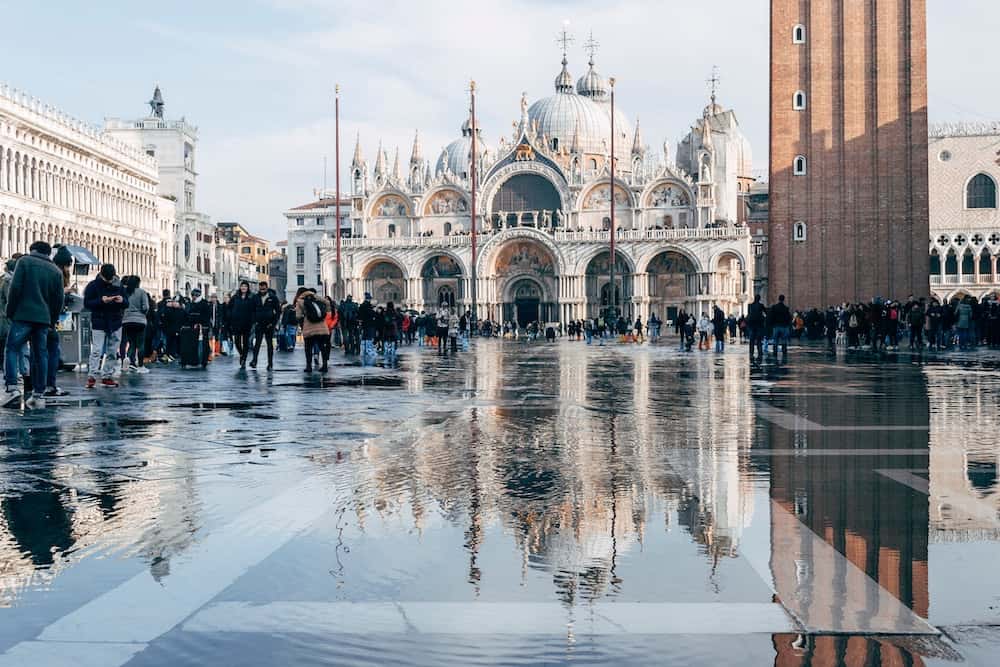
Peak summer, weekends, public holidays, Carnival and major events bring heavier crowds. Winter can be considerably calmer, although shorter daylight and occasional high-water conditions affect the wider Venice experience.
My recommendation: book the earliest suitable guided departure you can realistically reach without sprinting through Venice before breakfast.
Can You Take Photos Inside Doge’s Palace?
Personal photography is generally permitted inside Doge’s Palace without flash, although individual artworks, temporary exhibitions or areas undergoing conservation may have additional restrictions.
Follow the signs and instructions in each room. Tripods, professional equipment and anything that obstructs the visitor route may be restricted.
The chambers are often darker than they appear in photographs, so a phone or camera with decent low-light performance is useful. More importantly, remember to look up from the screen. The ceilings are where Venice decided subtlety was for other republics.
Accessibility at Doge’s Palace
Much of the standard museum route can be accessed by visitors with reduced mobility, but the historic building contains stairs, narrow transitions and sections where alternative routing may be required.
The standard route is considerably more accessible than the Secret Itineraries tour. The secret route uses steep, narrow staircases and confined passages and is not suitable for wheelchairs or many visitors with mobility, respiratory, balance or claustrophobia concerns.
Contact the museum or tour provider before booking if accessibility affects your visit. Do not assume that every room or special itinerary can be reached by lift.
Ready to visit? I recommend booking this Doge’s Palace and St Mark’s Basilica guided tour for the strongest first-time experience, or this Secret Itineraries tour if you want access to the hidden rooms and prisons.

Things to See Inside Doge’s Palace
There is far more to see inside Doge’s Palace than a series of grand rooms. The standard route moves through the remains of earlier palace structures, the courtyard and loggias, the Doge’s Apartments, government and judicial chambers, the Armoury, Picture Gallery, Bridge of Sighs and New Prisons.
The suggested visitor route is not linear. It moves up and down through several floors and repeatedly crosses between different wings of the building. Follow the marked route rather than trying to navigate the palace by floor.
The rooms become much more interesting once you understand what happened inside them. The art, carved ceilings and gilded decoration were not merely intended to look impressive. They communicated the wealth, stability, military strength and supposed moral authority of the Venetian Republic.
This is why I highly recommend booking a guided tour of Doge’s Palace and St Mark’s Basilica. The building is breathtaking on its own, but having someone explain the paintings, political bodies and purpose of each chamber gives you a much wider understanding of Venice.
The standard Doge’s Palace route usually includes:
- Museo dell’Opera
- Courtyard and Giants’ Staircase
- Loggias and lion’s-mouth denunciation boxes
- Golden Staircase
- Doge’s Apartments
- Main institutional and judicial chambers
- Chamber of the Great Council and Chamber of the Scrutinio
- Armoury and Picture Gallery
- Bridge of Sighs and New Prisons
Access to individual rooms can temporarily change because of exhibitions, events or conservation work. If one particular room or artwork is important to you, check current notices before your visit.
My top five: the Golden Staircase, Chamber of the Great Council, Collegio Chamber, Bridge of Sighs and New Prisons. The first three show the Republic at its most theatrical and powerful; the prisons reveal the much darker system operating behind all that gold.
1. Museo dell’Opera
Location: ground floor near the beginning of the standard route
Look for: original medieval capitals, sculptures and traces of an earlier palace wall
Best for: architecture, symbolism and understanding the exterior facade
The standard visit begins on the ground floor with the Museo dell’Opera, a six-room museum displaying original sculptures and architectural elements removed from the exterior of Doge’s Palace.
By the mid-19th century, parts of the palace had deteriorated so severely that its survival was in question. A major restoration programme began in 1876, and 42 particularly fragile capitals from the ground-floor arcade and upper loggia were removed and replaced with copies.
The originals were restored and placed inside the Museo dell’Opera, together with other sculptures and fragments from the facades. Many are masterpieces of 14th- and 15th-century Venetian sculpture.
The imagery is not random decoration. The capitals depict virtues, professions, plants, animals, planets, historical figures, moral lessons and political ideas. They formed an elaborate visual programme intended to communicate how Venetian society understood good government and its place in the world.
The rooms are also crossed by a wall built from large stone blocks, surviving from an earlier version of Doge’s Palace. It is an easy detail to overlook, but it helps reveal how many times the complex was rebuilt and expanded.
I would not rush through this section. The sculptures make much more sense before or after examining the replicas on the exterior facade.

2. Courtyard and Giants’ Staircase
Location: immediately inside the palace
Look for: Giants’ Staircase, Foscari Arch, Renaissance wing and wellheads
Best for: architecture and one of the strongest first impressions inside the palace
The central courtyard is one of the most beautiful parts of Doge’s Palace. It gives you a clear view of the contrast between the older Gothic wings and the more ornate Renaissance wing constructed after the fire of 1483.
The northern side is enclosed by the wing connecting Doge’s Palace to St Mark’s Basilica, which served as the Doge’s chapel. Two elaborate bronze wellheads stand in the courtyard, while the surrounding arcades, balconies and carved details create an almost overwhelming amount to examine.
The main highlight is the Giants’ Staircase, or Scala dei Giganti, designed by Antonio Rizzo as the palace’s ceremonial entrance. The staircase takes its name from the monumental statues of Mars and Neptune sculpted by Jacopo Sansovino and installed at the top in 1565.
Mars and Neptune represented Venetian power on land and at sea. Between them, newly elected Doges were formally crowned with the distinctive ducal cap.
Beside the staircase is the richly decorated Foscari Arch, dedicated to Doge Francesco Foscari. Alternating white Istrian stone and red Verona marble connect the Giants’ Staircase with the Porta della Carta.
This was already one of my favourite spaces. The courtyard immediately establishes the scale, theatricality and extraordinary craftsmanship that continue through the rest of the palace.
See it with context: this guided Doge’s Palace and St Mark’s Basilica tour connects the palace’s political spaces with the religious and ceremonial role of the basilica next door.


3. The Loggias
Location: first-floor loggia level
Look for: courtyard views, Piazzetta views, historic plaques and lion’s-mouth denunciation boxes
Best for: photography, architecture and seeing how the palace wings connect
The route climbs from the courtyard to the first-floor loggia through the Renaissance wing. From here, you can walk along the eastern, southern and western sides of Doge’s Palace, with views into the courtyard and across the Piazzetta.
The loggias connect the Censors’ Staircase with the Golden Staircase and the upper floors. Along the way, look for several historic plaques embedded into the walls.
One plaque dating from 1362 records an indulgence offered during the papacy of Urban V to people who gave charity to prisoners. Another, created by Alessandro Vittoria, commemorates the visit of French king Henry III to Venice in 1574.
Also look for the bocche di leone, or lion’s mouths. These carved openings were used from the late 16th century for submitting written accusations of crimes, corruption and misconduct to the appropriate magistrates.
The denunciations were not intended to function as completely unregulated anonymous gossip. Submissions generally had to name witnesses and were assessed by officials, although the system inevitably became associated with secrecy, suspicion and political intrigue.
The most recognisable surviving examples take the form of fierce carved faces with open mouths. They are small details, but they offer a direct physical connection to the surveillance and judicial systems operating inside the palace.

4. Golden Staircase
Italian name: Scala d’Oro
Look for: gilded stucco, allegorical figures and deliberately plain side walls
Best for: one of the palace’s most extravagant ceremonial spaces
The Golden Staircase was one of the highlights of my visit. This monumental ceremonial staircase leads from the loggia level toward the Doge’s Apartments and the institutional chambers on the upper floors.
Designed by Jacopo Sansovino and completed under Antonio Abbondi, known as Scarpagnino, it is decorated with elaborate white-and-gold stucco work. The gilded ceiling features allegories connected with Venice’s maritime power, dominion and virtues of good government.
The side walls are comparatively plain, which makes the ceiling feel even more extravagant. Look up as you climb rather than treating it as another staircase between rooms.
From sections of the staircase and surrounding passages, you can also glimpse the courtyard and the narrow Rio de la Canonica running beside the palace beneath the Bridge of Sighs.
Photos do not really convey the density of the decoration. It is wildly over the top, but that is precisely the point. Anyone entering these rooms was meant to understand that Venice was wealthy, powerful and very committed to making sure you knew it.
5. Doge’s Apartments
Location: first-floor loggia level in the Renaissance wing
Look for: carved ceilings, marble fireplaces, painted friezes and stucco decoration
Best for: understanding the difference between the Doge’s office and his personal life
After his election, the Doge moved with his family into the apartments provided inside Palazzo Ducale. Despite his prestigious title, the Doge was not an absolute monarch and the apartment was tied to his office rather than permanently belonging to his family.
The Republic provided the rooms, but the Doge supplied much of his own furniture and personal belongings. After his death, these items were removed quickly so the next elected Doge could move in with his own household.
Some Doges came from extremely wealthy families and may have owned larger or more comfortable private residences elsewhere in Venice. Living in the palace was part privilege, part duty and part very elegant surveillance.
The apartments were rebuilt in a Renaissance style after the destructive fire of 1483. Their decoration includes carved wooden ceilings, monumental marble fireplaces, painted friezes and intricate stucco work.
The apartments are not displayed as fully furnished domestic rooms. The architectural decoration survives, while many rooms are now used for exhibitions and displays.
Unfortunately, sections of the apartments were inaccessible because of works during my visit. Temporary closures can still happen, so do not assume every room will always be accessible.
The standard route does not include every private area associated with the Doge. The chapel, antechapel, private terrace, treasury and several hidden rooms require the separate reserved Doge’s Hidden Treasures itinerary.

6. Institutional Chambers
Location: first and second floors
Includes: chambers used by the Great Council, Senate, Collegio, Council of Ten and judicial bodies
Best for: art, politics and understanding how the Venetian Republic worked
The institutional chambers were the political and judicial heart of the Venetian Republic. They housed the councils, magistrates and administrative bodies that governed Venice and its extensive territories.
The political system was intentionally complex. Power was divided among numerous councils and offices designed to monitor one another and prevent any single person, including the Doge, from becoming too powerful.
The standard route begins this section in the Square Atrium and moves through rooms used by the principal government bodies, including the Collegio, Senate, Great Council, Council of Ten and Councils of Forty.
Each chamber was decorated to reflect the work performed inside it. Paintings and sculptures celebrated military victories, good government, justice, faith and Venice’s supposedly divinely protected political order.
This is the part of the palace where a guide adds the most value. Without context, the rooms can start blending into one long parade of carved ceilings and men in robes. With an explanation of the councils and paintings, the entire building begins to make sense.
I highly recommend this guided Doge’s Palace and St Mark’s Basilica tour. Understanding who met in each room and what the artwork was designed to communicate completely changes the experience.
Square Atrium
The Square Atrium, or Atrio Quadrato, formed a waiting area outside the institutional chambers and marks the beginning of the government-room route.
The ceiling decoration by Tintoretto includes allegorical figures and a central image of Doge Girolamo Priuli receiving the sword and scales of justice. The imagery establishes the themes repeated throughout the palace: legitimate authority, justice and the supposedly harmonious relationship between the Doge and the Republic.
Four Doors Room
The Sala delle Quattro Porte served as an important ceremonial antechamber and passage connecting several government rooms.
Its four monumental doorways are framed by precious marble and elaborate sculptural decoration. The room was reconstructed after the 1574 fire, with architectural designs associated with Andrea Palladio and paintings by major Venetian artists, including Tintoretto and Titian.
Ambassadors and officials waited here before being received by the Collegio, so the room was deliberately designed to impress visitors before they even reached the main centres of power.
Ante-Collegio Room
The Ante-Collegio was another waiting room used by foreign ambassadors and delegations before they entered the Collegio Chamber.
The room contains major mythological works by Tintoretto, while Veronese’s celebrated Rape of Europa traditionally forms one of its principal artistic highlights.
Because important artworks may periodically be removed or relocated for conservation, check the current display if seeing a specific painting matters to you.
Collegio Chamber
The Collegio Chamber is one of the richest and most important rooms in Doge’s Palace. The Doge, his Minor Council and the Savi met here to coordinate government business, prepare matters for the Senate and receive foreign ambassadors.
The Collegio effectively directed much of the Republic’s daily executive and diplomatic activity. Dispatches were read here, delegations were received and important political matters were organised before progressing to other bodies.
The Savi were divided into groups responsible for foreign policy, mainland territories and maritime affairs, while the Signoria brought together the Doge, Minor Council and heads of the Council of Forty.
The current decoration was created after the 1574 fire. Andrea Palladio contributed to the design, while the carved ceiling and paintings include major works by Veronese and Tintoretto.
The ceiling presents allegories of good government and Venetian virtues. Veronese’s large work above the throne shows Venice receiving divine honours, while other canvases connect the Republic’s political authority with Christian figures and military success.
This was one of the rooms where I most wanted a guide. Everything is beautiful, but almost every figure, position and object was chosen to communicate something political.
Senate Hall
The Senate Hall, or Sala del Senato, was also known as the Sala dei Pregadi because senators were formally “requested” or summoned to attend by the Doge.
Established in the 13th century, the Senate became one of the Republic’s most important bodies. It handled foreign affairs, commerce, finance, military policy and the administration of Venice’s territories.
The room was restored after the fire of 1574. Its decoration includes works by Tintoretto and Jacopo Palma il Giovane, with repeated religious imagery presenting Venice and its political institutions as operating under divine protection.
Christ appears prominently in Tintoretto’s compositions, while senators and Doges are placed within scenes designed to reinforce duty, faith and service to the Republic.
Council of Ten Chamber
The Council of Ten was created in the aftermath of a failed conspiracy in 1310 and developed into one of Venice’s most powerful institutions.
Its responsibilities included protecting state security, investigating treason, monitoring political threats and dealing with particularly sensitive criminal cases. The council operated with considerable secrecy and had access to confidential officials, informants and restricted prison areas.
The chamber’s paintings and ceiling decoration celebrate justice, vigilance and the authority of the state. The political message is not subtle: Venice’s survival depended on the council identifying and suppressing threats before they became dangerous.
The restricted offices, torture chamber, Piombi and Pozzi associated with this judicial machinery are not part of the standard route. To enter those areas, book the Secret Itineraries tour.
Compass Room
The Compass Room, or Sala della Bussola, was an antechamber connected with the administration of justice by the Council of Ten and the State Inquisitors.
Its name comes from the large wooden structure shaped like a compass that once concealed entrances to adjoining rooms. The chamber was used by people summoned to appear before these powerful judicial bodies.
A lion’s-mouth opening in the room was used for submitting accusations concerning matters handled by the Council of Ten. From this area, officials could reach restricted offices and prison spaces hidden within the palace.

Chamber of the Great Council
Italian name: Sala del Maggior Consiglio
Size: approximately 53 metres long and 25 metres wide
Look for: Tintoretto’s Paradise, the Doges’ portraits and Marin Faliero’s black veil
My take: the most breathtaking room in the palace
The Chamber of the Great Council completely blew my mind. It is the largest and most spectacular room in Doge’s Palace, measuring approximately 53 metres long and 25 metres wide.
The chamber could accommodate an enormous assembly of male members of Venice’s hereditary patrician class. Depending on the period, attendance could rise toward 2,000 members, making the Great Council one of the largest political assemblies in Europe.
The Great Council passed laws, appointed public officials, elected members of other councils and participated in the elaborate process used to select a new Doge. Membership represented patrician political equality, at least within Venice’s extremely limited ruling class.
The room’s earlier decoration was destroyed in the fire of 1577. The replacement programme covers the walls and ceiling with scenes from Venetian history, military victories, religious imagery and allegories celebrating the Republic.
Dominating the eastern wall is Tintoretto’s enormous Paradise, completed with the assistance of his workshop. It is widely regarded as one of the largest oil paintings on canvas in the world.
Below the ceiling runs a sequence of portraits representing the first 76 Doges. One space is different: instead of a portrait, a black veil marks Doge Marin Faliero.
Faliero was executed in 1355 after being accused of conspiring to overthrow the political order and establish personal rule. His image was removed as a form of damnatio memoriae, leaving the black-painted space as a permanent warning against betrayal.
This is exactly the kind of detail that makes a guided tour worth booking. Without an explanation, the black veil is just a curious blank portrait. Once you know the story and political message behind it, the whole wall takes on a different meaning.
Do not rush this room. Step back toward the centre, look at the ceiling as well as the walls and give yourself time to understand the scale. It is one of the most extraordinary interiors in Venice.

Chamber of the Scrutinio
The Chamber of the Scrutinio stands beside the Chamber of the Great Council. It was originally intended to house important manuscripts donated to the Republic, including collections associated with Petrarch and Cardinal Bessarion.
From the 16th century, it was increasingly used for voting and counting ballots during elections conducted by the Great Council. Its name refers to this scrutiny of votes.
After the 1577 fire, the room received a new decorative programme during the late 16th and early 17th centuries. The ceiling designed by Cristoforo Sorte and the large wall paintings celebrate Venetian military victories and territorial expansion.
Notable scenes include the Battle of Lepanto, Venetian campaigns against the Ottoman Empire and episodes from the Republic’s naval history. A monumental triumphal arch honours Doge Francesco Morosini, known as “the Peloponnesian” for his campaigns in the Morean War.
The room is less famous than the Great Council Chamber next door, but the scale and density of its decoration are still extraordinary.

7. Armoury
Collection: more than 2,000 weapons and related objects
Look for: armour, swords, crossbows, firearms and unusual concealed weapons
Best for: military history and a change from the painted chambers
The palace Armoury contains more than 2,000 weapons, suits of armour and military objects collected from several sources.
The core of the collection was already documented in the 14th century. During the Venetian Republic, the Armoury was controlled by the Council of Ten and stocked with weapons for guards responsible for palace security.
During especially sensitive occasions, such as the death of a Doge, the palace guards could be reinforced by trusted arsenalotti, skilled workers from the Venetian Arsenal. Gates were sealed and the building placed under increased protection while the transition of power began.
The collection includes swords, polearms, crossbows, firearms, protective armour, ceremonial pieces and prohibited or concealed weapons. Some objects are beautifully crafted; others make the Republic’s methods of maintaining order considerably less romantic.
The Armoury provides a useful visual break between the government chambers and the later judicial and prison sections of the route.
8. Picture Gallery
Location: toward the end of the institutional route
Look for: works associated with Bellini, Carpaccio, Titian, Tiepolo and Flemish painters
Best for: seeing individual paintings away from the monumental wall-and-ceiling schemes
The Picture Gallery occupies several rooms toward the end of the institutional route and contains important standalone works from the palace collections.
The Gallery occupies rooms including the Sala della Quarantia Criminale, Sala dei Cuoi and Sala del Magistrato alle Leggi. Unlike the monumental institutional chambers, where paintings form part of a complete political decorative programme, these rooms also display individual works drawn from palace and private collections.
The collection includes works by major figures in Venetian art, including Giovanni Bellini, Vittore Carpaccio, Titian and Giambattista Tiepolo.
The Sala dei Cuoi also reflects the longstanding presence of Flemish art in Venice. Among its works is an unusual apocalyptic painting once associated with Civetta and now attributed to an anonymous follower of Hieronymus Bosch.
This part of the route is easier to overlook after the sensory overload of the Great Council Chamber and Armoury, but it contains some of the palace’s most important standalone paintings.

9. Bridge of Sighs
Built: around the beginning of the 17th century
Purpose: connecting the palace’s judicial rooms with the New Prisons
Look for: the enclosed double corridor and small stone-latticed views over the canal
The Bridge of Sighs is an enclosed bridge connecting Doge’s Palace with the New Prisons across the Rio de la Canonica. It was designed by Antonio Contino and constructed around the beginning of the 17th century.
You can cross the bridge as part of the standard Doge’s Palace route. The passage begins near the Sala del Magistrato alle Leggi and leads through one of two parallel enclosed corridors into the prison building.
The bridge allowed prisoners, magistrates and guards to move between the judicial rooms and cells without passing through public streets.
Through the small stone lattice windows, you can glimpse the lagoon, San Giorgio Maggiore and the canal below. The popular story claims that condemned prisoners sighed at their final view of Venice before entering the cells.
The name itself became popular during the Romantic period, particularly through Lord Byron in the early 19th century. The bridge’s current romantic mythology is therefore considerably newer than the judicial system it served.
You can also see the exterior from the Ponte della Paglia on the waterfront or pass beneath it on a gondola. The Venice in a day tour with Doge’s Palace, St Mark’s Basilica and gondola ride combines the interior crossing with Venice’s classic canal experience.
10. New Prisons
Included on the standard route: New Prisons across the Bridge of Sighs
Not included: Pozzi, Piombi, torture chamber and Casanova’s reconstructed cells
Best for: understanding the stark contrast between Venetian ceremony and punishment
After crossing the Bridge of Sighs, visitors enter the Prigioni Nuove, or New Prisons, built across the canal from Doge’s Palace during the late 16th and early 17th centuries.
The New Prisons were among the earliest purpose-built standalone state prison complexes in Europe. Unlike cells squeezed into the palace itself, the new building was designed specifically for incarceration and included offices for magistrates.
The cells were intended to be larger, brighter and better ventilated than the older prison spaces inside Doge’s Palace. Even so, the stone corridors, heavy doors and confined cells remain a severe contrast to the gilded institutional chambers you have just left.
This was one of the most interesting parts of the visit for me. Walking directly from rooms designed to project limitless power into the prison system used to enforce that power makes the political history feel much less abstract.
The palace had several different prison areas over time, but they are not all included in a regular ticket:
| Prison area | What it was | How to visit |
|---|---|---|
| New Prisons | Purpose-built prison block across the Bridge of Sighs | Included on the standard route and regular Doge’s Palace and prisons tour |
| Pozzi | Damp, dark cells on the lower levels of the old palace | Secret Itineraries tour |
| Piombi | Attic cells beneath the lead-covered palace roof | Secret Itineraries tour |
| Casanova’s cells | Reconstructed cells associated with his imprisonment and escape | Secret Itineraries tour |
Giacomo Casanova famously escaped from Doge’s Palace in 1756 after being held in the Piombi. He did not escape from the New Prisons shown on the normal visitor route.
His reconstructed cells, the Pozzi, Piombi, torture chamber, secret offices and confidential archives can be visited on this Secret Itineraries tour.
Choose the right prison tour: book the standard palace and New Prisons tour for the main route, or the Secret Itineraries tour for the Piombi, Pozzi and Casanova-related rooms.
11. Porta della Carta
English name: Paper Gate
Location: between Doge’s Palace and St Mark’s Basilica
Look for: Justice, virtues of government and Doge Francesco Foscari kneeling before St Mark’s lion
The Porta della Carta is the ornate Gothic gateway connecting Doge’s Palace with St Mark’s Basilica. Built in the 15th century by Giovanni and Bartolomeo Bon, it functioned as one of the principal ceremonial entrances to the palace.
Its English name, the Paper Gate, may refer to official documents and petitions submitted nearby, to scribes working in the area or to the display of public notices. The precise origin of the name is not entirely certain.
The facade presents a dense programme of political and religious imagery. Sculptures represent Fortitude, Prudence, Hope and Charity, while Justice occupies the uppermost position.
Above the entrance, Doge Francesco Foscari kneels before the winged lion of St Mark. The image communicates that even the Doge remained subordinate to St Mark and the Venetian state.
The original sculptural group was destroyed after the fall of the Republic in 1797. The version visible today is a later reconstruction.
Visitors normally leave the standard palace route near the Porta della Carta, making it easy to rush straight past. Stop and examine the details before returning to St Mark’s Square.

12. Doge’s Palace Facade
Style: Venetian Gothic with Byzantine and Islamic influences
Main sides: Piazzetta facade and lagoon-facing facade
Look for: pink-and-white stonework, sculpted capitals, corner reliefs, balconies and two red columns
Do not treat the exterior as something to glance at on the way inside. Doge’s Palace is one of the defining examples of Venetian Gothic architecture, combining Gothic structure with Byzantine and Islamic decorative influences developed through Venice’s trading connections.
The building’s appearance is unusual because the visually heavier upper walls seem to float above two lighter levels of arcades and open loggias. White Istrian stone and pink Verona marble create the distinctive patterned facade.
The two principal facades face the Piazzetta and the lagoon. Their sculptural programmes include biblical scenes, allegories, saints, virtues, political imagery and lessons on justice and government.
At the corners, look for major sculptural groups traditionally identified with:
- The Judgment of Solomon near the Porta della Carta
- Adam and Eve at the corner facing the Piazzetta and lagoon
- The Drunkenness of Noah on the waterfront side
The central balconies are surrounded by additional figures and symbols associated with Venice, justice and St Mark. The sculpted capitals below contain an extraordinary variety of animals, occupations, plants, planets, peoples and moral lessons.
Many exterior capitals are replicas. The fragile originals removed during restoration are preserved inside the Museo dell’Opera.
On the first-floor loggia of the Piazzetta facade, two columns stand out because they are made from red Verona marble rather than white stone.
Tradition associates the space between these red columns with the proclamation and execution of serious sentences. Stories about precisely who was executed here and how vary, so I would avoid treating every dramatic version repeated by guides as settled fact.
The best places to appreciate the palace exterior are the Piazzetta, waterfront near the Molo and the opposite side of the Rio de la Canonica for a view toward the Bridge of Sighs.
Look twice: examine the exterior before entering, then look again after seeing the original sculptures in the Museo dell’Opera. The facade becomes much more interesting once you recognise how deliberately its political and moral imagery was constructed.

13. Secret Rooms, Piombi and Pozzi
Access: only with a reserved Secret Itineraries tour
Includes: secret offices, archives, torture chamber, Pozzi, Piombi and Casanova’s reconstructed cells
Not suitable for: restricted mobility, claustrophobia, vertigo and some health conditions
The standard visitor route shows the grand public face of the Republic and the New Prisons. The Secret Itineraries tour enters the concealed offices, passages and prison spaces where sensitive state business was conducted.
The route begins through a narrow courtyard entrance leading to the Pozzi, damp and dark cells located on the lower levels of the old palace.
From there, narrow staircases connect the offices of officials responsible for secret documents, including the Ducal Notary, the Deputy to the Secret Chancellery and the Great Chancellor.
The route continues through the Secret Chancellery, where decorated cabinets once held confidential government records, and into the Torture Chamber, used during interrogations.
Above are the Piombi, named after the lead covering of the palace roof. These attic cells held prisoners accused of political crimes by the Council of Ten and generally provided better conditions than the damp Pozzi below.
Giacomo Casanova was imprisoned here, and both reconstructed cells associated with his imprisonment form part of the special route.
The itinerary then passes through spaces beneath the roof and into the chambers of the State Inquisitors and Three Head Magistrates before reconnecting with the Council of Ten area.
This is the tour to book if the hidden prisons and darker political history are your main interests. The regular palace and prisons tour does not include these areas.
Book the Doge’s Palace Secret Itineraries and St Mark’s Basilica tour
14. The Doge’s Hidden Treasures
Access: separate reserved guided itinerary
Includes: Foscari Terrace, treasury, Doge’s Terrace, chapel and antechapel
Best for: repeat visitors, private spaces and a different view of the Doge’s residence
The Doge’s Hidden Treasures is a separate special itinerary focused on private and ceremonial spaces associated with the Doge.
While the Secret Itineraries tour focuses on justice, confidential government work and prisons, this route explores private and ceremonial spaces associated more directly with the Doge.
The itinerary begins at the Porta della Carta and continues through the Foscari Terrace and Loggia Foscara into the heavily protected Sala dei Forzieri, the former treasury.
It then reaches the Doge’s Terrace and passes through parts of the private apartment before climbing toward the Chiesetta del Doge and adjoining Antichiesetta.
The chapel contains elaborate decoration and sculpture associated with Jacopo Sansovino, while the antechapel includes paintings connected with the transfer of St Mark’s body to Venice.
This route is more specialised than the standard palace tour. I would prioritise it for a repeat visit or if the Doge’s private life, chapel and restricted architectural spaces particularly interest you.
Like the Secret Itineraries, it involves steep and narrow stairs and is not suitable for visitors with restricted mobility or some health conditions.
Which special route should you choose? Pick the Secret Itineraries for Casanova, prisons, interrogation rooms and confidential government offices. Choose the Doge’s Hidden Treasures for private rooms, the treasury, terraces and the Doge’s chapel.
My overall recommendation: for a first visit, book this Doge’s Palace and St Mark’s Basilica guided tour. For the most in-depth experience, choose the Secret Itineraries option.

Where to stay near the Palazzo Ducale
The best area to base yourself for your first time in Venice is the San Marco district since it’s the most central and home to the majority of attractions, including the Basilica and Dodge’s Palace.
When picking your accommodation in Venice you might want to choose a canal-side hotel for the ultimate Venetian experience.
AFFORDABLE & CENTRAL
Beautifully renovated, central, spacious and comfortable at a great price point.
MODERN MEETS HISTORY
Modern design with a bow to Venetian art and history. Central & comfortable.
CENTRAL AND LUXURIOUS
Incredible views over the Grand Canal, immaculate service, and breathtaking interiors.
Choosing Your Venice Accommodation?
In Venice, a hotel that looks close on the map can still involve bridges, stairs, boats and dragging luggage through crowded lanes. Choose your area first, then decide whether the canal view is worth the splurge.
These two guides cover both decisions:

Best areas and accommodation for your trip

Venice Hotels with Canal Views
Canal-view stays for different budgets

History of Doge’s Palace
The history of Doge’s Palace stretches back to the earliest centuries of Venice. A fortified residence was established near the entrance to the lagoon in the 9th century, but the building visible today developed through centuries of rebuilding, expansion, fires, political change and restoration.
The palace was never simply the Doge’s home. It was the centre of government for the Venetian Republic, containing council chambers, courts, administrative offices, archives, armouries and prisons alongside the official apartments of the Doge.
The older fortress was gradually transformed into a more open and ceremonial palace as Venice became one of Europe’s most powerful trading states. Work on the wing facing the lagoon began in the 14th century, creating the monumental Chamber of the Great Council and the distinctive Gothic facade that now defines the waterfront.
The Piazzetta wing followed, while later Renaissance additions reshaped the courtyard and eastern side of the complex. The result is not one perfectly planned building but a layered collection of medieval, Gothic and Renaissance spaces constructed around the changing needs of the Republic.
Key moments in the history of Doge’s Palace:
- 9th century: An early fortified ducal residence stood near the entrance to the Venetian Lagoon.
- 14th century: Construction of the lagoon-facing Gothic wing created the enormous Chamber of the Great Council.
- 15th century: The Piazzetta facade, Porta della Carta, Foscari Arch and other major ceremonial features were developed.
- 1483: A major fire damaged the Doge’s Apartments and led to the construction of the Renaissance wing around the courtyard.
- 1574 and 1577: Further fires destroyed important chambers and artworks, leading to extensive reconstruction and a new decorative programme.
- Early 17th century: The Bridge of Sighs connected the judicial areas of the palace with the purpose-built New Prisons.
- 1797: The Venetian Republic fell to Napoleon, ending the political system the palace had served for centuries.
- 19th century: The palace housed administrative institutions while a major restoration programme worked to preserve the deteriorating structure and sculptures.
- 1923: Doge’s Palace officially became a museum open to the public.
The fires of the 16th century were especially significant. They destroyed rooms, ceilings and major works by earlier Venetian painters, forcing the Republic to redecorate some of its most politically important spaces.
Rather than trying to recreate everything exactly as it had been, Venice commissioned a new generation of artists, including Tintoretto, Veronese, Palma il Giovane and Andrea Vicentino. Their paintings transformed the damaged chambers into an enormous celebration of Venetian history, military power, justice and supposedly divinely sanctioned government.
This helps explain why so many rooms feel almost aggressively impressive. The Republic was rebuilding after disasters, but it was also carefully controlling the story visitors would see. Fires had destroyed parts of the palace; the new artwork insisted that Venice itself remained eternal.
This history is why I highly recommend taking a guided tour of Doge’s Palace and St Mark’s Basilica. Once someone explains what was destroyed, rebuilt and deliberately communicated through the new paintings, the rooms become far more than beautiful interiors.
Government of the Venetian Republic
The Venetian Republic survived for more than a thousand years without one single written constitution. Its political system developed gradually through laws, customs, councils, elections and the promissione ducale, an oath that restricted the powers of each newly elected Doge.
The Doge was the head of state, but he was not an absolute ruler. His actions were closely monitored, and important decisions required cooperation between numerous councils and magistrates.
This complicated structure was designed to prevent one person or family from taking control of the Republic. Power was shared, balanced and repeatedly checked by overlapping institutions.
| Institution | Main role |
|---|---|
| Doge | Elected head of state and public symbol of the Republic, but heavily restricted by law and the councils around him |
| Minor Council | Six councillors who worked closely with the Doge and monitored his actions |
| Signoria | The Doge, Minor Council and heads of the Council of Forty; represented continuity and authority within the state |
| Collegio | Executive body coordinating government business, diplomacy and matters presented to the Senate |
| Senate | Managed foreign policy, war, commerce, finance and administration of Venetian territories |
| Great Council | Large assembly of adult male members of the hereditary patrician class; elected officials and members of other councils |
| Council of Forty | Important judicial body that also played a role in government and constitutional matters |
| Council of Ten | Protected state security and investigated treason, conspiracy and politically sensitive crimes |
| State Inquisitors | Small and secretive body dealing with serious threats to the state |
The system was republican only within a very narrow ruling class. The Great Council was dominated by men from hereditary patrician families, while ordinary Venetians, women, foreign residents and the population of Venice’s wider territories were excluded from meaningful political power.
Even within that elite, however, the Republic was deeply suspicious of personal ambition. Councils monitored one another, terms for many offices were short and relatives were sometimes restricted from serving together.
This is also why Doge’s Palace contains so many separate chambers. Each institution required meeting rooms, waiting areas, archives, clerks, courts and controlled routes through the building.
How the Doge Was Elected
The Doge was elected for life through one of the most complicated electoral systems ever devised. The process combined random selection with repeated rounds of voting to make bribery, organised factions and control by one powerful family more difficult.
Campaigning for the position was not formally permitted in the modern sense. Potential candidates did not simply announce that they wanted the job and start promising lower taxes and better gondola parking.
The mature election process moved through several rounds in which members of the Great Council were selected by lot, reduced through voting, expanded through further random selection and reduced again.
The sequence eventually produced 41 electors. These men were isolated from outside influence while considering candidates, and the final Doge required at least 25 votes.
Once elected, the new Doge swore an extensive oath defining what he could and could not do. He held office for life and was expected to serve even if the honour came with less freedom than advertised.
The Doge could not simply treat the Republic as a family business. His correspondence, movements, gifts and political decisions were restricted, and his family did not automatically inherit either the office or the palace.
After the election, the new Doge was presented publicly and crowned at the top of the Giants’ Staircase between the statues of Mars and Neptune.
Why this matters during your visit: the palace chambers are the physical map of this political system. A guided Doge’s Palace tour connects the Great Council, Senate, Collegio and judicial rooms so they stop feeling like an endless sequence of gold ceilings and become a functioning government.
Doge’s Palace FAQ
These are the most common questions about visiting Doge’s Palace, including tickets, tours, prisons, the Bridge of Sighs and what is actually included on the standard route.
Is Palazzo Ducale the Same as Doge’s Palace?
Yes. Palazzo Ducale is the Italian name for Doge’s Palace in Venice. They are the same building beside St Mark’s Basilica on the edge of St Mark’s Square.
You may also see it called the Ducal Palace, although Doge’s Palace and Palazzo Ducale are the names most commonly used in English and Italian.
What Was Doge’s Palace Used For?
Doge’s Palace was the official residence of the Doge and the political, administrative and judicial centre of the Venetian Republic.
It contained the Doge’s Apartments, council chambers, courts, government offices, archives, armouries and prison cells. Important political bodies including the Great Council, Senate, Collegio and Council of Ten met inside the palace.
What Was the Doge of Venice?
The Doge was the elected head of the Venetian Republic. He served for life and acted as its most visible representative, but his powers were limited by laws, councils and the oath he took upon election.
The title came from the Latin dux, meaning leader or duke. The Doge was not a hereditary king, and his children did not inherit the office.
Is Doge’s Palace Worth Going Inside?
Yes, Doge’s Palace is absolutely worth going inside. The exterior is beautiful, but it gives you only a fraction of the experience.
Inside, you see the Golden Staircase, Doge’s Apartments, monumental government chambers, Tintoretto’s enormous Paradise, the Armoury, Bridge of Sighs and New Prisons.
The Chamber of the Great Council alone made the visit worthwhile for me. The scale, artwork and craftsmanship are extraordinary, and the prisons provide a stark contrast to the rooms above.
My pick for a first visit: this guided Doge’s Palace and St Mark’s Basilica tour explains both landmarks within the wider history of the Venetian Republic.
How Long Does It Take to Visit Doge’s Palace?
Allow approximately 1.5 hours for a quicker visit or 2–3 hours if you want to explore the rooms, artwork, Armoury, Bridge of Sighs and prisons properly.
A guided palace-and-basilica combination normally requires a substantial part of the morning or afternoon. This Doge’s Palace and St Mark’s Basilica tour is the most efficient option if you want to understand both without coordinating separate visits.
Do You Need to Book Doge’s Palace in Advance?
Yes, I recommend booking Doge’s Palace in advance, particularly during summer, weekends, Carnival, public holidays and other busy periods in Venice.
Advance booking gives you a confirmed plan and a much better choice of guided departures. Special routes such as the Secret Itineraries have limited capacity and are even more important to reserve ahead.
Book ahead: reserve a Doge’s Palace entrance ticket, or secure this guided palace and basilica tour for the strongest overall experience.
What Is the Best Doge’s Palace Tour?
For most first-time visitors, I recommend this Doge’s Palace and St Mark’s Basilica guided tour.
It combines the two most important buildings around St Mark’s Square and explains how religion, politics, ceremony and state power fitted together in Venice.
Choose a different option when your priorities are more specific:
- Palace without the basilica: Doge’s Palace, Bridge of Sighs and New Prisons tour
- Secret rooms and Casanova history: Secret Itineraries and St Mark’s Basilica tour
- Only one day in Venice: Venice in a day with Doge’s Palace, basilica and gondola ride
- Evening experience: St Mark’s Basilica after hours with the Doge’s Palace option
Can You Visit Doge’s Palace Without a Tour?
Yes. You can explore the standard visitor route independently with a reserved Doge’s Palace entrance ticket.
There are signs and information inside, but the political history is complex and the decorative programmes contain far more symbolism than most visitors can decode while standing in a busy room.
I strongly recommend a guided tour for your first visit. You will understand significantly more of what you are seeing and why it matters.
Can You Skip the Line at Doge’s Palace?
Prebooked tickets and tours can reduce the time spent waiting at the ticket office and give you a reserved entry arrangement. They do not normally allow you to bypass required security checks.
Rather than relying too heavily on vague “skip-the-line” language, check that your selected product provides a confirmed meeting time or reserved entry.
This guided Doge’s Palace and St Mark’s Basilica tour handles the admission logistics for both attractions, while this reserved-entry ticket suits independent visitors.
What Does a Doge’s Palace Ticket Include?
A standard Doge’s Palace ticket normally includes the regular museum route through the courtyard, loggias, Golden Staircase, Doge’s Apartments, institutional chambers, Great Council Chamber, Armoury, Picture Gallery, Bridge of Sighs and New Prisons.
The wider admission arrangement generally also provides access to the Correr Museum, National Archaeological Museum and monumental rooms of the Marciana Library. Check the exact inclusions and validity shown on the ticket you book.
The Piombi, Pozzi, secret offices, torture chamber and Casanova-related cells are not included in the normal route.
Does a Doge’s Palace Ticket Include St Mark’s Basilica?
No. A standard Doge’s Palace ticket does not automatically include admission to St Mark’s Basilica.
Because the two landmarks stand beside one another and are historically connected, I recommend booking a combination tour rather than arranging completely separate visits.
Best combination: book this Doge’s Palace and St Mark’s Basilica guided tour to visit both with one guide and one coordinated itinerary.
What Is the Difference Between the Standard Route and Secret Itineraries?
The standard route focuses on the public and ceremonial palace: Doge’s Apartments, government chambers, artwork, Armoury, Bridge of Sighs and New Prisons.
The Secret Itineraries route enters restricted offices, archives and prison areas hidden within the older palace, including the Pozzi, Piombi, torture chamber and reconstructed cells associated with Casanova.
The Secret Itineraries are not simply a longer version of the regular route. They use narrow passages and steep staircases and require a reserved guided visit.
Book this Secret Itineraries and St Mark’s Basilica tour if the hidden political rooms, prisons and Casanova history are a priority.
Can You Walk Across the Bridge of Sighs?
Yes. Visitors cross the interior of the Bridge of Sighs as part of the standard Doge’s Palace route while moving between the palace’s judicial rooms and the New Prisons.
You can also see the exterior from the Ponte della Paglia on the waterfront or pass beneath it on a gondola.
This Venice in a day package combines Doge’s Palace, St Mark’s Basilica and a gondola ride, giving you both the interior palace experience and time on the canals.
Do You See the Prisons on a Regular Doge’s Palace Visit?
Yes, but you see the New Prisons, not every historic prison area within the palace complex.
The standard route crosses the Bridge of Sighs into the New Prisons. The older Pozzi cells, Piombi attic prisons, torture chamber and Casanova-related rooms require the Secret Itineraries route.
Choose this Doge’s Palace and New Prisons tour for the standard palace route, or this Secret Itineraries tour for the hidden cells and restricted spaces.
Can You See Casanova’s Cell in Doge’s Palace?
Casanova’s reconstructed cells are part of the restricted Secret Itineraries route rather than the standard visit.
Giacomo Casanova was imprisoned in the Piombi beneath the palace’s lead-covered roof and famously escaped in 1756.
Book this Secret Itineraries tour if seeing the Piombi and Casanova-related rooms is important to you.
Can You Combine Doge’s Palace with a Gondola Ride?
Yes. This Venice in a day tour packages Doge’s Palace, St Mark’s Basilica, a guided Venice walk and a gondola ride into one experience.
I recommend it for first-time visitors with one full sightseeing day, cruise visitors or anyone who would rather have the major reservations coordinated for them.
It is a full day and not the right choice if you want to spend several slow hours studying every palace room. For limited time, however, it is one of the easiest ways to cover Venice’s headline experiences.
Can You Visit Doge’s Palace in the Evening?
Doge’s Palace may offer extended hours on selected evenings during the warmer months, but the schedule changes and should be checked for your visit.
You can also book this St Mark’s Basilica after-hours tour with optional Doge’s Palace.
The exclusive after-hours access applies to the basilica. Select the booking option that explicitly includes Doge’s Palace if you want to visit both.
What Is the Best Time of Day to Visit Doge’s Palace?
Early morning and later afternoon are generally better than the busiest middle part of the day.
The best time is ultimately the confirmed entry or tour departure that fits your itinerary. Book ahead rather than arriving at St Mark’s Square and joining whichever queue looks least emotionally damaging.
For a first visit, I would choose the earliest practical departure of this Doge’s Palace and St Mark’s Basilica tour.
Can You Take Photos Inside Doge’s Palace?
Personal photography is generally allowed without flash, although restrictions can apply to individual artworks, conservation areas and temporary exhibitions.
Follow the signs and staff instructions inside each room. Tripods, professional setups and equipment that blocks the visitor route may be restricted.
Is There a Dress Code for Doge’s Palace?
Doge’s Palace is a museum rather than an active religious building, so it does not have the same modest-dress requirements as St Mark’s Basilica.
Wear comfortable shoes because the route includes stairs, stone floors and a substantial amount of walking.
If you book a combined Doge’s Palace and St Mark’s Basilica tour, dress appropriately for the basilica and keep shoulders and knees covered.
Can You Take Bags into Doge’s Palace?
Small personal bags are generally manageable, but large luggage, bulky backpacks and items that could obstruct the route may need to be stored or may not be accepted.
Do not arrive with full-size travel luggage and assume the museum will solve the problem. Leave large bags at your accommodation or a dedicated luggage-storage facility before visiting.
Is Doge’s Palace Wheelchair Accessible?
Large parts of the standard museum route can be accessed by visitors with reduced mobility, although alternative routes and lifts may be needed within the historic building.
Not every section is accessible. The Bridge of Sighs, prisons and certain transitions may present limitations depending on the current route.
The Secret Itineraries and Doge’s Hidden Treasures routes use narrow passages and steep staircases and are not wheelchair accessible.
Contact the museum or tour operator before booking when accessibility is a deciding factor.
Is Doge’s Palace Suitable for Children?
The standard route can be interesting for older children, particularly the Armoury, Bridge of Sighs, prisons, secret accusations and Casanova stories.
Younger children may find the long sequence of government chambers tiring. A shorter guided visit can work better than trying to inspect every room independently.
The Secret Itineraries route has age and accessibility restrictions and is not suitable for very young children. Check the minimum age listed by the tour provider before booking.
Where Is the Entrance to Doge’s Palace?
The regular public entrance is normally through the Porta del Frumento on the waterfront side of Doge’s Palace.
The palace stands beside St Mark’s Basilica at the edge of St Mark’s Square. Follow the instructions on your ticket or tour confirmation because guided groups may meet at a separate nearby location before entering.
How Far Is Doge’s Palace from St Mark’s Basilica?
Doge’s Palace stands directly beside St Mark’s Basilica. The Porta della Carta occupies the narrow connection between the two buildings.
Their location makes them easy to visit together, which is why this combined palace and basilica tour is my top recommendation for first-time visitors.
Can You See Doge’s Palace Without Paying?
You can admire the exterior facades, Porta della Carta and views of the Bridge of Sighs without buying a ticket.
You need admission to enter the courtyard, ceremonial staircases, apartments, institutional chambers, Armoury, Bridge of Sighs and prisons.
The exterior is worth studying, but it is not a substitute for going inside. The most impressive rooms and the political story of the building are hidden behind the Gothic facade.
Ready to book? Choose this Doge’s Palace and St Mark’s Basilica tour for the best first visit, this Secret Itineraries tour for the hidden rooms, or this palace, basilica and gondola package if you want Venice’s headline experiences in one booking.


Planning a Trip to Venice?
Venice is compact on a map but extremely good at turning a ten-minute walk into a scenic 35-minute detour involving six bridges, one dead end and a canal where Google Maps confidently insists a road should be.
Plan the major timed attractions first, then build the rest of your itinerary around neighbourhood walks, cicchetti, churches, viewpoints and enough free time to get mildly lost without triggering a logistical collapse.
For a first visit, I would book Doge’s Palace, St Mark’s Basilica and any major combination tour before filling in the smaller sights. My Venice itinerary explains how to combine everything across one, two, three or five days.
Read next:
Reliable travel insurance
Good travel insurance is an absolute must when traveling abroad, and I’ve learned that the hard way!
Now I always get insured before I leave and Travel Insurance Masters is my go-to platform to find the best insurance options for the specific trip.
The TIM platform works as a search engine and suggests the best insurance company and insurance plan for your criteria so you don’t end up paying more for things you don’t need! It also takes into account your age, nationality, destination etc. which can greatly impact the final price.
You can get your quote & provider recommendations here.
